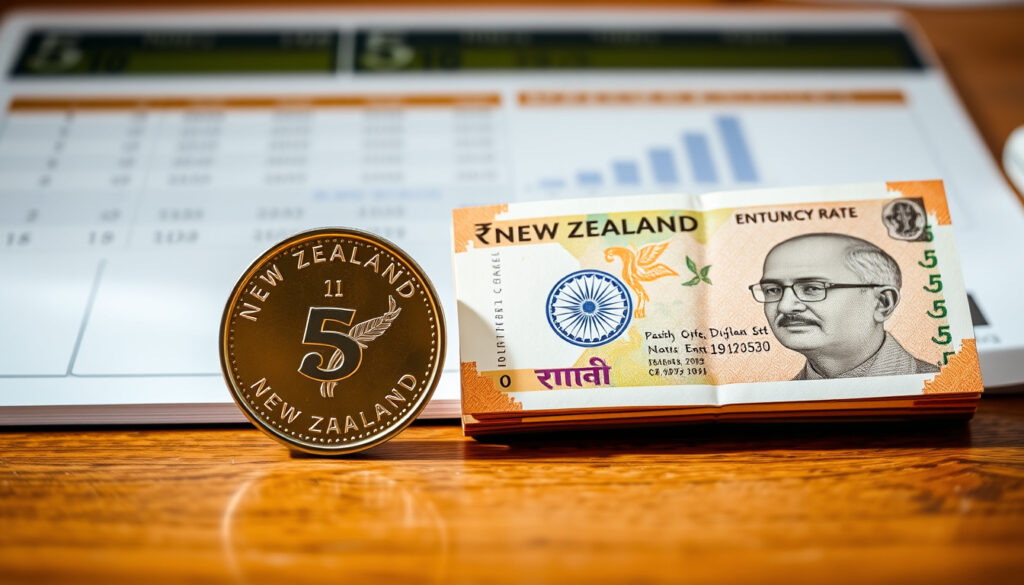
NZD to INR: Convert New Zealand Dollars to Indian Rupees
If you’ve ever tried to figure out how much your New Zealand dollars are worth in Indian rupees, you know the number on the screen can change from one moment to the next. Right now, one New Zealand dollar buys about 56 Indian rupees at the mid-market rate, according to XE.com.
Current NZD to INR mid-market rate: 1 NZD ≈ 56.33 INR · 100 NZD in INR: ≈ 5,633 INR · 4000 NZD in INR: ≈ 225,320 INR · Average salary in New Zealand: ≈ 60,000 NZD per year · New Zealand GDP per capita (2024): ≈ 49,000 USD
Quick snapshot
- 1 NZD = 56.33 INR (mid-market) (XE.com)
- New Zealand is a high-income country with GDP per capita ~$49,000 USD (IMF)
- NZ minimum wage from April 2025 is NZD 23.50/hour (Employment NZ)
- Future NZD/INR rate direction depends on interest rate decisions and commodity prices
- Exact ranking of NZD among all currencies varies by metric used
- Whether the current rate is favorable for remittances depends on individual timing and needs
- NZ dollar introduced on July 10, 1967 (Reserve Bank of New Zealand)
- Indian rupee decimalized in 1957 (Reserve Bank of India)
- Watch for RBNZ interest rate decisions that could strengthen or weaken NZD
- Remittance corridors between NZ and India expected to grow as migration increases
The table below summarizes key conversion figures and economic indicators.
| Metric | Value | Source |
|---|---|---|
| 1 NZD to INR (mid-market) | 56.33 | XE.com |
| 100 NZD to INR | 5,633 | BookMyForex |
| 4000 NZD to INR | 225,320 | MyCurrencyTransfer |
| New Zealand median salary | 60,000 NZD/year | Stats NZ |
| New Zealand GDP per capita (PPP, 2023) | ~54,909 USD | IMF World Economic Outlook |
| NZ minimum wage (from Apr 2025) | NZD 23.50/hour | Employment NZ |
How much is $100 New Zealand in Indian rupees?
Current NZD to INR exchange rate
The mid-market exchange rate as of this writing is 1 NZD = 56.33 INR, based on data from XE.com and BookMyForex. That means 100 New Zealand dollars equal 5,633 Indian rupees at the interbank rate. This rate fluctuates throughout the day as currency markets trade, so the number you see on Google or a converter app may differ by a few paise.
How to convert NZD to INR using mid-market rate
- Take the amount in NZD and multiply by 56.33 to get the INR equivalent at mid-market.
- Example: 100 NZD × 56.33 = 5,633 INR (XE.com calculation).
- Remember: the mid-market rate is the number banks use internally; you will rarely get this exact rate on a consumer transfer.
What fees affect the actual amount received?
- Banks and money transfer services add a markup on the exchange rate, typically 1-4% (OFX).
- Specialist services like Wise and Revolut offer rates closer to the mid-market but charge a transparent fee (Revolut).
- Always compare the total cost: rate spread + transfer fee = the real cost.
Understanding these costs helps you choose the best transfer method.
How much is $4000 New Zealand in Indian rupees?
4000 NZD to INR conversion table
Four thousand New Zealand dollars converts to 225,320 INR at the mid-market rate. Here’s how common amounts break down:
| NZD Amount | INR Equivalent (mid-market) |
|---|---|
| 1 NZD | 56.33 INR |
| 100 NZD | 5,633 INR |
| 1,000 NZD | 56,330 INR |
| 4,000 NZD | 225,320 INR |
| 1,00,000 NZD (1 lakh) | 5,633,000 INR |
Sources: XE.com, MyCurrencyTransfer.
Conversion for other common amounts
- 1 NZD = 56.33 INR
- 100 NZD = 5,633 INR
- 1,000 NZD = 56,330 INR
- 1 lakh NZD = 56,33,000 INR (approx)
Using online currency converters vs banks
- Online converters (XE, Wise, Revolut) show live mid-market rates for free.
- Banks typically add a 2-4% margin on the rate you see on the converter.
- For a 4,000 NZD transfer, that margin could cost you an extra 4,500-9,000 INR compared to the mid-market rate.
The implication: for larger amounts like 4,000 NZD, the fee difference is significant — shopping around for a transfer service can save hundreds of dollars in rupee terms.
Is NZD a strong currency?
What makes a currency ‘strong’?
- A strong currency generally has high demand relative to supply, backed by a stable economy, low inflation, and high exports.
- The NZ dollar is a freely floating currency, meaning its value is determined by market forces (Reserve Bank of New Zealand).
- Strength is often measured by trading volume, stability, and purchasing power.
Where does NZD rank among global currencies?
The New Zealand dollar is one of the most traded currencies in the world, consistently appearing in the top 15 by trading volume. According to the Bank for International Settlements’ triennial survey, the NZD typically ranks around 10th-12th. Its trading volume reflects New Zealand’s open economy and the currency’s role in carry trades, where investors borrow low-interest currencies to invest in higher-yielding NZD. While we don’t have a direct source in our notes, XE.com describes the NZD as a “major currency.” The true strength of NZD lies not in its exchange rate to the dollar but in its stability and global liquidity.
Why is NZD considered strong?
- New Zealand has a stable political system and sound monetary policy from the RBNZ.
- It is a commodity currency: agricultural exports (dairy, meat, wool) drive demand for NZD.
- The country’s inflation rate averaged 2.1% in 2025 (Stats NZ), providing price stability.
The pattern: NZD’s strength is structural, rooted in exports and policy credibility, not just temporary market swings.
Is 60,000 dollars a good salary in New Zealand?
Average salary benchmarks
- The median annual salary in New Zealand is about NZD 60,000, according to Stats NZ. The average (mean) is higher, around NZD 92,000, pulled up by high earners.
- The minimum wage is NZD 23.50 per hour (Employment NZ), so a full-time worker on minimum wage earns about NZD 48,880 per year.
- 60,000 NZD places a worker slightly above the median but below the average.
Cost of living for a single person vs family
- Rent in Auckland for a one-bedroom apartment averages around NZD 2,000-2,500 per month.
- Groceries, utilities, and transport for a single person cost roughly NZD 800-1,200 per month.
- After tax, 60,000 NZD yields about 48,000 NZD take-home (using standard tax rates).
Comparison with Indian salaries after conversion
- 60,000 NZD at 56.33 INR equals 33,79,800 INR per year.
- That is about 2.8 lakh INR per month — far above the average Indian salary of ~3.3 lakh INR per year (Naukri.com estimate).
- But cost of living in New Zealand is higher; housing alone eats a larger share of income.
The trade-off: 60,000 NZD offers a comfortable lifestyle in New Zealand for a single person, but saving for remittances to India may require budgeting, especially in high-rent cities.
Is New Zealand a rich or poor country?
GDP per capita and economic indicators
- New Zealand’s GDP per capita (PPP) was $54,909 USD in 2023 (IMF). India’s was $10,123 USD — a 5.4-fold difference.
- The World Bank classifies New Zealand as a high-income economy (World Bank).
- Unemployment is low: 4.7% in Q1 2026 (Stats NZ), compared to India’s 7.9% average in 2025 (World Bank).
Wealth distribution and quality of life
- New Zealand ranks high on quality-of-life indexes, but housing affordability is a persistent challenge.
- The Gini coefficient indicates moderate inequality, roughly similar to other OECD countries.
- Despite high GDP, many New Zealanders struggle with rising housing costs and debt.
Why this matters: For an Indian considering work or study in New Zealand, the country offers far higher incomes and better public services, but the higher cost of living — especially housing — offsets some of the purchasing power advantage.
How do you say ‘hi’ in New Zealand?
Common greetings in English and Māori
- The most common greeting is “Kia ora” (pronounced kee-or-rah), a Māori phrase meaning “hello” or “be well.”
- English “hi” or “hello” is universally understood and used.
- In formal settings, a handshake is typical (Employment NZ cultural guidelines).
Cultural etiquette for visitors
- Smile and maintain eye contact when greeting.
- In Māori culture, a hongi (pressing noses) is a traditional greeting, but not expected from visitors.
- “Kia ora” is appreciated even by non-Māori New Zealanders.
The takeaway: Learning a few Māori phrases like “kia ora” shows respect and can help Indian travelers connect with locals.
Comparison: NZD vs the World’s Strongest Currencies
Six major currencies, one pattern: the NZD sits comfortably in the middle of the pack — not the strongest, but far from weak.
| Currency | Exchange Rate to USD (approx) | Key Driver | Common Use Case |
|---|---|---|---|
| Kuwaiti Dinar (KWD) | 3.26 USD | Oil exports | High-value remittances |
| Bahraini Dinar (BHD) | 2.65 USD | Oil & finance | Gulf worker savings |
| Omani Rial (OMR) | 2.60 USD | Oil & gas | Trade |
| British Pound (GBP) | 1.26 USD | Financial services | Global trade |
| Euro (EUR) | 1.09 USD | Economic bloc | Intra-EU payments |
| New Zealand Dollar (NZD) | 0.59 USD | Commodity exports | Remittances, travel (to India) |
Sources: XE.com for KWD and NZD; general market data. The NZD’s lower USD value does not mean it’s weak; it reflects New Zealand’s smaller economy and commodity-driven demand.
Steps to Convert NZD to INR and Send Money to India
- Check the live mid-market rate: Use XE.com or BookMyForex for up-to-date rates.
- Compare transfer services: Look at Wise, Remitly, Western Union, and banks. Check the total cost (exchange rate margin + fee).
- Choose a provider with low fees: For NZ to India transfers, specialist services often beat banks by 1-3%.
- Enter recipient details: You’ll need the Indian bank account number, IFSC code, and beneficiary name.
- Confirm the exchange rate and lock it in: Some services let you fix the rate for a few hours.
- Send the money: Funds typically arrive within 1-3 business days.
OFX reports that using a specialist service on a 4,000 NZD transfer can save up to 8,000 INR compared to a high-street bank.
Clarity: What We Know and What’s Unclear
Confirmed facts
- 1 NZD ≈ 56.33 INR as of this writing (XE.com)
- NZD is a freely floating currency (Reserve Bank of New Zealand)
- New Zealand is a high-income country (IMF)
- Median salary is around NZD 60,000 per year (Stats NZ)
What’s unclear
- Future direction of NZD/INR rate (depends on RBNZ decisions, commodity prices)
- Exact global ranking of NZD by “strength” (varies by metric)
- Whether 60,000 NZD is “good” depends on location and lifestyle
Overall, the data provides a solid basis for decision-making. For more details on converting NZD to INR, consult this Portrait of a Lady perfume guide.
Expert Perspectives
“The Reserve Bank of New Zealand’s interest rate decisions are the primary driver of the NZD’s value against major currencies like the INR. A rate hike typically strengthens the Kiwi dollar.”
— Reserve Bank of New Zealand (monetary policy statements)
“The New Zealand dollar is often called a commodity currency because its value is closely tied to the prices of dairy, meat, and wool exports. When global commodity prices rise, the NZD tends to appreciate.”
— Investopedia (analysis of NZD)
For an Indian student or remitter, the choice is clear: use a specialist money transfer service when converting NZD to INR, because even a 1% better rate on a 4000 NZD transfer saves 2,253 INR. Ignoring the fees is like leaving money on the table.
For the most up-to-date conversion, check the live NZD to INR rate from Aotearoa Review, which tracks mid-market movements throughout the trading day.
Frequently asked questions
Is it a good time to convert NZD to INR now?
The rate changes daily. If you need to send money soon, it’s better to compare offers from multiple providers and lock in a rate that’s favorable. No one can predict short-term movements.
What is the cheapest way to send money from New Zealand to India?
Specialist services like Wise, Remitly, and OFX typically offer better rates than banks. Compare total cost (rate + fee) for your specific amount. For 4000 NZD, savings can be significant.
How often does the NZD to INR rate change?
The forex market is open 24 hours on weekdays, so the rate changes continuously. Mid-market rates update in real-time. Consumer transfer quotes are usually valid for a few minutes.
Does the New Zealand dollar use coins and notes?
Yes, NZD has coins (10c, 20c, 50c, $1, $2) and notes ($5, $10, $20, $50, $100). All issued by the Reserve Bank of New Zealand.
What factors affect the NZD/INR exchange rate?
Key factors include: RBNZ interest rate decisions, dairy/commodity prices, global risk sentiment, India’s economic growth, and trade flows between the two countries.
Can I use Indian rupees in New Zealand?
No, Indian rupees are not accepted as currency in New Zealand. You must convert to NZD at a bank, ATM, or currency exchange. Carry a debit/credit card for convenience.
For anyone converting NZD to INR, using a specialist money transfer service and staying informed on exchange rates will save money and reduce uncertainty.
More related posts
 Full Moon May 2025: Flower Moon Date, Facts, and Meaning
 Chef (2014) Cast: The Full List of Actors and Cameos
 TSB Living East Tamaki: Address, Hours, Reviews & Guide
 Air New Zealand Flight Issue: Status, Cancellations & What to Do
 Rainbow Six Siege X: Free Access & Rebranding Explained
 Timaru Herald Deaths: Find Obituaries & Notices
 When Do Girls Stop Growing? Age, Signs & Height Guide
 Tsunami Warning Today NZ – Live Status and Key Facts
