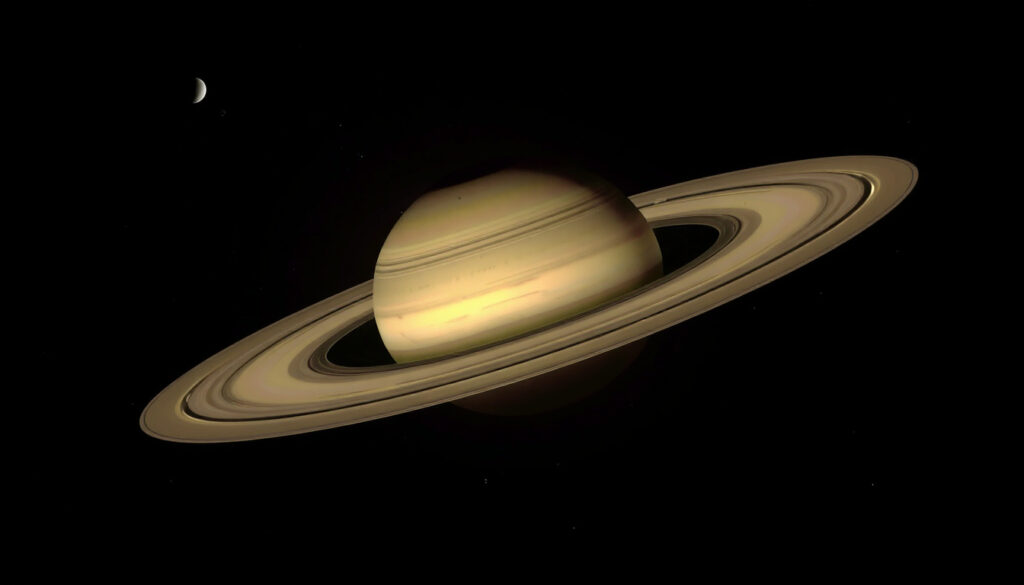
Which Planet Has the Most Moons? Saturn Leads with 285
Saturn holds the record for the most moons of any planet in the solar system. Jupiter has been catching up fast, cracking 100 confirmed moons for the first time in April 2026, but it still trails Saturn by a significant margin.
Saturn moons: 285 (April 2026) ·
Jupiter moons: 115 (April 2026) ·
Uranus moons: 28 ·
Zero moons: Mercury, Venus
Quick snapshot
- Saturn has 285 confirmed moons as of March 16, 2026 (EarthSky)
- Jupiter likely hosts thousands of small objects beyond the 115 recognized moons (NASA Science)
- Jupiter cracked 100 moons for the first time on March 16, 2026 (EarthSky)
- Further discoveries will likely narrow the gap between Jupiter and Saturn, though Saturn retains a wide lead (EarthSky)
Here is how all planets in the solar system stack up for confirmed moon counts.
| Planet | Confirmed Moons | Source |
|---|---|---|
| Saturn | 285 | EarthSky |
| Jupiter | 115 | Wikipedia |
| Uranus | 28 | NASA Space Place |
| Neptune | 16 | NASA Space Place |
| Mercury | 0 | Space.com |
| Venus | 0 | Space.com |
| Mars | 2 | Space.com |
| Earth | 1 | Space.com |
Which planet has the most moons?
Saturn holds the record for the most moons of any planet in the solar system. As of April 9, 2026, the planet has 285 confirmed moons following an announcement from the Minor Planet Center that added 11 new moons on March 16, 2026 (EarthSky). This latest batch was declared in Minor Planet Electronic Circular MPEC 2026-F14 (Space.com).
The lead is substantial: Saturn’s 285 moons dwarf Jupiter’s 115, a gap of 170 moons. NASA has confirmed that Saturn has more moons than any other planet in the solar system (NASA Science).
The solar system-wide count as of March 25, 2025, stood at more than 891 confirmed moons (NASA Science). Saturn alone accounts for roughly 32% of that total.
How many moons does Saturn have?
Saturn had 274 confirmed moons as of March 2026, when NASA verified 128 newly discovered small moons in a single announcement (NASA Science). By March 16, 2026, that count had grown to 285 following the Minor Planet Center’s MPEC 2026-F14 announcement (EarthSky), which added 11 more moons.
Saturn’s moon system includes planet-sized Titan—the only moon in the solar system with a dense atmosphere—and smaller oddly-shaped moons that resemble potatoes or ravioli (NASA Science). The Minor Planet Center, which serves as the clearing house for astronomical discoveries of asteroids, comets, centaurs and moons, handled the official designation of these new discoveries (Space.com).
In May 2023, the International Astronomical Union announced 64 new moons for Saturn and Jupiter combined, illustrating how discovery rates have accelerated in recent years (IAU Minor Planet Center).
Which planet has the most moons Jupiter or Saturn?
Saturn is the clear winner in this comparison. As of April 9, 2026, Saturn has 285 confirmed moons while Jupiter has 115—giving Saturn a 170-moon advantage (EarthSky). Jupiter’s count increased from 95 in April 2026 to 115 in April 2026, a gain of 20 moons in roughly 13 months (Wikipedia).
Jupiter cracked 100 confirmed moons for the first time on March 16, 2026, when the Minor Planet Center announced four additional moons in Minor Planet Electronic Circulars MPEC 2026-F09, F10, F11 and F12 (EarthSky). This was a milestone for Jupiter, but Saturn was already well ahead. The new moons for Jupiter announced in April 2026 were declared across those four consecutive circulars (Space.com).
For now, Saturn holds a substantial lead on Jupiter for most moons in our solar system (EarthSky). Jupiter has 101 moons that have been officially recognized by the International Astronomical Union as of April 2026, though that figure has since grown to 115 (NASA Science).
Jupiter details
Jupiter’s four largest moons are the Galilean satellites, discovered by Galileo Galilei in 1610 (NASA Science). Beyond those four iconic moons, Jupiter hosts thousands of small objects in its orbit beyond the 115 officially recognized moons, though the exact count of possible additional bodies remains uncertain (NASA Science). These do not include meter-sized moonlets thought to be shed from inner moons, nor hundreds of possible kilometer-sized outer irregular moons (Wikipedia).
Saturn details
Saturn’s moon system is more diverse than Jupiter’s in sheer numbers. The planet’s moons include planet-sized Titan and small oddly-shaped moons resembling potatoes or ravioli (NASA Science). Saturn has 274 confirmed moons, far more than any other planet in our solar system (NASA Science).
Head-to-head
Saturn grew from 274 moons in March 2026 to 285 by March 2026, an addition of 11 moons (EarthSky). Jupiter, meanwhile, added 20 moons over the same period, growing faster numerically but from a smaller base.
Saturn’s 285 moons to Jupiter’s 115 means the gas giant still leads by nearly 2.5×. Jupiter’s discovery rate is accelerating, but Saturn isn’t standing still.
Which planet has no moons?
Two planets in our solar system have no moons: Mercury and Venus (Space.com). Mercury orbits too close to the Sun to have captured a permanent satellite, and any ancient moon would likely have been stripped away by solar gravity. Venus, despite being larger than Mercury, also lacks any confirmed moons—though some theories suggest it may have had one in the distant past.
Earth has one moon, Mars has two, Venus and Mercury have none (Space.com). Dwarf planets add complexity to the picture: Pluto has five moons, Eris has one, Makemake has one, Haumea has two, and Ceres has none (Space.com).
Inner planets
The inner terrestrial planets—Mercury, Venus, Earth and Mars—collectively host just three moons: Earth’s one and Mars’s two. The outer gas and ice giants dominate the moon counts by an enormous margin.
List
The planets with zero confirmed moons are Mercury and Venus. This makes them outliers in the solar system, where most planets have accumulated at least some satellites over their histories.
The absence of moons around Mercury and Venus contrasts sharply with the outer planets’ crowded satellite systems. The reasons involve orbital distance, solar gravity, planetary mass, and historical collision history.
Which planet has the most moons besides Saturn?
Jupiter is the runner-up with 115 confirmed moons as of April 9, 2026 (Wikipedia). The Minor Planet Center announced 14 additional Jupiter moons on April 9, 2026, bringing the total to that figure (Wikipedia).
Before April 2026, Jupiter’s count stood at 101 following four new additions announced on March 16, 2026 (EarthSky). Jupiter’s moon count reached 95 following an announcement of three moons from a 2022 survey in February 2023 (Wikipedia). On April 30, 2025, the Minor Planet Center had announced two additional Jupiter moons, bringing the count to 97 (Wikipedia).
In February 2023, astronomer Sheppard announced three more moons discovered in a 2022 survey, bringing Jupiter’s total to 95 (Wikipedia). The rapid series of announcements in 2025-2026 shows that Jupiter’s moon discovery rate has accelerated significantly.
Jupiter runner-up
Jupiter now holds second place comfortably, ahead of Uranus at 28 moons and Neptune at 16 moons. Jupiter has 101 moons that have been officially recognized by the International Astronomical Union as of April 2026, though the April 2026 count of 115 is the current figure (NASA Science).
Uranus and others
Uranus has 28 known moons while Neptune has 16, making Uranus the third-most moon-rich planet (NASA Space Place). The gap between Jupiter and Uranus is substantial: Jupiter has roughly four times as many confirmed moons.
This ranking shows how the outer gas giants dominate moon counts in the solar system.
| Planet | Moon Count (2026) | Rank |
|---|---|---|
| Saturn | 285 | 1st |
| Jupiter | 115 | 2nd |
| Uranus | 28 | 3rd |
| Neptune | 16 | 4th |
| Mars | 2 | 5th |
| Earth | 1 | 6th |
| Mercury | 0 | Tied 7th |
| Venus | 0 | Tied 7th |
Timeline of recent discoveries
Both Saturn and Jupiter have seen rapid discovery activity in recent years, with the Minor Planet Center handling official announcements.
- : Jupiter reaches 95 moons following announcement of three moons from 2022 survey (Wikipedia)
- : 64 new moons announced for Saturn and Jupiter combined (IAU Minor Planet Center)
- : 128 new moons confirmed for Saturn; Jupiter remains at 95 (NASA Science)
- : Minor Planet Center announces 2 additional Jupiter moons, count reaches 97 (Wikipedia)
- : Minor Planet Center announces 11 new Saturn moons and 4 new Jupiter moons; Saturn reaches 285, Jupiter reaches 101 (EarthSky)
- : Minor Planet Center announces 14 additional Jupiter moons, total reaches 115 (Wikipedia)
Confirmed facts
- Saturn has 285 confirmed moons as of March 16, 2026
- Jupiter has 115 confirmed moons as of April 9, 2026
- Jupiter cracked 100 for the first time in March 2025
- Uranus has 28 known moons
- Mercury and Venus have zero moons
- The solar system has more than 891 confirmed moons
What’s unclear
- How many of Jupiter’s potential thousands of small objects might eventually be confirmed
- Whether Jupiter’s discovery rate will eventually match or surpass Saturn’s
- The exact sizes and compositions of many recently announced moons
What experts say
Saturn now has 285 confirmed moons! Plus, Jupiter’s moon count has finally cracked 100, with the addition of four newly discovered moons.
— EarthSky (Science communication outlet)
For now, Saturn holds a substantial lead on Jupiter for most moons in our solar system.
— EarthSky (Science communication outlet)
Jupiter has 101 moons that have been officially recognized by the International Astronomical Union, as of April 2026.
— NASA Science (Government space agency)
The moon counts for both Saturn and Jupiter are updated frequently as new discoveries are confirmed through the Minor Planet Center, the official clearing house for astronomical discoveries. For stargazers and space enthusiasts, the takeaway is straightforward: Saturn remains firmly in the lead, Jupiter is closing fast, and the outer solar system’s moons are still yielding secrets to patient observers.
Jupiter’s discovery rate has outpaced Saturn’s in recent months. If that trend continues, the 170-moon gap could narrow—but Saturn’s head start makes it unlikely Jupiter will catch up anytime soon.
Saturn now leads planetary moon counts with 285 confirmed as of early 2026, matching Saturns 2026 moon tally from March observations.
Frequently asked questions
What planet has 600 moons?
No planet currently has 600 confirmed moons. Jupiter has over a thousand small objects in its orbit beyond the 115 officially recognized moons, but only a fraction have been confirmed and designated by the International Astronomical Union.
Who has 28 moons?
Uranus has 28 known moons, making it the third-most moon-rich planet in the solar system after Saturn and Jupiter.
Which planet has the most moons in the universe?
Within our solar system, Saturn holds the record with 285 confirmed moons. Moons beyond our solar system have been detected around exoplanets, but confirmed counts for those distant systems are far lower and less thoroughly verified.
What planet has 1000 moons?
No planet has 1,000 confirmed moons. Jupiter likely has thousands of small objects in its orbit, but only 115 have received official recognition from the International Astronomical Union.
Who has 0 moons?
Mercury and Venus have zero confirmed moons. Earth has one, Mars has two, Jupiter has 115, Saturn has 285, Uranus has 28, and Neptune has 16.
Which planet has the most moons besides Saturn?
Jupiter has the most moons besides Saturn, with 115 confirmed satellites as of April 2026. Uranus comes in third with 28 moons.
Why does Saturn have so many moons?
Saturn’s large mass and distance from the Sun allow it to capture and retain many small bodies in its gravitational field. Its rings and complex orbital dynamics also contribute to an environment where numerous moons—both large and small—can exist.
More related posts
 Civil Engineer Salary NZ 2025: Average Pay & Senior Rates
 Regent Seven Seas Cruises – Reviews, Prices, Itineraries
 Register for GST NZ – Step-by-Step myIR Guide
 Te Rūnanga o Kirikiriroa: Hamilton Social Services Guide
 Guns N’ Roses 2026 Tour: Ireland Dates, Setlist & Updates
 Brentford vs Man United 2026: Head-to-Head Record, Stats & Preview
 Volume of a Sphere: Formula, Proof, and GCSE Guide
 Cleveland Cavaliers vs Pacers: Score, Prediction & Stats
