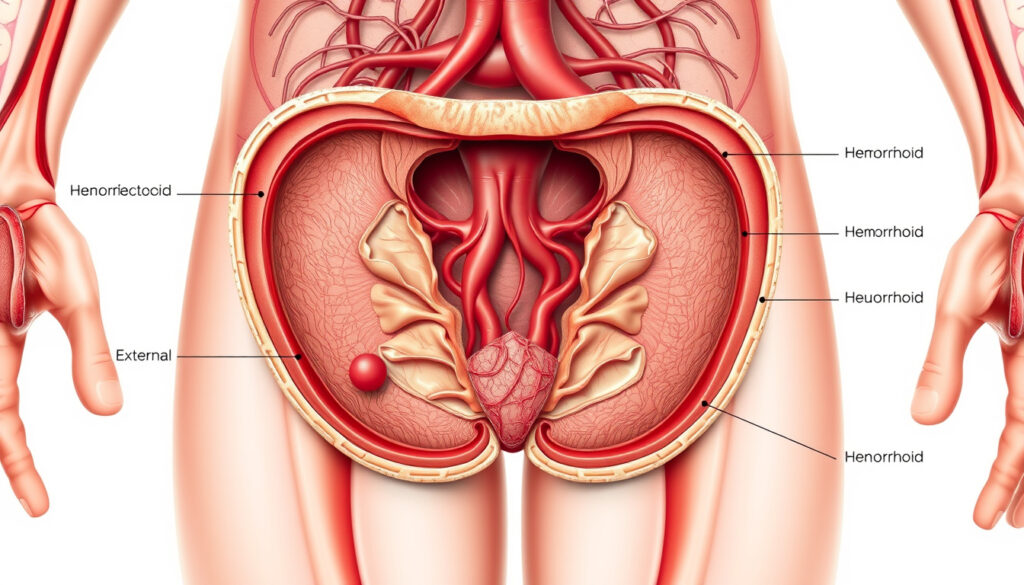
What Do Hemorrhoids Look Like? Visual Guide & Symptoms
You notice a lump, a bit of blood on the toilet paper, or an ache that makes sitting uncomfortable — and the obvious question pops up: is this a hemorrhoid? It’s one of the most common health concerns people Google, yet the visual differences between a hemorrhoid, a skin tag, or something else entirely are rarely explained with the clarity they deserve. This guide uses published clinical descriptions from institutions like the Mayo Clinic (tier-1 medical center) to help you identify what you’re really dealing with — and when it’s time to stop guessing and see a doctor.
Lifetime risk of hemorrhoids: up to 75% of adults ·
Symptomatic visits to a primary care provider: over 1 million annually in the US ·
Typical size of an external hemorrhoid lump: pea-sized to grape-sized ·
Most common type: internal hemorrhoids (often painless)
Quick snapshot
- Not visible unless prolapsed (Mayo Clinic)
- Painless bleeding (bright red) (Mayo Clinic)
- Sensation of incomplete evacuation (Mayo Clinic)
- Pea-sized lump outside anus (Cleveland Clinic)
- Can be painful, especially if thrombosed (Cleveland Clinic)
- Itching or irritation (Cleveland Clinic)
- Lump that sticks out of the anus (Mayo Clinic)
- May be pushed back (early stages) (Mayo Clinic)
- Pain and bleeding (Mayo Clinic)
- Firm, bluish-purple lump (Cleveland Clinic)
- Sudden severe pain (Cleveland Clinic)
- Often resolves with pain within days (Cleveland Clinic)
Here are the core facts that define the four main hemorrhoid presentations at a glance:
| Feature | Value |
|---|---|
| Peak age | 45–65 years |
| Prevalence | Up to 75% of adults at some point |
| Common cause | Straining during bowel movements |
| Typical duration | 3–7 days for mild external flares |
What do hemorrhoids look like?
How to identify an internal hemorrhoid
Internal hemorrhoids form above the dentate line, inside the rectum. They typically cannot be seen or felt unless they prolapse. When they do prolapse, they appear as soft, pinkish-red or purplish tissue protruding through the anus — described by the Mayo Clinic (top-tier academic medical center) as “moist pink or reddish tissue.” The hallmark symptom is painless bright red bleeding during bowel movements.
How to identify an external hemorrhoid
External hemorrhoids are located under the skin around the anus. They present as small, pea-sized lumps (5–10 mm) that can enlarge to grape-sized. According to Cleveland Clinic (leading US health system), a symptomatic external hemorrhoid often appears as a “bluish-colored painful lump just outside the anus.” Color ranges from pink to purple or blue, depending on blood clot presence. They are covered by skin and located outside the anal verge.
When a hemorrhoid prolapses
A prolapsed internal hemorrhoid sticks out of the anal opening and may resemble a reddish or purplish lump. In early grades, it can be pushed back inside. The Mayo Clinic (physician education resource) notes that Grade IV hemorrhoids are “irreducible and constantly prolapsed.”
Painless bleeding almost always points to internal hemorrhoids — but rectal bleeding can also signal colorectal cancer. The Mayo Clinic stresses that any rectal bleeding should be evaluated by a healthcare provider.
What do external hemorrhoids look like?
Size and color of external hemorrhoids
External hemorrhoids are typically pea-sized (5–10 mm) but can swell to grape-size. Their color ranges from skin-pink to purplish-blue, especially when a blood clot forms. The Mayo Clinic describes them as “lumps under the skin around the anus.” They are covered by skin, not mucous membrane.
Signs of a thrombosed external hemorrhoid
A thrombosed external hemorrhoid is a hard, bluish-purple lump that develops suddenly and is intensely painful. The Cleveland Clinic (US multispecialty health system) explains that pain spikes because pressure rises rapidly when a clot forms in the tightly held skin. Over time, the skin may erode and leak clotted blood. Most resolve spontaneously over about six weeks, according to Cornwall NHS (UK primary care referral guidance), often leaving a skin tag.
The pattern: if you see a firm, blue-purple lump that hurts to touch, it’s almost certainly a thrombosed external hemorrhoid — not a simple internal prolapse.
What does a stage 4 hemorrhoid look like?
A stage 4 hemorrhoid is a prolapsed internal hemorrhoid that cannot be pushed back inside the anus. It appears as a large, persistent, reddish-purple lump that may be painful and bleed. The Mayo Clinic (clinical review for physicians) defines Grade IV as “irreducible and constantly prolapsed.” This is the most severe stage and often requires surgical intervention.
What this means: a lump that stays outside no matter what you do is a red flag. It’s not something home care can fix.
What can be mistaken for a hemorrhoid?
Several anal conditions look deceptively like hemorrhoids. The table below highlights the key differences, drawn from Cleveland Clinic (anorectal specialists) and Cornwall NHS (UK clinical guidelines).
Four conditions, one takeaway: pain pattern and visual appearance usually tell the story.
| Condition | What it looks like | Pain pattern | Source |
|---|---|---|---|
| Anal fissure | A crack or tear in the skin of the anal canal; no lump | Sharp, tearing pain during and after bowel movements, lasting minutes to hours | Cleveland Clinic |
| Anal skin tag | Soft, painless flap of skin; may be leftover from a healed hemorrhoid | Typically none; can cause itching if irritated | Coventry & Rugby GP Gateway NHS |
| Perianal abscess | Red, swollen, warm lump; often pus-filled | Throbbing constant pain, worse with movement | Mayo Clinic |
| Prolapsed internal hemorrhoid | Moist pink/reddish lump protruding from anus | Usually painless unless thrombosed; bleeding may occur | Mayo Clinic |
Anal fissure versus hemorrhoid
Anal fissures are not lumps — they are skin cracks. The Cleveland Clinic (anorectal experts) notes that fissures cause severe pain during and after a bowel movement, lasting from minutes to hours. Cornwall NHS adds they are typically found in the midline anteriorly or posteriorly in the lower third of the anal canal. If you feel a sharp pain but no lump, it’s likely a fissure.
Anal skin tag versus hemorrhoid
Anal skin tags are soft, painless flaps of skin that do not bleed. According to the Coventry & Rugby GP Gateway NHS (UK primary care resource), they are common, benign, and often associated with previous hemorrhoids. Cleveland Clinic states they may be a residual effect of a resolved external hemorrhoid. Skin tags don’t cause pain or bleed, which is the easiest distinction.
Perianal abscess versus hemorrhoid
A perianal abscess is a red, swollen, warm lump caused by infection. It is painful constantly, not just during bowel movements. While a thrombosed hemorrhoid can also be painful, an abscess typically feels hot and may ooze pus. The Mayo Clinic classifies abscesses as a separate condition requiring drainage — not something that resolves with sitz baths alone.
What do hemorrhoids look like in the toilet?
Blood in the toilet from hemorrhoids
Internal hemorrhoids often leave bright red blood on the toilet paper or in the toilet bowl after a bowel movement. The blood is typically separate from the stool, not mixed in. The Mayo Clinic highlights that painless bright red bleeding is the classic sign of internal hemorrhoids. If you see blood coating the stool or dark/tarry blood, that’s a different concern — and a reason to see a doctor promptly.
Mucus or tissue in stool
Some people notice mucus discharge along with hemorrhoids. WebMD (consumer health information) mentions that mucus can accompany prolapsed hemorrhoids. However, mucus without blood can also signal other issues like inflammatory bowel disease.
Seeing blood in the toilet is frightening, but hemorrhoid-related bleeding is almost always bright red and separate from stool. Any dark blood, clots, or blood mixed into the stool warrants immediate medical evaluation.
What shrinks a hemorrhoid quickly?
Home remedies to reduce swelling
Warm sitz baths for 15 minutes several times a day are the top home strategy. The Mayo Clinic recommends this to soothe inflammation. Cold compresses applied for 10 minutes can shrink a thrombosed hemorrhoid by constricting blood vessels. Adding Epsom salt may offer additional relief, though clinical evidence is limited.
Over-the-counter treatments
OTC creams with hydrocortisone (like Preparation H) reduce swelling and itching. Witch hazel wipes (Tucks) provide temporary relief. The Mayo Clinic notes that these products should not be used for more than one week without medical advice, as prolonged use can thin skin.
Two essential habits for prevention: eating enough fiber and staying hydrated. How Much Fibre Per Day explains that a high-fiber diet softens stool and reduces straining — the primary cause of hemorrhoid formation.
When to see a doctor
If a hemorrhoid doesn’t improve after 7 days of home care, or if pain, bleeding, or a lump persists, consult a healthcare provider. The Mayo Clinic advises seeing a doctor if you experience rectal bleeding for any reason, especially if combined with changes in bowel habits. For grade 3–4 hemorrhoids, medical procedures (rubber band ligation, sclerotherapy, or surgery) are more effective than home remedies — though the exact superiority is unclear for severe cases.
“A thrombosed external hemorrhoid appears as a firm, bluish-purple lump that is acutely painful.”
— Cleveland Clinic (anorectal coloproctology service)
“External hemorrhoids look like small lumps just outside the anus.”
mycolondoc.com, pmc.ncbi.nlm.nih.gov, mayoclinic.org, ubiehealth.com, toproctology.com, mayoclinic.org, northeasternsurgical.com.au
For a more detailed visual breakdown of the different stages, you can refer to this comprehensive guide on what hemorrhoids look like.
Frequently asked questions
Do hemorrhoids go away on their own?
Mild external and internal hemorrhoids often resolve within 3–7 days with home care. Thrombosed hemorrhoids may take up to six weeks to fully heal, leaving a skin tag behind. Grade 4 prolapsed hemorrhoids usually require medical treatment (Mayo Clinic).
Can I treat a hemorrhoid without a doctor?
Yes, for mild cases. Sitz baths, cold compresses, and OTC hydrocortisone creams are first-line home treatments. But if bleeding persists, pain worsens, or a lump remains for more than a week, see a doctor (Mayo Clinic).
How long do hemorrhoid flare-ups last?
Most mild external flare-ups last 3–7 days. Thrombosed hemorrhoids can cause severe pain for 2–3 days, then gradually improve over 1–2 weeks. Residual skin tags may persist (Cornwall NHS).
Is bright red blood from a hemorrhoid dangerous?
Bright red blood from hemorrhoids is usually not dangerous in itself, but it can mask other conditions. The Mayo Clinic stresses that any rectal bleeding should be evaluated by a healthcare provider to rule out colorectal cancer or polyps.
What foods help hemorrhoids shrink?
Fiber-rich foods (oatmeal, beans, apples, broccoli) soften stool and reduce straining. Prunes and psyllium husk supplements also help. Increasing fiber gradually prevents gas and bloating (How Much Fibre Per Day).
Can pregnant women get hemorrhoids?
Yes, hemorrhoids are very common during pregnancy due to increased pressure from the uterus and hormonal changes. Up to 35% of pregnant women experience them. Safe treatments include cold compresses, sitz baths, and fiber supplements (Mayo Clinic).
Are hemorrhoids painful all the time?
No. Internal hemorrhoids are usually painless unless they prolapse and become strangulated. External hemorrhoids are painful only when irritated or thrombosed. Between flare-ups, symptoms often resolve (Mayo Clinic).
The challenge with hemorrhoids is not just the discomfort — it’s the uncertainty of whether you’re dealing with a harmless flare or something more serious. For anyone experiencing a new lump, persistent bleeding, or pain that disrupts daily life, the Right Side Abdominal Pain: Causes and Red Flags guide on Southern Scope offers a broader look at abdominal and digestive symptoms that warrant attention. But for hemorrhoids specifically, the rule is straightforward: if it hurts but has no lump, think fissure; if it’s a soft painless flap, think skin tag; if it’s a blue painful lump, think thrombosed hemorrhoid. And always — if bleeding, see a doctor.
More related posts
 Te Rūnanga o Kirikiriroa: Hamilton Social Services Guide
 ANZ goMoney Login: Step-by-Step Guide & Troubleshooting
 Christchurch to Palmerston North Flights: Time, Cost & Tips
 2degrees Online Top Up: How to Add Credit to Your Prepay Phone
 ANZ Fixed Term Deposit Rates 2025: Current Rates & Comparison
 Can Body Wash Be Used as Hand Wash? Experts Weigh In
 Boxing Day Sale NZ 2026: Deals, Dates & Black Friday
