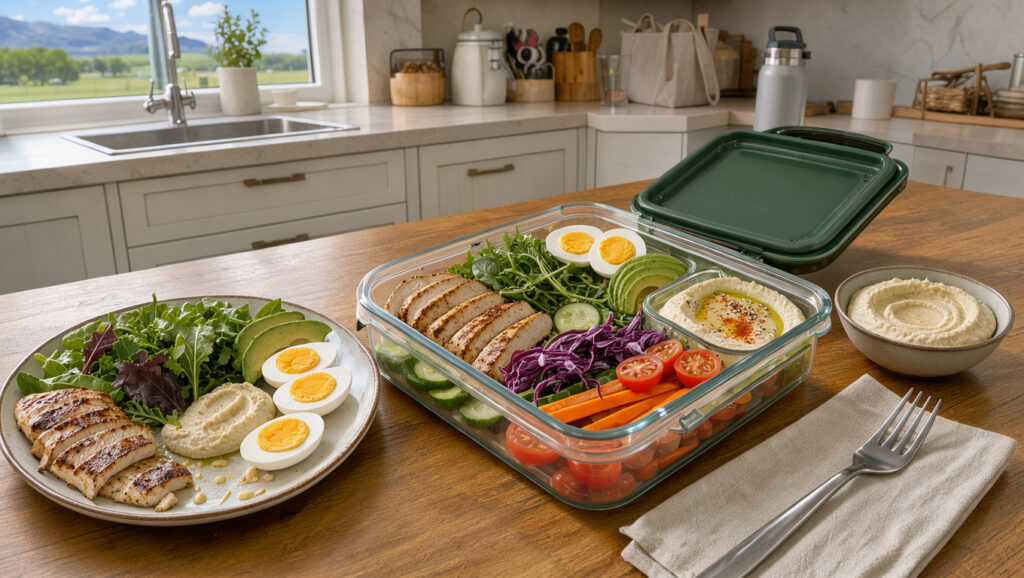
Healthy Lunch Ideas NZ: Work, Protein and Low-Carb Options
Most of us have stood at the fridge at 7:40 in the morning, guessing which leftovers will survive a day in a backpack. Packed lunches in New Zealand can be cheap and filling, and the difference usually comes down to the filling and the cooling, with Mission Nutrition (NZ dietitian resource) recommending at least 20g of protein per lunch, roughly a palm-sized serve of chicken, eggs, tofu or pulses.
Notification deadline: within 2 hours of a food safety incident (Ministry of Education NZ (NZ government school programme)) · Cooling kit: insulated bag with a small ice brick (Ecostore (NZ lunchbox guidance)) · Kids frittata freezer window: a week or two (PAK’nSAVE (NZ supermarket guidance))
Quick snapshot
- Aim for half the plate, or two good handfuls, of lower-starch vegetables (Mission Nutrition (NZ dietitian resource)) (British Dietetic Association (UK professional body))
- Beans, pulses, eggs, nuts, fish, dairy and lean meat are listed as protein sources (British Dietetic Association (UK professional body))
- The evidence reviewed here contains no verified temperature threshold for packed lunches in New Zealand.
- Calorie and carbohydrate targets vary by person, so no single lunch figure applies to everyone.
- NZ Herald Viva lunchbox recipe article dated (NZ Herald (NZ media))
- Ecostore lunchbox article dated (Ecostore (NZ lunchbox guidance)) (NZ Herald (NZ media))
- Check school rules before packing nut products, since many NZ schools do not allow nuts (PAK’nSAVE (NZ supermarket guidance))
Seven rules and storage limits do most of the work in a packed lunch, and most of them sit outside the recipe pages.
| Fact | Detail |
|---|---|
| Rice storage | Eat within a day and reheat until piping hot, according to Healthy Food Guide (UK food guide) |
| Radiators and sunlight | Keep lunch away from radiators and direct sunlight, as the British Dietetic Association (UK professional body) advises |
| Boiled eggs | Keep up to a week in the fridge after boiling, according to The Kitchn as cited by Eat Well NZ (NZ food blog) |
| Heated fish and egg dishes | Strong odours can bother coworkers, while cold fish salads and hard-boiled eggs that stay cold are exceptions, according to Elizabeth Rider (work lunch blog) |
| Insulated coolers | Use them and eat packed lunch within a few hours of preparation, according to Feel Good Foodie (food blog) |
| Unrefrigerated foods | Bread, nuts, onions, winter squash, dehydrated meat, avocados and most fruit need no fridge, according to Instacart (grocery platform) |
Which healthy lunches are easiest to pack for work?
Work lunches succeed or fail on the trip, not on the plate. The best options are the ones that still look appealing at lunchtime after a morning in a bag.
What do wraps, wholegrain bread and crackers add to a packed lunch?
- Wraps and wholegrain bread give a lunch its base and pack flat in a bag.
- Crackers add crunch and suit a side of salad or hummus.
- NZ Herald Viva’s lunchbox list includes pawpaw, prawn and tofu salad, pan bagnat and salmon seaweed cups (NZ Herald (NZ media)).
- Grain salads, wraps and tuna or chicken salads taste good from the fridge, and vinaigrette dressings hold up better than creamy ones, according to Elizabeth Rider (work lunch blog).
Wraps are a sensible choice, but the filling decides whether the lunch survives a warm office.
Which fillings and salads keep well until lunchtime?
- Meal-prep components such as bulgur and chicken keep up to three days in the fridge, and anything kept longer than four days should be frozen (PAK’nSAVE (NZ supermarket guidance)).
- Cooked rice or quinoa keeps four to five days in the fridge, according to Feel Good Foodie (food blog).
Office lunches have to survive a bag and a desk, so the fillings that taste right cold do the heavy lifting. Sharp-dressed salads and grain bowls fit that brief better than hot or creamy dishes.
The implication: pack the grain or vegetable salad for a desk lunch, and save the creamy pasta for days when there is a fridge.
Which high-protein lunches work in New Zealand?
Protein is the easiest part of a lunch to leave out, so a filling that is already cooked makes the job simpler.
Which protein foods are easiest to pack?
- The Ministry of Education NZ chicken sandwich mixes shredded chicken with mayonnaise, spreads catering spread on bread, and layers lettuce, sliced tomato and cheese (Ministry of Education NZ (NZ government recipe page)).
- Cold hard-boiled eggs are among the exceptions to the odour problem, according to Elizabeth Rider (work lunch blog).
How do legumes and eggs fit a protein-focused lunch?
- A tub of beans or lentils is a practical fallback when meat is too much to keep cold.
- Protein foods held for several hours need to stay cold, and the steps further down explain how.
Protein-heavy fillings ask more of the cooler than salads do, so the protein choice sets the cooling plan. A lunch kept cold without a fridge needs an ice pack, a frozen bottle or a bag of ice, according to Instacart (grocery platform).
The trade-off: chicken and eggs are the fillings that call for the most attention to temperature, so they suit days when the cooling plan is solid.
Which low-carb lunches suit adults?
Low-carb lunches are easier to manage when the bread steps back and the vegetables take over. Carbohydrate needs differ widely between adults, so the plate should fit the person eating it.
Which vegetables can replace bread in a low-carb lunch?
- Lettuce cups, cucumber ribbons or a bed of salad leaves can stand in for bread under a protein filling.
- NZ Trucking’s simple lunchbox guidance says a lunch needs protein, carbohydrates and fats (NZ Trucking (workday lunch guide)).
Does a low-carb lunch still need fibre?
- No verified fibre target sits behind this advice, so the guidance here stays with food choices.
- Build the plate around vegetables and pulses rather than starch, and keep the protein filling on top.
Carbohydrate needs differ between adults, so match the lunch to the appetite and activity of the person eating it.
The implication: a low-carb lunch works best as a vegetable-led plate with a clear protein on top, and each adult sets the portion.
Can a healthy lunch support weight loss?
A single lunch will not decide the scale, but the filling does shape how the afternoon feels. That is where the choice starts to matter.
Which lunch portions suit a weight-loss plan?
- Energy needs differ between people, so no single lunch guarantees weight loss.
- A balanced lunch combines lean protein, complex carbohydrates and healthy fat, according to iHerb Wellness Hub (wellness blog).
Portion guidance for weight loss is not verified in the sources reviewed here, so build the lunch from the plate rather than a calorie count.
How does fibre affect fullness after lunch?
- Mission Nutrition says a plain vegetable soup will not keep you full all afternoon, while adding barley or pulses makes it more filling (Mission Nutrition (NZ dietitian resource)).
- Soup and salad work best when they carry pulses or grains, not just water and vegetables.
A lunch labelled healthy can still leave someone hungry if it lacks the filling elements. Mission Nutrition’s soup advice shows that the ingredients decide fullness, not the label.
The catch: the lunch that helps most is the one that sets fullness and portion size, not the one with the healthiest-sounding name.
How do you keep a packed lunch safe to eat?
Food safety is the part of packed lunches that recipe pages skip, and it is the part that matters most once a lunch sits on a desk.
What temperature should chilled lunch foods stay at?
- The evidence reviewed here contains no verified temperature threshold for New Zealand packed lunches, so this article gives no number.
- Keeping the lunch cool is the control you can manage yourself, because it depends on the bag, the ice and the time away from a fridge.
How do ice packs help a packed lunch stay safe?
- Keep cold foods chilled with ice packs or frozen water bottles, and refrigerate if a fridge is available, according to Feel Good Foodie (food blog).
Here is the order that works for a packed lunch.
- Make the lunch the night before and keep it in the fridge overnight, as the British Dietetic Association (UK professional body) advises.
- Cool cooked rice quickly, cover it and refrigerate it, because Healthy Food Guide (UK food guide) notes that Bacillus cereus spores can survive cooking.
- Pack an ice brick or frozen drink in an insulated bag, and keep the bag out of direct sun.
- Add the cold-chain step last, close to leaving, so the cooling kit starts working when the lunch goes in the bag.
The implication: the cooling plan matters more than the recipe, because the food that goes wrong is the food left out for hours.
Where the evidence is solid and where it is thin
Confirmed facts
- Schools and meal providers in the Healthy School Lunches programme must notify their senior advisor within 2 hours of a food safety incident (Ministry of Education NZ (NZ government school programme)).
- Half the plate should be lower-starch vegetables, or two good handfuls (Mission Nutrition (NZ dietitian resource)).
- Beans, pulses, eggs, nuts, fish, dairy and lean meat are protein sources (British Dietetic Association (UK professional body)).
What’s unclear
- No verified New Zealand temperature threshold for packed lunches appears in the evidence.
- Individual calorie and carbohydrate targets for weight loss or low-carb eating are not settled.
- Whether any brand or meal service beats home-packed lunches is not established.
- Regional variation within New Zealand is largely untested beyond general sourcing.
The implication: the confirmed list is short, so the cooling advice in this article should be read as practical guidance rather than a verified standard.
In the sources’ own words
“Keep your lunchbox cool, otherwise harmful bacteria might grow and spread in the food.”
Martyna Angell, nutrition contributor, via Ecostore (NZ lunchbox guidance)
“All schools and meal providers participating in the programme must notify their Healthy School Lunches senior advisor within 2 hours of a food safety incident.”
Ministry of Education NZ (NZ government school programme)
What this means for your next lunch
Packed lunches reward a plan more than a recipe: a grain or vegetable salad, a protein filling that holds its chill, and an ice pack in the bag. For office workers without a fridge, the choice is clear: pack the salad with an ice pack, or leave the chicken until there is cold storage at work.
Related reading: Best meal prep containers for packed lunches
Related reading: best meal prep containers for packed lunches
Frequently asked questions
Are wraps a healthier choice than sandwiches for lunch?
Not on their own. NZ Trucking’s simple lunchbox guidance says a lunch needs protein, carbohydrates and fats, so the filling decides the balance (NZ Trucking (workday lunch guide)).
Can leftovers from dinner make a healthy lunch?
Yes, if they are cooled promptly and eaten within a few hours. Feel Good Foodie (food blog) recommends insulated coolers and eating within a few hours of preparation.
What is a quick healthy lunch that needs no cooking?
Grain salads, wraps and tuna or chicken salads need no cooking and taste good from the fridge, according to Elizabeth Rider (work lunch blog).
Are cold pasta salads a healthy lunch option?
They fit the work lunch brief that PAK’nSAVE sets out: easy to make, affordable, practical to eat cold and tidy to eat (PAK’nSAVE (NZ supermarket guidance)).
How can a lunch box be packed the night before?
Prepare the lunch the night before and keep it in the fridge until you leave, a method Ecostore (NZ lunchbox guidance) describes.
More related posts
 Man City vs Newcastle – Kick-Off Lineups Prediction Odds
 When Do Girls Stop Growing? Age, Signs & Height Guide
 Brigitte Macron as a Child: Her Early Life and Family
 Chelsea vs Liverpool Timeline: History & Key Matches
 Best Wide Angle Lenses 2026: Top Picks for Every Mount
 Hot Water Heat Pumps Prices NZ: $4,250-$6,750 Units + Install
 Octopus Riding a Mako Shark: Rare Footage Explained
 How Many Fridays Until Christmas: 2026 Countdown
