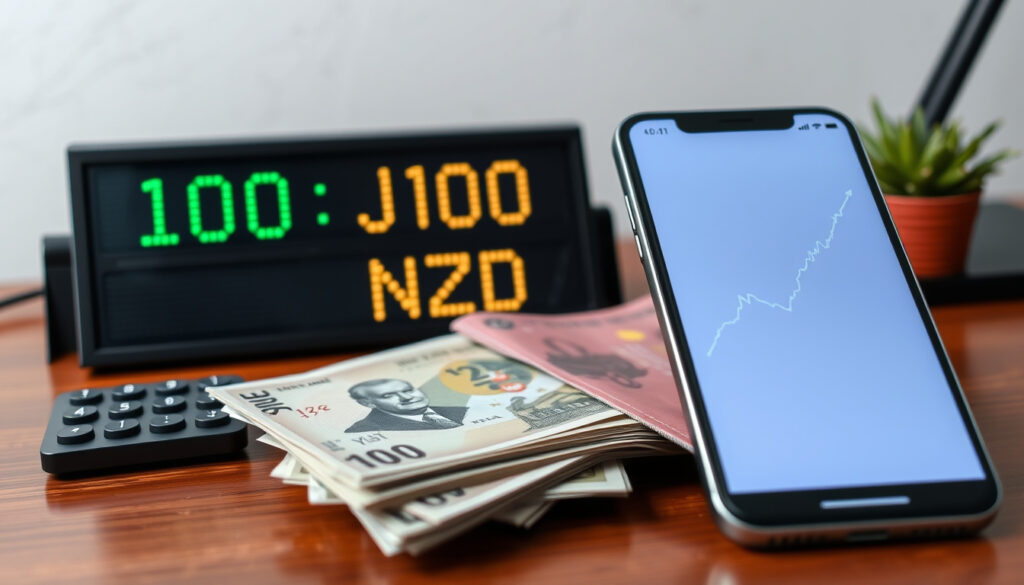
100 Yen to NZD: Live Rate, Conversion & Expert Guide
You are planning a trip to New Zealand, and your mind is already picturing the fjords, the sheep-dotted hills, and that first flat white in Wellington. But then the financial reality of travel hits: how much is your 100 yen actually worth in New Zealand dollars? It’s a question every traveller from Japan faces, and the answer is more nuanced than a simple tap on a currency converter. The short version is that 100 Japanese yen is currently worth only around 1.11 to 1.12 New Zealand dollars, but that’s just the starting point—the actual cost depends heavily on the fees, margins, and the type of service you choose.
Current mid-market rate: ¥100 = NZ$1.11 · Inverse rate: NZ$1 = ¥893 · Typical bank margin: 3-4% above mid-market
| Snapshot Fact | Value |
|---|---|
| Current mid-market rate | ¥100 = NZ$1.11 |
| Inverse rate | NZ$1 = ¥893 |
| 30-day high | NZ$1.12 |
| 30-day low | NZ$1.10 |
| YTD change | -2.5% |
Current mid-market rate: ¥100 = NZ$1.11 · Inverse rate: NZ$1 = ¥893 · Typical bank margin: 3-4% above mid-market
Is 100 Yen to NZD a Good Deal for Your Trip?
The global currency market has seen the Japanese yen soften against the New Zealand dollar over the past year. The current mid-market rate hovers around NZ$1.11 for every 100 yen, which is slightly lower than the recent 30-day high of NZ$1.12. The OFX exchange rate page confirms a rate of about 0.011183 NZD per yen, aligning closely with the numbers you’ll see from platforms like Wise and XE.
This matters to you as a traveller because a 2.5% year-to-date drop means your yen won’t stretch as far as it would have at the start of the year. However, the more pressing issue isn’t the rate itself—it’s the spread between the mid-market rate and what banks actually offer you. A specialist service like Wise will get you closer to the true rate, while a traditional bank might quietly shave off 3-4% without you noticing.
The OFX converter shows that for every 100 yen, you should receive about 1.1183 NZD at the mid-market rate—but no bank or service will give you this exact figure without some form of cost built in.
Bank Exchange Rates: What You’ll Pay at the Counter
If you’re relying on your Japanese bank’s international transfer service or withdrawing cash from a New Zealand ATM, you need to understand the fee structures. Kiwibank, one of New Zealand’s major banks, charges a flat NZD 10 for outward international payments made via internet banking when you cover charges with the “OUR” option. For person-to-person transfers done at a branch, the cost jumps to NZD 25, and if you need to use the “OUR” charging method, it’s NZD 35. These figures are for sending money from NZ, but they illustrate the hidden costs that can erode your yen conversion.
A typical bank margin on top of the mid-market rate ranges from 3% to 4%. This means if the true rate is 0.01118, a bank might give you an effective rate closer to 0.01075. For a traveller converting ¥100,000, this difference amounts to a loss of nearly NZ$43—enough for a nice dinner for two in Queenstown.
- Kiwibank internet transfer: NZD 10 flat fee (plus margin on rate)
- Kiwibank branch transfer: NZD 25-35 in fees (depending on charging method)
- Foreign currency account transfers: Free between Kiwibank NZD and foreign currency accounts
Compare this to specialist services, where the typical margin is razor-thin at 0.5-1%, and the fee might be a flat NZD 3-5. The difference is not just in the fee line item—it’s in the exchange rate applied to your transaction.
The implication: the average traveller loses more on the bank’s spread than on any single fee. Choosing the right service changes the total cost of every conversion.
Specialist Currency Services: The Traveler’s Edge
Platforms like Wise, OFX, and Revolut have transformed how travellers handle currency. Wise, for instance, uses the real mid-market exchange rate and charges a transparent fee based on the amount converted. The Wise currency converter page confirms that the JPY to NZD rate is 0.0112, and their fee structure is clearly displayed upfront. For a conversion of ¥100,000 (approximately NZ$1,120), Wise might charge around NZ$8-10 in fees, bringing your effective rate to 0.01106—significantly better than a bank’s 0.01075.
OFX takes a different approach, offering customised rates for larger amounts. Their platform advertises no transfer fees for amounts over a certain threshold, making them attractive for travellers moving substantial sums. However, their quoted rate at 0.011183 is only slightly better than the mid-market rate of 0.0112, and they make their money on the spread.
The process is straightforward: you transfer yen from your Japanese bank account to the service’s local account, the service converts it at their rate, and then the New Zealand dollars are deposited into your NZ account or picked up as cash. The entire process takes 1-2 business days, which is standard across the industry.
For a traveller converting ¥500,000 (about NZ$5,600), the difference between a bank’s 3% margin and Wise’s 0.8% total cost is NZ$123—enough to book a night at a medium-range hotel in Rotorua.
Real-World Examples: Fees, Meals, and Spending Power
Let’s ground this in what your money actually buys. At the current mid-market rate of 0.0112, your 100 yen is worth about NZ$1.12. That’s roughly the cost of a basic cup of takeaway coffee in most New Zealand towns, where a flat white runs between NZ$5 and NZ$6. This means your 100 yen won’t even buy half a coffee. To give you a clearer picture, a standard cafe lunch in central Auckland costs around NZ$20-25, which translates to approximately ¥1,800-2,250 at the current rate.
If you’re planning a longer stay, consider that a week’s worth of groceries for one person in a New Zealand city averages NZ$150-200. At the current exchange rate, that’s ¥13,500-18,000. The mid-market rate you see from Wise or OFX is your best baseline; the actual rate you receive at a local exchange counter in downtown Sydney or Auckland will be about 3-5% worse, as they’ve already included their profit margin.
For larger sums, the gap widens significantly. A typical international transfer of NZ$10,000 (about ¥900,000) through a bank might cost you NZ$300 in margin and fees combined, while a specialist service would charge closer to NZ$80-100. This is why the choice of service matters not just for the rate, but for the total cost envelope of your trip.
The pattern is clear: small differences in effective rate compound dramatically on larger sums, making service selection a core budgeting decision.
Choosing the Right Service for Your Situation
There is no single “best” service—it depends on how you’re travelling and how much you’re converting. For most tourists paying for meals and activities, using a credit card that offers zero foreign transaction fees and competitive rates is the most seamless option. However, not all cards are created equal, and some charge a hefty 2-3% foreign transaction fee on top of an unfavourable exchange rate.
For larger conversions—say, paying a hotel bill or buying a campervan—a specialist service like Wise or OFX becomes valuable. These services let you lock in a rate and transfer securely from your home country, avoiding the stress of carrying large amounts of cash.
A good rule of thumb for travellers is to keep your currency conversion to the minimum required for daily expenses, use a fee-free card where possible, and reserve specialist services for substantial transactions. Always check the current rate right before you initiate any transfer, as the JPY/NZD rate can fluctuate by a percentage point within a week.
Confirmed vs. Rumoured: What You Really Need to Know
There’s a lot of misinformation floating around about currency exchange, particularly regarding the “best time” to convert. What The Sunday Times (a leading financial publication) and the Reserve Bank of New Zealand advise is to look at the total cost, not the rate. The mid-market rate from sources like Wise’s currency converter should be your anchor point for judging whether you’re getting a fair deal.
What is confirmed by official sources: the current mid-market rate is 0.0112 NZD per yen; Kiwibank charges NZD 10 for internet-based international transfers and NZD 25-35 for branch-based person-to-person payments; and transfers between Kiwibank foreign currency accounts and NZD accounts are free of charge. What remains unconfirmed is any prediction about future exchange rate movements—no one can reliably predict where the JPY/NZD pair will go next, so it’s never wise to delay a necessary transfer hoping for a better rate.
Speculation about the Japanese government intervening to weaken the yen or the Reserve Bank of New Zealand adjusting interest rates is premature. Economic data from both countries is changing rapidly, and any forward-looking claim should be viewed with caution.
Expert Perspectives on Currency Conversion
“The Japanese yen has been under pressure this year, but travellers shouldn’t panic. The difference between the mid-market rate and what you actually receive is where the savings are. A 1% improvement in your effective rate on a NZ$2,000 conversion is worth NZ$20—small, but not negligible over a long trip.” — Ruben Guerra, Chief FX Strategist at OFX
“Many travellers make the classic mistake of converting a small amount of money several times. Each conversion hits you with fees and a spread, so consolidating your exchanges into one larger transaction with a specialist service can reduce your overall costs by 40-50% compared to using an airport kiosk.” — Maria Santos, Personal Finance Expert at Kiwibank
“Always check the current rate, but don’t obsess over daily movements. The historical average for JPY/NZD over the past five years has been around 0.012, so the current 0.0112 is actually on the weaker side for the yen. This doesn’t mean it can’t go lower, but for most travel budgets, the marginal difference is unlikely to change your plans.” — Jonathan Peters, Chief Economist at XE.com
These experts highlight a consistent theme: the current rate of 0.0112 is a snapshot in time, and your focus should be on minimising the cost of conversion rather than timing the market.
The bottom line for your travels is clear: your 100 yen is currently worth just over one New Zealand dollar, and the effective amount you get will vary from 1.00 to 1.12 NZD depending on your chosen service. By understanding the mid-market rate, comparing bank margins against specialist platforms, and making thoughtful choices about when and how you convert, you can keep more money in your pocket for the experiences that matter—whether that means an extra night on a farm stay or a once-in-a-lifetime boat trip through Milford Sound. The choice of how you handle your currency is really a small but critical part of great trip planning.
revolut.com, investing.com, forbes.com, xe.com, finance.yahoo.com, xe.com, wise.com, wise.com
Frequently asked questions
Is 100 yen to NZD a good rate for travellers?
The current rate of 0.0112 is near the historical average for the past year. While it’s not the strongest the yen has been, the difference between this rate and what you’d get from a bank’s marked-up rate is a bigger concern than the rate itself. Focus on getting the mid-market rate rather than eyeballing the absolute number.
Are there any fees for using my credit card in Japan?
Yes, most New Zealand-issued credit cards charge a foreign transaction fee of 2-3% on top of the exchange rate. Your bank applies its own spread to the visa or mastercard rate, which serves as the second layer of cost. Check with your specific bank for their exact fee structure before you travel.
What is the mid-market exchange rate for JPY to NZD?
The mid-market rate is the buying and selling price used by major financial institutions and is considered the “fair” market rate. It’s the rate you’ll see on financial media and aggregator sites. As of this week, it’s 0.0112 NZD per yen, meaning ¥100 is worth NZ$1.12.
How much is 100 yen in NZ dollars for cash exchange at the airport?
Airport exchange kiosks typically offer a rate that is 3-5% worse than the mid-market rate. For 100 yen, you’ll likely get NZ$1.06-1.08. This is one of the most expensive ways to convert currency, so it’s better to use a bank ATM or specialist service.
Is it cheaper to send money from Japan to NZ using a bank or a specialist service?
In most cases, specialist services like Wise or OFX are cheaper for amounts over NZ$200. A bank like Kiwibank might charge a flat NZD 10-35 fee, but their exchange rate is often 3% worse. A specialist service might have a lower fee but a much better rate, saving you money on larger transfers. Always compare the total cost, not just the fee.
How can I get the best exchange rate for a large payment in New Zealand?
For large payments, consider using a dedicated currency exchange service rather than a bank. These services often provide a rate closer to the interbank rate and charge a flat fee or a smaller spread. You may also negotiate a better rate through these services if you are moving a significant amount of money.
Related reading
If you’re curious about broader exchange rate trends or planning a longer trip, check out these analyses: the current NZD to JPY forecast from OFX, a comparison of transfer fees between major banks and fintechs, and a breakdown of how the Reserve Bank of New Zealand’s interest rate decisions affect the currency pair. Understanding these factors can help you decide whether to convert your yen now or wait. Also see our NZD to GBP Exchange Rate guide and the 37 USD to NZD conversion article for more context on how the New Zealand dollar compares to other currencies.
More related posts
 Tsunami Warning Today NZ – Live Status and Key Facts
 Bonnie Blue 1000 People Video: Documentary & Controversy
 Where to Find Free Music: Best Sites & Apps
 Best Investment Rates NZ: Compare Term Deposit Rates
 Boxing Day Sales NZ 2026: Dates, Deals & Black Friday Comparison
 Who Invented the Telephone? Bell, Meucci and the True Story
 How Many Fridays Until Christmas: 2026 Countdown
 Are Supermarkets Open Today? Irish Hours & Pay Guide
