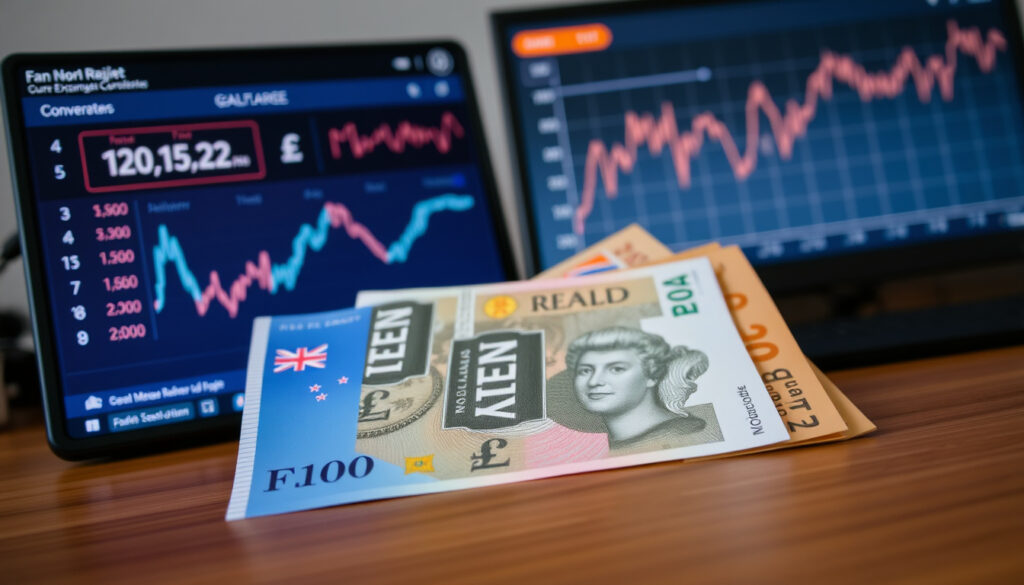
NZD to GBP Exchange Rate: Current Rate, Converter, and History
If you’re planning a trip from New Zealand to the UK or sending money between these two markets, the NZD to GBP exchange rate is probably already on your mind. Right now, one New Zealand dollar buys about 0.4357 GBP at the mid-market rate (XE (currency converter)). This guide explains what drives that number, how to get the best deal, and a bit of history behind the two currencies.
Mid-market rate (NZD to GBP): 0.4357 (from XE.com) ·
Mid-market rate (GBP to NZD): 2.2958 (from Eurochange.co.uk) ·
Daily change: -0.15% (from Eurochange.co.uk) ·
Popular converters: XE.com, Wise, Revolut, OFX
Quick snapshot
- Current mid-market rate: 1 NZD = 0.4357 GBP (XE) (Investing.com (financial data provider))
- 52-week range: 0.4246 – 0.4494 (Investing.com (financial data provider))
- New Zealand adopted the dollar in 1967 (Reserve Bank of New Zealand (central bank))
- Future direction of the rate – depends on interest rates, commodity prices, and central bank policies
- The exact moment the rate hits its best point for your transfer varies unpredictably
- Over the past 6 months, the average NZD/GBP rate was 0.4339 (Wise (money transfer service))
- Highest in 180 days: 0.4492 (18 Jun 2025); lowest: 0.4260 (16 Oct 2025) (Exchange-Rates.org (currency data aggregator))
- Market watchers track NZ interest rate decisions and UK inflation data for signals – but no near-term catalyst is clear.
A quick look at the core numbers shows where the pair stands right now.
| Metric | Value |
|---|---|
| NZD to GBP rate | 0.4357 |
| GBP to NZD rate | 2.2958 |
| Rate date | As of latest available (mid-March 2025) |
| Best provider for near mid-market | Wise |
Is GBP getting stronger against NZD?
How to measure currency strength
- One common gauge is the trade-weighted index (TWI), which the Reserve Bank of New Zealand publishes regularly. It measures the NZD against a basket of major currencies.
- For the NZD/GBP pair specifically, the simplest metric is the spot exchange rate. Over the past year, GBP has gained ground – from a 12-month high of 0.4492 NZD per GBP (June 2025) to recent levels around 0.4277 (Investing.com).
Factors influencing NZD/GBP rate
- Interest rate differentials: The Bank of England has held rates higher than the Reserve Bank of New Zealand, which tends to support GBP.
- Commodity prices: New Zealand exports dairy, meat, and wool. When commodity prices fall, the NZD often weakens.
- Risk sentiment: The NZD is considered a risk-sensitive currency. In times of global uncertainty, investors favour the GBP as a safer bet.
A stronger GBP is good for NZ travelers heading to the UK, but it hurts New Zealand exporters who earn in NZD and pay costs in GBP. The current tilt favours UK buyers.
The pattern: GBP has indeed strengthened relative to NZD over the past 18 months, driven by interest rate policy and commodity price headwinds for New Zealand. If the RBNZ cuts rates sooner than the Bank of England, that trend may continue.
How much is $100 NZ in pounds?
Conversion for other common amounts: $50, $500, $1000 NZD
- At the current mid-market rate of 0.4357, $100 NZ = £43.57. (XE)
- $50 NZ = £21.79
- $500 NZ = £217.85
- $1,000 NZ = £435.70
Using mid-market rate vs bank rates
Banks and exchange kiosks typically add a markup of 2–5% above the mid-market rate. For example, if you convert $100 NZ at a bank counter in the UK, you may receive as little as £41.00 instead of £43.57. That’s a loss of more than £2.50. Wise and Revolut (digital banking platform) often offer near mid-market rates for a small transparent fee.
Why this matters: On a $1,000 transfer, even a 1% markup costs you £4.36. Over multiple transfers, that adds up. Using a service that charges a fair fee and passes on the mid-market rate is the cheapest option.
What is a good exchange rate from NZD to GBP?
Comparing rates from different providers
Here’s a quick comparison of typical rates and markups across providers.
| Provider | Typical rate type | Estimated markup vs mid-market |
|---|---|---|
| XE (currency converter) | Mid-market reference | 0% (informational) |
| Wise (money transfer service) | Mid-market + small fee | 0.5–1% |
| Revolut (digital banking platform) | Mid-market on weekdays | 0% (no markup, but fees for weekends) |
| OFX (foreign exchange specialist) | Commercial rate | 1–2% |
| Traditional bank | Marked-up rate | 3–5% |
Factors to consider: fees, speed, reliability
- Transparency: Wise and Revolut show the exact fee upfront.
- Speed: Bank transfers can take 2–5 days; specialist services often deliver within 1 day.
- Reliability: For larger amounts, OFX and similar firms offer a dedicated account manager but with slightly less favourable rates.
A “good rate” is any mid-market rate with a markup under 1%. For most travellers and expats, Wise or Revolut are the safest bets. If you’re moving serious money, compare OFX’s rates as well – the difference may justify the service.
The catch: No single provider is best for every scenario. The ideal choice depends on how much you’re sending, how often, and whether you value speed over a slightly better rate.
How much is 100 pounds in NZ money?
Conversion of other GBP amounts
- At the current rate of 2.2958 NZD per 1 GBP (Eurochange.co.uk), £100 = $229.58 NZ.
- £50 = $114.79 NZ
- £500 = $1,147.90 NZ
- £1,000 = $2,295.80 NZ
Using the inverse rate
The relationship is reciprocal: 1 / 0.4357 = 2.2958. So if you know the NZD→GBP rate, you can calculate the reverse. But the rate you actually get from a provider may differ slightly due to rounding and spreads. MTFX (currency exchange provider) shows a 30-day high of 2.3046 and low of 2.2809, indicating the GBP/NZD rate can move by about 1% in a month.
What this means: If you’re a UK resident sending money to New Zealand, even a 1% swing in the rate changes the amount your recipient gets by £10 on a £1,000 transfer. Monitoring the rate and using a mid-market service matters.
When did New Zealand drop the pound?
Adoption of New Zealand dollar
New Zealand used the New Zealand pound, which was pegged to the British pound sterling, until 1967. On July 10, 1967, the country decimalised and introduced the New Zealand dollar, dividing it into 100 cents (Reserve Bank of New Zealand).
Decimalisation in 1967
- The change simplified calculations: one NZ pound became two NZ dollars.
- The NZ dollar remained pegged to the British pound until 1973, when the peg was broken after the UK’s own decimalisation and the Smithsonian Agreement.
- In 1985, the NZ dollar was fully floated and has been determined by market forces ever since (OFX (foreign exchange specialist)).
The historical break from the pound means the NZD and GBP are now independent currencies, each moved by their own domestic economic forces. Their relationship is no longer politically managed – it’s pure market supply and demand.
The trade-off: While the NZD is no longer tied to the pound, the UK remains a significant trade partner and source of tourists. That economic connection still influences the rate, even if it’s not a formal peg.
What we know and what’s uncertain
Confirmed facts
- Current mid-market rate is 0.4357 (XE).
- New Zealand adopted the dollar in 1967 (RBNZ).
- Daily change on the latest data: -0.15% (Eurochange.co.uk).
- Six-month average rate: 0.4339 (Wise).
What’s unclear
- Future movement of the rate – no forecast is certain; depends on central bank decisions and global economic conditions.
- The exact moment of the best rate for your transfer – rates fluctuate intraday and overnight.
- The best provider for a specific transfer depends on amount, speed, and fee transparency.
- The exact impact of commodity price changes on the NZD/GBP rate is not predictable.
The trade-off: While the confirmed facts provide a clear snapshot, the uncertain factors remind us that exchange rates are inherently unpredictable, and the best approach is to stay informed and use transparent services.
Expert takes on the NZD/GBP rate
“The current mid-market rate is 1 NZD = 0.4357 GBP.”
— XE.com (currency converter), live rate snapshot
“GBP/NZD is currently 2.2958, with a daily change of -0.15%.”
— Eurochange.co.uk, rate data
“Over the past six months the average NZD-to-GBP rate was 0.4339.”
— Wise (money transfer service), historical summary
The common thread: All major sources show a rate just above 0.43, with the pound holding the upper hand. The slight disagreement (0.4277 from Investing.com vs 0.4357 from XE) reflects different sampling times and data sources – but the range is narrow.
Summary
The NZD/GBP exchange rate hovers around 0.4357, reflecting a pound that has gained strength over the past year. For a New Zealander sending money to the UK, the best strategy is to use a provider that offers near mid-market rates (Wise, Revolut) and to avoid bank markups. For a UK resident sending funds to New Zealand, the same principle applies: compare rates and fees before hitting send. For the traveller from New Zealand, the current rate means your pounds will go about 6% further than they did a year ago – but don’t wait for a better one.
poundsterlinglive.com, exchangerates.org.uk, revolut.com, investing.com, investing.com, xe.com
Frequently asked questions
What factors influence the NZD to GBP exchange rate?
The rate is driven by interest rate differentials, commodity prices (dairy in particular for NZ), economic growth data, and global risk sentiment. Central bank decisions from the RBNZ and Bank of England are the most influential.
How often does the exchange rate change?
It changes continuously during market hours (24 hours a day on weekdays, with slight weekend variations). Live rates update every second on services like XE.
What is the best time to exchange NZD to GBP?
There’s no reliably “best” time, but many observers note that rates tend to be slightly better during London trading hours (11am–7pm NZ time) when liquidity is highest. Avoid weekends when spreads widen.
Are there fees when converting currency online?
Yes. Most online services charge a small percentage fee or a flat transaction fee. Wise and Revolut are transparent about their fees; banks often hide the cost in a poor exchange rate.
How can I get the best exchange rate?
Compare the mid-market rate on XE or Google with the rate your provider offers. Choose a service that charges a clear fee and keeps its spread under 1%. For amounts over $10,000 NZD, consider negotiating with OFX or another specialist.
Is it better to exchange in New Zealand or the UK?
Generally, you get a better rate using a digital service before you travel, rather than exchanging cash at a UK bureau de change. ATMs in the UK using a no-fee debit card (like Wise or Revolut) are also competitive.
More related posts
 2 Degrees Monthly Plans: Prices, Deals & How to Switch
 How to Secure Sliding Doors: 5 Ways to Stop Burglars
 Univer ity of Otago Logo: Meaning, Hi tory, and Brand Guide
 Palmerston North to Hamilton: Compare Bus, Train, Flight & Drive
 How Many Ounces in a kg? Avoirdupois & Troy Explained
 Double Bed Base NZ: Prices, Types & Where to Buy
 When Is Father’s Day 2026? Dates by Country
 Game of Thrones Books: How Many Are There & Reading Order
