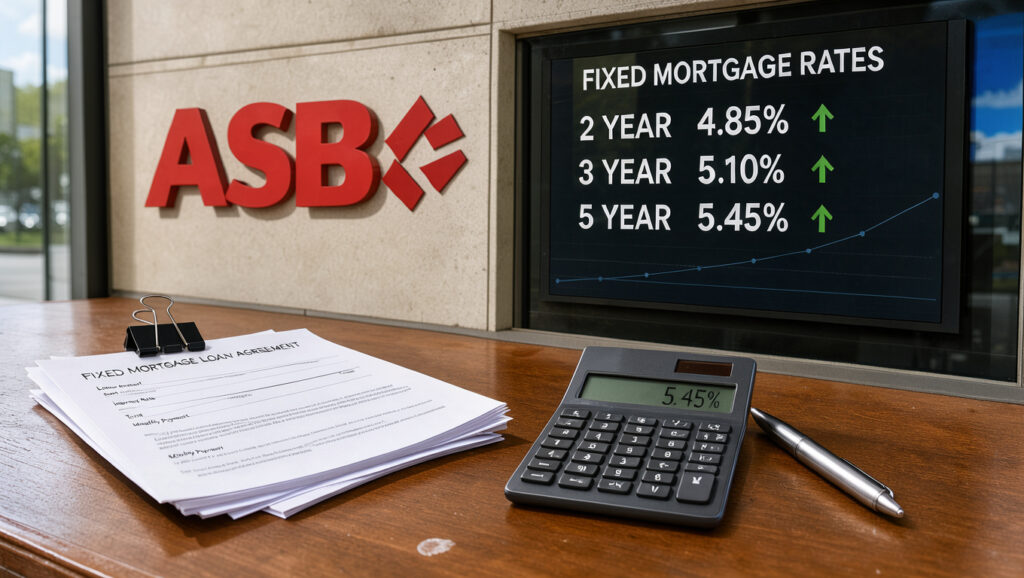
ASB Raises Fixed Rates: Which Terms Went Up and by How Much
ASB raised its fixed rates on 18-month to five-year terms by 20 to 30 basis points on 18 January 2026, about three weeks after trimming its variable rates, according to the ASB press release (Scoop). This piece follows each term as a dated sequence and marks which figures are firm and which still need checking.
Rise on 18-month to five-year terms: 20 to 30 basis points (ASB press release, Scoop) · 18-month fixed rate after the rise: 4.65% (ASB press release, Scoop) · Two-year fixed rate after the rise: 4.75% (ASB press release, Scoop) · Five-year fixed rate after the rise: 5.45% (ASB press release, Scoop) · Later 18-month rate, dated 5 January 2026 in metadata: 5.35% (NZ Herald (national daily), low confidence)
Quick snapshot
- ASB raised its 18-month rate by 20 basis points to 4.65% and its two-year rate by 26 basis points to 4.75%, effective 18 January 2026 (ASB press release, Scoop)
- The five-year rate rose 30 basis points to 5.45% on the same date (ASB press release, Scoop)
- The 5.35% 18-month rate is dated 5 August 2026 only in NZ Herald metadata, and the research could not confirm that date (NZ Herald) (NZ Herald (national daily))
- Whether the temporary removal of most discounts is still in place (NZ Herald (national daily))
- Early December 2025: most mortgage discounts were withdrawn, except on six-month and floating rates (NZ Herald) (interest.co.nz (rate-tracking specialist))
- 27 January 2026: the four-year rate rose 16 basis points and the five-year rate 24 basis points (interest.co.nz (rate-tracking specialist))
- ASB chief economist Nick Tuffley said mortgage rates had not yet caught up with the rise in wholesale rates (MPA Magazine (industry trade title))
- Fixed rates follow wholesale markets more than the official cash rate, so the next move depends on those costs (ASB press release, Scoop) (MPA Magazine (industry trade title))
Seven facts carry most of the story, and each one ties to a single date, which is what makes the sequence trackable.
| Fact | Value |
|---|---|
| Terms raised (18 Dec 2025) | 18-month to five-year fixed terms (ASB press release, Scoop) |
| Size of rise | 20 to 30 basis points (ASB press release, Scoop) |
| 18-month rate after rise | 4.65% (ASB press release, Scoop) |
| Two-year rate after rise | 4.75% (ASB press release, Scoop) |
| Discounts retained (early Dec 2025) | Six-month and floating rates (NZ Herald) |
| Official cash rate after Nov 2025 cut | 2.25% (Stuff (national news coverage)) |
| Two-year swap rate, 15 Dec 2025 | 3.09% (RNZ (public broadcaster)) |
Did ASB raise its fixed mortgage rates?
Yes. On 18 January 2026 ASB raised its fixed rates on 18-month to five-year terms, and the bank’s own release puts the rise at 20 to 30 basis points (ASB press release, Scoop). The bank tied the move to wholesale funding costs, which set fixed rates, rather than to the official cash rate.
BNZ raised its 18-month rate by 19 basis points on or about the same day, and ASB had joined Westpac and ANZ in lifting some fixed rates in mid-December (Stuff).
Terms affected: 18-month to five-year
- 18-month: up 20 basis points to 4.65% (ASB press release, Scoop)
- Two-year: up 26 basis points to 4.75% (ASB press release, Scoop)
- Three-year: up 30 basis points to 5.09% (ASB press release, Scoop)
- Four-year: up 30 basis points to 5.39% (ASB press release, Scoop)
- Five-year: up 30 basis points to 5.45% (ASB press release, Scoop)
Size of the rise and effective date
- Effective date: 18 January 2026 (ASB press release, Scoop)
- Range: 20 basis points on the 18-month term, 26 on the two-year term, and 30 on the three- to five-year terms (ASB press release, Scoop)
- Shorter terms: the six-month rate fell 20 basis points to 4.65%, and the one-year rate held at 4.49% (Stuff)
ASB raised its longer terms while cutting its six-month rate, so on that day the six-month fix at 4.65% sat below the two-year at 4.75% and the five-year at 5.45% (ASB press release, Scoop).
The implication: the increases stopped where the short end begins, so a borrower choosing a six- or twelve-month fix faced a different market from one choosing three to five years.
How much did ASB’s fixed rates increase?
The longest terms rose most consistently, with the three-, four- and five-year rates each up 30 basis points in the December release (ASB press release, Scoop). Across the full range, the bank’s moves were not uniform.
Seven terms appear in the December 2025 release, and one pattern stands out: the 18-month and longer terms rose by 20 to 30 basis points, while the six-month rate fell and the one-year rate held.
| Term | Rate after 18 Dec 2025 | Change | Source |
|---|---|---|---|
| 6-month | 4.65% | Down 20 basis points | Stuff |
| 1-year | 4.49% | Unchanged | Stuff |
| 18-month | 4.65% | Up 20 basis points | ASB press release, Scoop |
| 2-year | 4.75% | Up 26 basis points | ASB press release, Scoop |
| 3-year | 5.09% | Up 30 basis points | ASB press release, Scoop |
| 4-year | 5.39% | Up 30 basis points | ASB press release, Scoop |
| 5-year | 5.45% | Up 30 basis points | ASB press release, Scoop |
A later rise, dated January 2026
- 18-month: reportedly up 26 basis points to 5.35% (NZ Herald)
- Two-year: 5.45% in the same report
- Date: the article metadata shows 5 August 2026, which the research could not confirm
- Adam Boyd cited continued volatility in wholesale interest rates as the reason (NZ Herald)
The August figures rest on one NZ Herald report whose date the research could not confirm, so treat 5.35% as a lead to verify against an ASB release, not a rate to budget on.
The implication: until a primary ASB notice confirms the August figures, the January 2026 and January 2026 numbers are the ones a borrower can quote with confidence.
How can a borrower estimate the cost of an ASB fixed rate rise?
No ASB repayment calculator or worked example appeared in the sources reviewed, so the estimate below relies on simple arithmetic from the published rise. The repayment change depends on three inputs: the loan balance, the remaining term and the new rate.
Inputs needed: loan balance, remaining term and new rate
- Loan balance: the amount still owed on the fixed loan
- Remaining term: the years left on the loan, which sets how long the new rate applies
- New rate: the rate on your renewal offer, such as the 4.65% 18-month rate (ASB press release, Scoop)
Comparing repayments before and after the change
- A 20 basis point rise equals 0.20 percentage points, or about $200 a year in extra interest on each $100,000 owed (own calculation from the ASB press release, Scoop, figure)
- A 30 basis point rise equals 0.30 percentage points, or about $300 a year in extra interest on each $100,000 owed
- This is a simple-interest approximation, so compare full repayments on your bank’s loan schedule before deciding
The implication: the same rise costs more on a larger balance, so a borrower with a big loan should run the numbers on the full amount rather than on the headline percentage.
Has ASB cut any fixed mortgage rates recently?
Yes, in narrow cases. The six-month rate fell 20 basis points to 4.65% on 18 January 2026 (ASB press release, Scoop), and ASB cut its six-month rate again on 24 January 2026 while lifting longer terms (RNZ (public broadcaster)). None of the sources reviewed confirms a cut to the 18-month to five-year fixed rates.
Discounts withdrawn on most mortgage rates
- Discounts were removed on most fixed terms in early January 2026 (NZ Herald)
- The move was not publicised, but ASB disclosed it to brokers (NZ Herald)
- Discounts kept: six-month and floating rates only
Six-month and floating rates still discounted
- Six-month: 4.65% after the 18 January 2026 change (ASB press release, Scoop)
- Six-month: cut again on 24 January 2026, while longer terms and term deposit rates rose (RNZ)
- Floating: discount kept in early January 2026, per the same NZ Herald report
The catch: a six-month discount does little for a borrower who wants a three- or five-year fix, which is where the December increases landed.
What does a floating rate do when fixed rates rise?
A floating rate tracks the official cash rate, while ASB’s fixed rates follow wholesale markets. The bank drew that line in its January 2026 release, describing wholesale costs as the price banks pay to buy the money they lend out (ASB press release, Scoop).
The cash rate fell in late November, yet fixed rates rose weeks later. On 26 January 2026 ASB trimmed its variable rates by 20 basis points after the cash rate cut (ASB media centre (bank’s own release)), and the official cash rate stood at 2.25% after that cut (Stuff).
Fixed rate locked for the term
- A fixed rate is set for an agreed term, so later wholesale moves change new offers rather than the rate already agreed
- January 2026: fixed rates rose while the cash rate was being cut (Stuff)
- January 2026: ASB said longer wholesale rates had risen more than 50 basis points since the November OCR announcement (MPA Magazine)
Floating rate movement and repayment exposure
- Floating rates follow cash-rate decisions, and ASB’s 26 January 2026 trim was 20 basis points (ASB media centre)
- Floating borrowers feel cash-rate cuts at the next repricing
- Fixed borrowers keep their agreed rate until the term ends, then meet the rate on offer at renewal
The cash rate was cut to 2.25% in late January 2026, yet ASB and other banks raised fixed rates within weeks, because the wholesale costs behind fixed loans moved differently from the cash rate (Stuff).
What this means: a floating-rate borrower feels a cash-rate cut quickly, while a fixed-rate borrower renewing now faces wholesale costs that can run against the cash rate.
Timeline of ASB rate moves, 2024 to 2026
Eleven dated moves show that ASB’s rate changes arrived as a sequence rather than as one event.
- 14 August 2024: 18-month rate fell 34 basis points to 6.15%, and the five-year rate fell to 5.89% (ASB media centre (bank’s own release))
- 28 January 2026: one-year and 18-month rates cut to 4.75% after a cash rate cut (NZ Herald (national daily))
- 26 January 2026: variable rates trimmed by 20 basis points (ASB media centre)
- Early January 2026: most mortgage discounts removed, with six-month and floating rates kept (NZ Herald)
- 11 to 12 January 2026: Co-operative Bank became the second major lender to lift longer-term rates (1News (national broadcaster))
- 18 January 2026: ASB raised 18-month to five-year rates, and BNZ raised its 18-month rate by 19 basis points (ASB press release, Scoop; RNZ)
- 27 January 2026: four-year rate up 16 basis points and five-year rate up 24 basis points (interest.co.nz)
- January 2026: ASB’s one- to three-year rates rose 10 to 20 basis points, and Kiwibank raised fixed terms too (MPA Magazine)
- 24 January 2026: six-month rate cut, while longer home loan terms and term deposit rates rose (RNZ)
- 29 January 2026: ASB raised several fixed rates again amid wholesale volatility (interest.co.nz (rate-tracking specialist))
- 5 August 2026 (metadata date): 18-month rate reportedly up 26 basis points to 5.35% (NZ Herald, low confidence)
The pattern: after November 2025, every reported move on 18-month or longer terms went up, while the cuts were confined to six-month and variable products.
Confirmed facts and open questions
Confirmed facts
- 18 January 2026: 18-month to five-year rates rose 20 to 30 basis points (ASB press release, Scoop)
- After that rise, the 18-month rate was 4.65% and the two-year rate 4.75% (ASB press release, Scoop)
- In early January 2026, most mortgage discounts were withdrawn (NZ Herald)
What’s unclear
- Whether the 5.35% 18-month rate is accurate, since the research could not confirm its 5 January 2026 date (NZ Herald)
- Whether the temporary discount removal has ended, since no source confirms its current status (NZ Herald)
- How the December rises affect ASB fixed loans already in place, which none of the sources reviewed addresses
- The year of ASB’s 18-month term deposit rise to 3.65%, which the release does not state (ASB media centre (bank’s own release))
The implication: the confirmed list is short, so a borrower should treat the August figures as a prompt to check the bank’s current rate sheet, not a number to plan around.
What bankers and economists said
While today’s adjustments reflect the reality of higher funding costs, the change in market conditions is good news for some of our savers with term deposit rates increasing by up to 35 basis points.
Adam Boyd, Executive General Manager Personal Banking, ASB (ASB press release, Scoop)
We’ve seen for two-year rates, a good 50 basis point increase in wholesale rates and nearly 60 for the 3 year… so to date, the moves we’ve seen with mortgage rates aren’t really keeping up with that yet.
Nick Tuffley, chief economist, ASB (MPA Magazine)
Longer-term fixed-rate mortgages are influenced primarily by wholesale interest rates and the future rate outlook, as opposed to the current OCR.
Mark Wilkshire, chief executive, Co-operative Bank (1News)
The implication: the bankers agree on the mechanism, with wholesale costs ahead of the cash rate, but Tuffley’s comment suggests mortgage repricing still had further to run as of February 2026.
Where this leaves borrowers
Related reading: New Zealand home loan rates
The sequence shows ASB repricing in steps rather than in one move. The 18 December rise was followed by increases on longer terms in January and February 2026 (interest.co.nz), and fixed-rate pricing has followed wholesale markets more than the cash rate. For borrowers renewing an ASB fixed loan, the choice is clear: compare the published rate on each term before accepting the renewal offer, or accept whatever the next repricing brings.
Related reading: New Zealand home loan rates
tvnz-1-news-prod.cdn.arcpublishing.com, article.wn.com, interest.co.nz
Frequently asked questions
Do fixed rate increases apply to home loans already fixed at ASB?
The sources reviewed do not say whether the December 2025 rises changed rates on loans already fixed. Check the rate and expiry date in your own loan agreement with ASB.
Is ASB still discounting six-month or floating rates?
NZ Herald reported that ASB kept discounts on six-month and floating rates in early January 2026 (NZ Herald). Whether that still holds is one of the open questions above.
Are other New Zealand banks also raising fixed rates?
Yes. BNZ raised its 18-month rate by 19 basis points on 18 December 2025 (RNZ), Co-operative Bank lifted its two- to five-year rates by 30 basis points (1News), and Kiwibank raised fixed terms in December 2025 (MPA Magazine).
Why are banks lifting fixed mortgage rates now?
ASB’s Adam Boyd cited higher funding costs, and the two-year swap rate rose from 2.54% in October 2025 to 3.09% on 15 December 2025 (RNZ).
Is there a fee for repaying an ASB fixed loan early?
None of the sources reviewed states ASB’s break cost. Early repayment charges are set in each loan’s terms, so read that section before repaying or refinancing early.
Can a fixed rate change before the term ends?
The reported increases concern the rates ASB offers on new terms. None of the sources describes a change to a rate already agreed partway through a term.
More related posts
 Cat Age in Human Years: Calculator, Chart & Formula
 Roast Chicken Recipe NZ – Easy & Perfect Every Time
 Bigg Boss 19 Winner Gaurav Khanna: Prize Money Details
 How does KiwiSaver work? Contributions, withdrawals, funds
 Best Accounting Software for Sole Traders: Xero vs Sage vs QuickBooks
 Cheapest Unlimited Broadband NZ 2025: Compare Plans Under $80
 Pakistan vs New Zealand: Washout Hurts Semi-Final Hopes
 Auckland FC vs Central Coast Mariners FC Stats: H2H & Analysis
