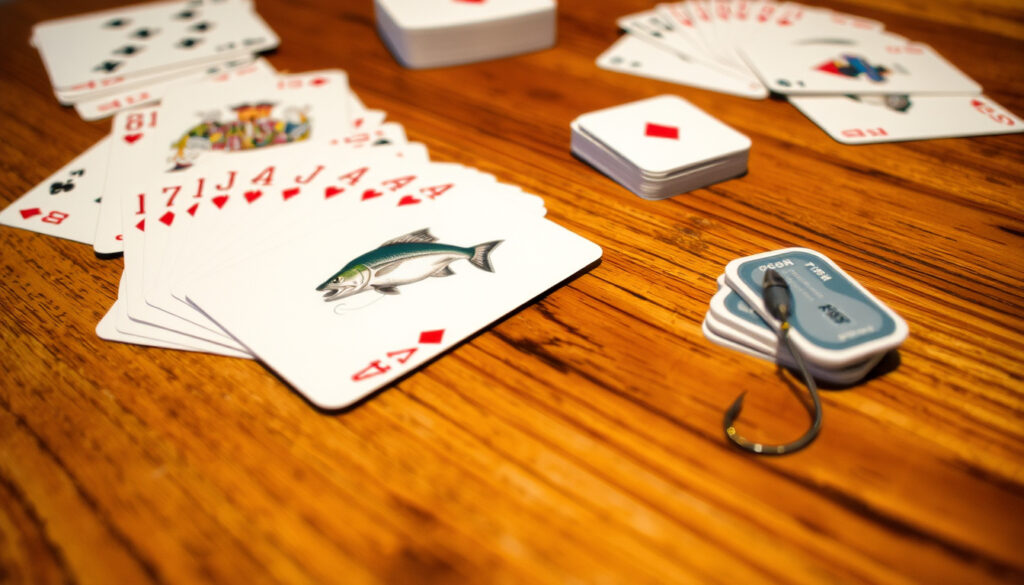
How to Play Go Fish: Rules, Card Counts & Tips
There’s a reason Go Fish keeps showing up at family card tables: it rewards attention, not reading ability, and you’re here for the exact rules — how many cards each player gets, what counts as a “book,” and how the game changes with two players or five. We’ve grounded the deal counts in a University of Waterloo classroom guide and added the house-rule variants worth settling before you shuffle.
Players: 2 or more ·
Cards per player, 2-4 players: 7 ·
Cards per player, 5+ players: 5 ·
Deck: Standard 52-card pack ·
Goal: Collect books of four matching cards
Quick snapshot
- Go Fish uses a standard 52-card deck. (Bicycle Cards official rules)
- For 2-4 players, everyone starts with 7 cards; with 5 or more, deal 5. (University of Waterloo classroom guide)
- The goal is to collect books of four matching cards. (Play Go Fish teaching guide)
- Does a successful ask earn another turn? House rules split on this.
- Do you collect four-card books or two-card pairs? Both versions are widely played.
- Must you hold a rank before asking for it? Rulebooks disagree.
- Turn flow: ask for a rank you hold → collect matches or hear “Go fish” → draw one card and pass unless you made a book. (Play Go Fish teaching guide)
- Lay down each completed book as soon as you make it.
- For a faster first round with kids, play for pairs instead of books.
- Count books at the end — the most books wins.
Six numbers, one pattern: as the table grows, the starting hand shrinks so the draw pile stays useful.
| Rule | Value |
|---|---|
| Deck | Standard 52-card pack |
| Minimum players | 2 |
| Starting hand, 2-4 players | 7 cards |
| Starting hand, 5+ players | 5 cards |
| Draw pile | Remaining cards face down in the middle |
| Winning condition | Most books of four matching cards |
What this means: the deal is the only rule your table must lock in before the first hand — everything else flows from it.
What are the rules for Go Fish?
Go Fish’s official rules are compact: the object is to collect sets of four cards of the same rank, and each completed set is a “book.” Bicycle Cards official rules state that object in one line, which is why the game takes under a minute to explain.
- Ask for a rank you already hold. If the player has it, they hand over every matching card and you keep your turn; if they don’t, they say “Go fish” and you draw one card. (Play Go Fish teaching guide)
- When every book is formed, the player with the most books wins. Completed books sit face up, so the score is visible all game. (Play Go Fish teaching guide)
Asking for a rank you already hold is the game’s probability lesson: every successful ask removes four known cards from the deck and narrows what the next player can hold.
What is the goal of Go Fish?
- Build books of four matching cards and lay them down as you go.
- The player with the most books at the end of the game wins.
That’s the whole goal — no points, no suit logic, no complex scoring.
What is a book in Go Fish?
- Four cards of the same rank: four 3s, four queens, four aces.
- A completed book goes face up in front of the player who made it, so everyone can count the score.
“Book” is the only bit of card-game jargon in Go Fish; the rest of the game uses plain language.
What are common Go Fish rule variants?
- Deal split: Bicycle Cards official rules deal 7 cards for 2-3 players and 5 cards for 4-5 players.
- Extra turns: some tables give a successful asker another turn; others pass play after one question regardless.
- Hand requirement: some rulebooks say you may only ask for a rank you already hold; others let you ask for anything.
The trade-off: the printed rules are a clean baseline, but a family version that tweaks the deal or the turns is just as “correct” once the table agrees.
The implication: once these two variables are agreed upon, the game is fully defined.
How do you play Go Fish?
The turn-by-turn version is identical for 2, 3, 4, or 5 players; only the starting hand changes once the table hits five.
- Shuffle and deal. Deal 7 cards each when 2-4 people play, or 5 cards each when five or more play. Place the remaining cards face down in the middle as the draw pile. (University of Waterloo classroom guide)
- Start to the dealer’s left. On your turn, ask one player for a rank — “Do you have any 8s?” — and you should already hold at least one 8.
- React to the answer. If the player hands over 8s, add them to your hand, lay down any completed book, and go again. If they say “Go fish,” draw one card; if the draw completes a book, set it down too. Your turn then ends.
- Repeat until every book is formed. Count books and declare the winner.
The same loop works at every player count; only the starting hand changes.
How do you play Go Fish with 2 players?
- Deal 7 cards each; the draw pile holds the remaining 38 cards.
- You ask the only other player at the table — there’s no third opinion to remember.
- Every answer matters more, because one opponent means every response tells you half the table’s holdings.
How do you play Go Fish with 3 players?
- The 7-card deal stays in effect for 2-3 players, per Best Days With Dad (family game guide).
- You can ask either opponent, which makes memory and bluffing more useful.
- With 21 cards dealt, the draw pile sits at 31 cards.
How do you play Go Fish with 4 players?
- Four players keep the 7-card deal: 28 cards in hands, 24 in the draw pile.
- Turn order rotates; asking the player across the table is a classic bluff position.
How do you play Go Fish with 5 players?
- With more than four players, deal 5 cards each — the University of Waterloo classroom guide sets that cutoff.
- Total dealt: 25 cards, leaving a 27-card draw pile.
- Smaller hands make the game faster, which matters more with a bigger table.
How do you win at Go Fish?
- Watch what other players ask for — every request is a clue about what they hold.
- Ask for ranks you already hold, so a successful ask always adds cards.
- Follow the crowd: if several players keep asking for 5s, the remaining 5s are likely in the draw pile.
- Keep your books face up and count them out loud on the final hand.
Why this matters: Go Fish is a memory game disguised as luck. The player who tracks requests usually has the edge over the player who asks randomly.
The pattern: the turn sequence is invariant; only the starting hand changes with player count.
Do you always keep 7 cards in Go Fish?
No. Seven is the starting hand for 2-4 players, not a permanent hand size. Once the game begins, your hand grows when you draw, grows again when you receive cards, and shrinks every time you lay down a book.
- 2-4 players: start with 7 cards each; 5 or more: start with 5.
- After the turn loop starts, hand sizes change constantly — nobody “keeps” 7 cards.
- Some house versions deal 7 cards for every player count; agree on that before the game begins.
How many cards do you get in Go Fish?
- 2-4 players: 7 cards each.
- 5 or more players: 5 cards each.
- Family-guide alternative: some guides keep 7 cards for 2-3 players and drop to 5 for 4-6.
The pattern: 7 is the small-table default, 5 is the big-table compromise, and either works once everyone agrees.
The extra-turn rule is the most common source of family-table arguments: Play Go Fish gives a successful asker another turn, while some house rules pass play after one question. Decide before you deal.
The catch: if house rules differ, they should be written down to avoid confusion.
How to explain Go Fish to a kid?
Explain the goal in one sentence: “We’re collecting four matching cards, and we ask each other for them.” Then say the asking phrase aloud before every turn, so the language becomes the game.
- “Do you have any…?” is the only phrase a child needs to practice.
- Call a book a “match” during the first game.
- Let the child place completed matches in their own pile, so progress is visible.
- Keep the first games slow; repeat the question together before each ask.
For a first game, say the asking phrase aloud before every turn — “Do you have any…?” — it turns the rule into a script kids can copy.
How do you play Go Fish for kids?
- First-round variant: collect pairs instead of books; the game ends twice as fast.
- For a child under 6, deal fewer cards or play with cards face up for the first few rounds.
- Celebrate every successful ask with a clear “Good question!” — confidence matters more than the score.
The catch: kids learn Go Fish through repetition, not explanation. Two slow games teach more than five minutes of rules.
Is there a kids’ version of Go Fish?
There are several, and the best one changes the scoring unit, not the turn structure. The pairs version keeps the exact same ask-and-answer loop but makes the goal small enough for a preschooler to hold in one hand.
- Pairs version: collect two matching cards instead of four.
- Face-up version: keep all cards visible while children learn the asking rule.
- Number-card version: use a deck with large numbers or picture cards so matching is easier to see.
- Classroom version: use Go Fish as a matching-and-memory warm-up, where every completed set is “solved.”
What is the simplest card game for kids?
- Pairs-only Go Fish is the simplest: two of a kind, one deck, no scoring math.
- It uses the same turn order as the standard game, so a child can graduate to books later without relearning anything.
Simplicity has a trade-off: some children prefer “four of a kind” because a full book feels like completing a puzzle.
What is a good matching game for a 3-year-old?
- For age 3, play the face-up pairs version: spread the cards out and take turns asking for a visible rank.
- The real goal at this age is turn-taking; celebrate every clear “Do you have any…?” no matter who gets the match.
The implication: there is no single kids’ version — there’s a dial. Switch pairs on, switch books off, and adjust until the game fits the child.
Which Go Fish rules are fixed, and which ones vary?
Two lists settle every table dispute: the rules that are stable across guides, and the ones families routinely change.
Confirmed facts
- Go Fish uses a standard 52-card deck. (Bicycle Cards official rules)
- Two to four players start with 7 cards; five or more start with 5. (University of Waterloo classroom guide)
- Books are four matching cards; the most books wins. (Play Go Fish teaching guide)
What’s unclear
- Does a successful ask grant another turn? Varies.
- Books of four or pairs of two? Both are played.
- Must you hold a rank before asking? Different rulebooks disagree.
What this means: write your chosen variants down before the first hand — it is faster than arguing after the last one.
What the rulebooks actually say
Two sources, one consistent picture: the printed rules agree on the core game and drift only on the details.
Go Fish is played with a standard 52-card deck; the object is to collect sets of four cards of the same rank.
Some family-and-kids guides use 2–3 players = 7 cards and 4–6 players = 5 cards.
The trade-off: a printed rulesheet gives you a clean baseline, but the version your family remembers is the one you play consistently.
Go Fish survives because it scales: a 3-year-old can play pairs, a 10-year-old can track every ask, and adults can still get caught holding four 8s. The next time someone says “Let’s play cards,” the rulebook is already settled: standard deck, 7 cards for up to four players (or 5 for a bigger table), ask for ranks you hold, and count books at the end. For any parent teaching a first card game, the choice is clear: teach the question — “Do you have any…?” — and reward every successful ask, or the game collapses into random drawing.
Related reading
- Best Knock Knock Jokes: 100+ Funny Jokes for All Ages
- Best Toy Cars for Kids: 2025 Complete Guide & 2026 Trends
These articles provide additional context for family game nights.
suitedgames.com, kidfriendlythingstodo.com, playgofish.org, lovetoknow.com, mybaba.com, thegeniusofplay.org, ducksters.com, blogs.glowscotland.org.uk
Frequently asked questions
Do you ask for a specific card or a rank in Go Fish?
You ask for a rank, not a specific card: “Do you have any 7s?” — not “Do you have the 7 of hearts?” A rank request works because a book is built from all four suits of the same rank.
What do you say when you do not have the card someone asks for in Go Fish?
You say “Go fish.” The player who asked draws one card from the draw pile, and if that card completes a book, they lay the book down. Their turn then ends.
Can Go Fish be played with a regular deck of cards?
Yes. A standard 52-card deck is all you need — the jokers stay in the box.
What is the difference between a book and a pair in Go Fish?
A book is four matching cards, such as four 4s or four kings, and it is the standard scoring unit. A pair is two matching cards and is the target in most kids’ versions, where the game ends once every pair is collected.
How does Go Fish help kids practice math skills?
Go Fish asks kids to recognize ranks, count completed books, remember which cards players ask for, and decide which rank to ask for next. That matching-and-memory loop is the same logic teachers use in classroom math games.
More related posts
 Grand Prix of Europe Movie: Review, Age Rating, and Where to Watch
 USD to NZD Exchange Rate: Current Trends & Analysis
 5’2″ in cm – Exactly 157.48 cm Converted
 Cleveland Cavaliers vs Pacers: Score, Prediction & Stats
 Apple Watch SE 40mm: Price, Specs & Ireland Buy Guide
 Carterton Pub Boarding House Fire Risk: Dangerous Building Notice
 Do Not Disturb on iPhone: What It Does & How to Turn Off
