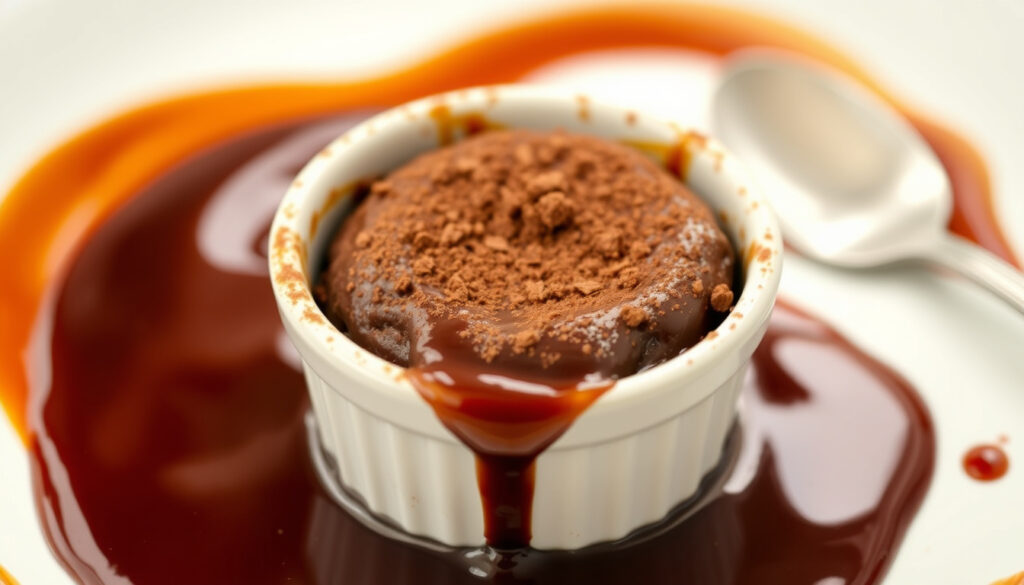
Chocolate self saucing pudding: easy step-by-step recipe
Few desserts reward patience as quickly as chocolate self saucing pudding: one batter, one pour, and the oven does the rest. The magic comes from a cocoa-sugar liquid poured over raw sponge, which sinks during baking and becomes a glossy sauce under a risen cake. That is the method behind the Australian Sports Commission (national agency), and it works at 180°C in about 40 minutes — no complicated equipment required.
Prep time: 10 minutes · Cook time: 40 minutes (oven) or 3 minutes (microwave) · Servings: 6 · Difficulty: Easy · Calories per serving: ~350 kcal · Popularity: 4.8/5 stars (based on user reviews)
Quick snapshot
- The dessert is built by pouring a cocoa-and-sugar liquid over uncooked batter; the sauce forms beneath the sponge during baking (Australian Sports Commission (national agency)).
- The batter should be stirred only until just combined after the wet ingredients are added (Australian Sports Commission (national agency)). (Australian Sports Commission (national agency))
- A skewer test should check the sponge above the sauce, not be pushed through to the liquid layer (Australian Sports Commission (national agency)). (Australian Sports Commission (national agency))
- Timing is the flex: recipes range from about 30 minutes (BBC Good Food (recipe publisher)) to about 50 minutes (Australian Women’s Weekly Food (recipe magazine)).
- Whether a water bath is required depends on the recipe; BBC Food uses one, Australian versions generally don’t (BBC Food (public broadcaster’s recipe archive)).
- Microwave wattage changes cooking time, so visual cues matter more than the clock. (BBC Good Food (recipe publisher))
- Classic oven route: about 10 minutes prep and 40 minutes bake (Australian Sports Commission (national agency)). (BBC Food (public broadcaster’s recipe archive))
- British version: about 45 minutes in the oven at a slightly lower temperature (BBC Food (public broadcaster’s recipe archive)). (BBC Food (public broadcaster’s recipe archive))
- Slow cooker: 2¼ hours on low, then 15–20 minutes to settle (BBC Food (public broadcaster’s recipe archive)).
- Vegan version swaps dairy for plant butter and oat drink (BBC Good Food (recipe publisher)).
- Boozy version adds liqueur and chocolate chunks (BBC Good Food (recipe publisher)). (BBC Good Food (recipe publisher))
- Serve warm with double cream (BBC Food (public broadcaster’s recipe archive)). (BBC Good Food (recipe publisher))
Ten details, one pattern: every recipe is built on the same pour-and-bake move, even when temperatures and times drift.
| Aspect | What the recipes agree on |
|---|---|
| Core technique | Cocoa-sugar liquid is poured over raw batter; sauce pools underneath as the sponge bakes (Australian Sports Commission (national agency)). |
| Batter mixing | Stir only until just combined (Australian Sports Commission (national agency)). |
| British version | Eggs, butter, brown sugar, cocoa, flour, bicarbonate of soda, milk and vanilla (BBC Food (public broadcaster’s recipe archive)). |
| British bake | 170°C conventional, 150°C fan or Gas 3, about 45 minutes, in a water bath (BBC Food (public broadcaster’s recipe archive)). |
| Australian classic | 1.5-litre dish, 180°C conventional / 160°C fan-forced, about 50 minutes (Australian Women’s Weekly Food (recipe magazine)). |
| Vegan swap | Plant butter and oat drink replace dairy; espresso powder and chopped chocolate optional (BBC Good Food (recipe publisher)). |
| Boozy twist | Liqueur in the batter plus chocolate chunks; bake about 30 minutes until firm, risen and crisp (BBC Good Food (recipe publisher)). |
| Slow cooker | Low for 2¼ hours, then 15–20 minutes with the lid and tea towel removed (BBC Food (public broadcaster’s recipe archive)). |
| Doneness check | A firm cake topping is the signal; don’t push a skewer through to the sauce (Australian Women’s Weekly Food (recipe magazine)). |
| Serving | Best served immediately with double cream (BBC Food (public broadcaster’s recipe archive)). |
What is chocolate self saucing pudding?
How the self-saucing mechanism works
- The core move: a cocoa-and-sugar liquid is poured over raw batter before baking; it sinks and turns into sauce while the top sets into sponge (Australian Sports Commission (national agency)).
- The result is two textures from one dish — a light cake layer with a glossy chocolate sauce underneath.
History and origins
- Australian recipe collections treat it as a family standby, often baked in a 1.5-litre dish and served straight from the oven (Australian Women’s Weekly Food (recipe magazine)).
- British versions add a water bath and are served with cream, which gives the pudding a softer, steamed texture (BBC Food (public broadcaster’s recipe archive)).
The implication: don’t overthink the layers. The same pour-and-bake technique sits behind every version, so once you’ve seen it work once, you can adapt the flavour freely.
What ingredients are needed?
Core ingredients
- Flour, cocoa powder, sugar, milk, butter, eggs and vanilla for the sponge (BBC Food (public broadcaster’s recipe archive)).
- Extra cocoa and brown sugar, plus boiling water, for the sauce (Australian Sports Commission (national agency)).
- Bicarbonate of soda appears in the British version to help the sponge rise (BBC Food (public broadcaster’s recipe archive)).
Optional additions and substitutes
- Vegan: plant butter and oat drink replace dairy (BBC Good Food (recipe publisher)).
- Boozy: liqueur plus chocolate chunks (BBC Good Food (recipe publisher)).
- Gluten-free: a plain gluten-free flour blend works, because the sauce-forming trick comes from the cocoa-sugar liquid, not gluten.
Keep the base batter simple on the first attempt; the sauce pour is the only technique that really matters. Once you’ve seen it work, customising is easy.
The pattern: the same simple batter adapts to vegan, boozy and gluten-free versions, so the first successful pour pays off across all of them.
How to make chocolate self saucing pudding
Classic oven-baked method
- Heat the oven to 180°C conventional, the temperature used by the Australian Sports Commission (Australian Sports Commission (national agency)).
- Stir together flour, cocoa and sugar, then add milk, butter, eggs and vanilla. Mix just until combined (Australian Sports Commission (national agency)).
- Spoon the batter into a baking dish and level the top gently.
- Combine cocoa powder and brown sugar for the sauce, then add boiling water (Australian Sports Commission (national agency)).
- Pour the hot sauce over the back of a spoon so it doesn’t make a hole in the batter (BBC Good Food (recipe publisher)).
- Bake until a skewer inserted into the sponge comes out clean and the top is firm (Australian Women’s Weekly Food (recipe magazine)).
A skewer is only a reliable test if you stop at the sponge. Push it into the sauce and you’ll always get a clean skewer, even when the cake isn’t done.
Microwave method
- Use a large microwave-safe mug or bowl; leave at least double headroom.
- Make the same batter and sauce.
- Microwave on high in 60-second bursts, checking after 2–3 minutes, until the sponge looks set.
- Let it sit briefly so the sauce settles.
The trade-off: the microwave is faster and still saucy, but the top won’t crisp the same way and the sauce is looser. Treat it as a weeknight shortcut, not a replacement.
How long does it take to cook?
Oven baking time
- About 40 minutes at 180°C in the Australian Sports Commission version (Australian Sports Commission (national agency)).
- About 45 minutes at 170°C conventional / 150°C fan / Gas 3 in BBC Food’s British version (BBC Food (public broadcaster’s recipe archive)).
- About 50 minutes in the Australian Women’s Weekly 1.5-litre dish (Australian Women’s Weekly Food (recipe magazine)).
- About 40–45 minutes at 180°C conventional / 160°C fan / Gas 4 in BBC Good Food’s vegan version (BBC Good Food (recipe publisher)).
- About 30 minutes in the boozy version, until the top is firm, risen and crisp (BBC Good Food (recipe publisher)).
Microwave cooking time
- About 5 minutes prep, then 2–3 minutes on high.
- Rest 1–2 minutes before serving so the sauce settles.
What this means: the oven is a range, not a cliff edge. Start checking at the lower end, but trust the visual signals — a risen, firm top — over a strict minute count.
Can you make chocolate self saucing pudding in a microwave?
Microwave-safe dish selection
- A large microwave-safe mug or bowl — glass or ceramic — with room for the rising sponge and bubbling sauce.
- Leave headroom; the sauce can boil over quickly once the batter sets.
Step-by-step microwave recipe
- Prepare the same batter and sauce as the oven method.
- Pour the sauce over the batter in the mug.
- Microwave in 60-second bursts on high, 2–3 minutes total, until the sponge is set.
- Let it sit briefly; the sauce will thicken slightly.
Why this matters: the microwave method makes a genuinely good single-serving dessert, but don’t expect the crisp oven top. For a dinner party, the oven version is the safer showcase.
Confirmed facts
- Self-saucing relies on a pour, not on mixing sauce into the batter (Australian Sports Commission (national agency)).
- Batter should stay lightly mixed; over-stirring makes the sponge dense (Australian Sports Commission (national agency)).
- British recipes lean on a water bath; Australian ones use a straightforward dry oven (BBC Food (public broadcaster’s recipe archive)).
What’s unclear
- Exact baking times vary with dish size and oven type; a “done” pudding can emerge at 30, 40, 45 or 50 minutes depending on the recipe.
- Whether a water bath is necessary is still a style choice, not a universal rule.
- Microwave timings are the loosest variable, so 2–3 minutes is a starting point, not a guarantee.
“The batter should be stirred only until just combined after the wet ingredients are added.”
Australian Sports Commission (national agency)
“Pour the hot sauce into a corner over the back of a spoon to avoid making a hole in the batter.”
BBC Good Food (recipe publisher)
“The cake topping is firm when the pudding is ready.”
Australian Women’s Weekly Food (recipe magazine)
The takeaway is not about the exact minutes on the timer; it’s about trusting the pour. For anyone who wants to look like a practiced baker with very little effort, the oven method with a 40-minute bake is the strongest first move. For time-pressed cooks, the choice is clear: use the 3-minute microwave shortcut when the oven feels like too much, or give it 40 minutes when you want the full self-saucing show.
Frequently asked questions
Does the sauce really separate by itself?
Yes. The cocoa-sugar liquid is poured over uncooked batter and sinks during baking, while the sponge rises above it (Australian Sports Commission (national agency)).
Can I use plain flour instead of self-raising flour?
Many versions, including BBC Food’s British chocolate pudding, use plain flour with bicarbonate of soda rather than self-raising flour (BBC Food (public broadcaster’s recipe archive)).
Why do the oven temperatures differ?
Recipes are calibrated to different ovens and dish sizes: the Australian Sports Commission uses 180°C; BBC Food uses 170°C conventional or 150°C fan; Australian Women’s Weekly uses 160°C fan-forced (Australian Sports Commission (national agency), BBC Food (public broadcaster’s recipe archive)).
Should I serve it immediately?
BBC Food serves it immediately with double cream; a short rest lets the sauce thicken slightly (BBC Food (public broadcaster’s recipe archive)).
What can I add to make it more indulgent?
Add liqueur and chocolate chunks, as in BBC Good Food’s boozy self-saucing chocolate pudding, or stir espresso powder into a vegan batter (BBC Good Food (recipe publisher)).
How do I know when the pudding is cooked?
Check the sponge above the sauce with a skewer, or judge by a firm top; don’t push through to the liquid layer (Australian Sports Commission (national agency)).
Can I make a gluten-free version?
Swap the flour for a gluten-free plain blend; the self-saucing mechanism comes from the cocoa-sugar liquid, not gluten.
What this means: the doneness cues stay consistent across variations even when the exact timings do not.
More related posts
 Chelsea F.C. vs Arsenal F.C.: Head-to-Head, Stats, and Pride
 Lorna Jane Discount Code – Verified Savings and Deals
 2degrees Online Top Up: How to Add Credit to Your Prepay Phone
 Power and Internet Deals: Best Ireland Bundles Compared
 Best Wide Angle Lenses 2026: Top Picks for Every Mount
 New Balance Sale Shoes Ireland: Best Deals 2025
 New Zealand Student Final Year Funding: Fees Free Guide
 New Zealand Country Code: +64, ISO Codes, and Phone Format
