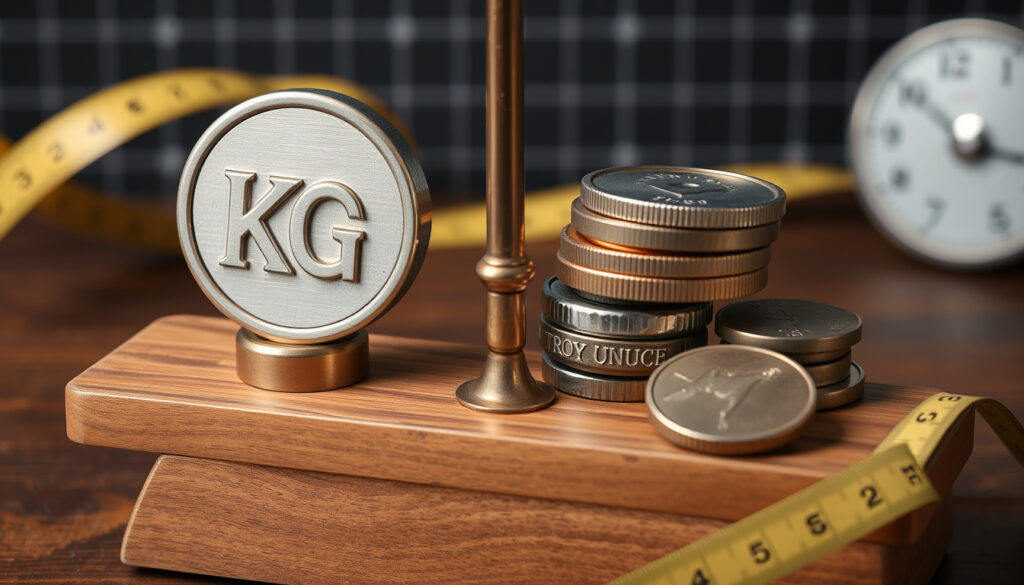
How Many Ounces in a kg? Avoirdupois & Troy Explained
Ever stood in a kitchen with a European recipe calling for grams while your scale only reads ounces, or tried to figure out a gold bar’s weight in familiar units? The answer isn’t a single number — ounces come in two flavors, and this guide gives exact conversions, clears up mix-ups, and explains when to use which.
1 kilogram in ounces: 35.27 oz ·
1 ounce in kilograms: 0.02835 kg ·
1 kilogram in pounds: 2.205 lb ·
1 pound in kilograms: 0.4536 kg
Quick snapshot
- 1 kg = 35.27396 avoirdupois ounces (UnitConverters.net)
- 1 troy ounce = 31.1035 g (The Royal Mint)
- 1 lb = 0.45359237 kg (NIST)
- Rounding in recipes can differ by country (US vs UK conventions) (The Spruce Eats)
- Historical ounce definitions (e.g., troy vs avoirdupois) still cause confusion in metals trading (The Spruce Eats)
- No recent changes to the SI kilogram definition (2019 redefinition was about Planck constant, not conversion factors) (The Spruce Eats)
- The troy ounce has been used for precious metals since medieval times. (Wikipedia)
- Use exact conversions (35.274) for precision; rounded (35) is acceptable for rough estimates (Inch Calculator)
- Precious metals will continue trading in troy ounces — always verify which ounce is being referenced
Key conversion facts
Five units, one pattern: the ounce has two distinct identities depending on what you’re weighing.
| Unit | Definition |
|---|---|
| Kilogram (kg) | Base SI unit of mass |
| Avoirdupois Ounce (oz) | 28.3495 grams |
| Troy Ounce (oz t) | 31.1035 grams |
| Pound (lb) | 453.592 grams |
| Stone (st) | 6.35029 kilograms |
The takeaway: the avoirdupois ounce is your everyday ounce, while the troy ounce is reserved for precious metals — and it’s about 9.7% heavier.
How many ounces make 1 kg?
The exact answer: 1 kilogram equals 35.27396195 avoirdupois ounces, according to UnitConverters.net (conversion calculator). For everyday use, rounding to 35.27 or 35.274 is common. The derivation: 1 kg = 2.20462262 lb × 16 oz/lb = 35.27396 oz. The U.S. National Institute of Standards and Technology (NIST) gives 1 kg ≈ 2.2 lb, which works out to roughly 35.2 oz — close enough for cooking.
How many ounces in a kg of flour?
Flour is measured by weight (avoirdupois ounces). So 1 kg of flour = 35.27 oz. Many bakers prefer grams for precision, but if you’re converting a recipe, round to 35 oz per kg. The Spruce Eats (cooking resource) notes that recipes often simplify 1 oz = 28 g, making 1 kg ≈ 35.7 oz.
How many ounces in a kg of water?
Water’s density is nearly 1 g/mL, so weight and volume align. One kilogram of water is exactly 35.27 avoirdupois ounces. The same conversion applies to any substance measured in kilograms — the ounce count doesn’t change by material.
How many ounces in a kg of silver?
Here we switch to troy ounces. One kilogram of silver = 32.1507 troy ounces. The Royal Mint (bullion authority) and Investopedia (financial reference) confirm that precious metals are always weighed in troy ounces. If you’re quoted a silver price “per ounce,” verify which ounce they mean — a troy ounce is 31.1035 g vs 28.3495 g for an avoirdupois ounce.
The pattern: for cooking and daily items, use the avoirdupois ounce. For gold, silver, and platinum, use the heavier troy ounce.
Is 100g the same as 4 oz?
No — this is one of the most common metric-imperial mix-ups. 100 grams equals 3.527 avoirdupois ounces, not 4. Using 4 oz instead of 100 g adds more than 13% extra weight, which can ruin a recipe. The table below shows where standard approximations fall short.
| Metric | Common (wrong) equivalent | Exact conversion | Error |
|---|---|---|---|
| 100 g | 4 oz | 3.527 oz | –0.473 oz (13.4% under) |
| 250 g | 8 oz | 8.818 oz | +0.818 oz (10.2% over) |
| 500 g | 1 lb | 1.102 lb | +0.102 lb (10.2% over) |
| 2 lb | 1 kg | 0.907 kg | –0.093 kg (10.3% under) |
The caution: rounding tricks like “250 g = 8 oz” can lead to noticeable errors. For scaling precision, use the exact factor or a digital scale.
Is 250 grams equal to 8 oz?
Not exactly. 250 g = 8.818 oz — more than 8 oz. Many recipe books state “250 g = 8 oz,” but that’s a convenience rounding. NIST’s cooking equivalencies list 28 g per 1 oz, which would make 250 g = 8.93 oz. Always double-check with a calculator if the result matters.
Is 500g the same as 1 lb?
No. 500 g = 1.102 lb, while 1 lb = 453.592 g. The difference is about 46 g (10.2%). For many casual cooking tasks that’s tolerable, but for baking or portion control it matters. NIST defines 1 lb as 454 g in its cooking chart, confirming the small gap.
Is 2 pounds the same as 1kg?
No. 2 lb = 0.907 kg, not 1 kg. The difference is nearly 10%. That means if you’re shipping a package and the courier quotes 2 lb per kg, you’re overpaying by 9.3%.
The key insight: memorizing rounded approximations is convenient, but when accuracy counts — especially in trade, baking, or fitness — the exact values prevent costly mistakes.
How many kg is 12 oz?
Reversing the calculation: 12 ounces (avoirdupois) = 0.340194 kilograms. Use the formula: kilograms = ounces × 0.0283495. Inch Calculator (conversion tool) provides the same factor. For a quick mental check: 12 oz is about one-third of a kg (since 12/35.27 ≈ 0.34).
How many 100g are in 1lb?
Since 1 lb = 453.592 g, there are about 4.536 lots of 100 g in a pound. In other words, four 100 g portions weigh about 88% of 1 lb. That’s useful for portioning protein or produce: a pound of chicken breast is roughly 4.5 servings of 100 g each.
The trade-off: knowing the reverse conversion (oz → kg) helps when you have a U.S. scale reading ounces but need metric results for a recipe or label.
How many troy ounces in a kilo?
One kilogram = 32.1507 troy ounces. The Royal Mint (official mint of the UK) and Investopedia (finance education) both confirm this. The troy ounce is about 9.7% heavier than a standard avoirdupois ounce — so a kilo of gold contains fewer “ounces” when using troy measure.
How many ounces of gold makes 1 kilo?
32.1507 troy ounces of gold make 1 kilogram. That’s the standard unit in the London Bullion Market and other exchanges worldwide. U.S. Money Reserve (precious metals dealer) explains that a troy ounce = 31.1034768 grams, so 1,000 / 31.1035 = 32.15.
How many ounces in a kg silver?
Same answer: 32.1507 troy ounces. Silver, like gold and platinum, is traded in troy ounces. StoneX Bullion (bullion trader) and Investopedia both reinforce that the troy system is the precious metals standard. Always ask “troy or avoirdupois?” when you see a spot price.
Why this matters: a 1 kg gold bar contains significantly fewer troy ounces (32.15) than if it were measured in avoirdupois ounces (35.27). Misunderstanding can lead to thousands of dollars in errors.
What is 12 stone in weight in kg?
12 stone = 76.2035 kilograms. One stone equals 14 pounds, and 1 pound = 0.45359237 kg (NIST). So 12 × 14 = 168 lb, then 168 × 0.45359237 = 76.2035 kg.
For anyone tracking body weight with a stone-based scale but needing metric results for medical or travel forms, this conversion is handy: multiply stones by 6.35029 to get kilograms.
How to convert kilograms to ounces in 3 steps
Use this method to convert any weight from kg to oz without a conversion table.
- Identify the ounce type. Is it a kitchen item (avoirdupois) or a precious metal (troy)? If unsure, assume avoirdupois for general use.
- Apply the formula. For avoirdupois ounces: oz = kg × 35.27396. For troy ounces: oz t = kg × 32.1507. Omni Calculator (conversion tool) provides these factors.
- Round appropriately. Cooking can tolerate 35.27 or even 35. Baking and metals trading should use at least 4 decimal places.
The simplicity: once you know the starting weight in kg, one multiplication gives you the answer in the correct ounce system.
What we know for sure — and what’s still fuzzy
Confirmed facts
- 1 kg = 35.2739619496 avoirdupois ounces (exact by definition) (UnitConverters.net)
- 1 troy ounce = 31.1034768 grams (The Royal Mint)
- 1 lb = 0.45359237 kg (NIST)
What’s unclear
- Rounding differences in recipes vary by country; some use 28 g per oz, others 30 g (The Spruce Eats)
- Historical ounce definitions (e.g., US vs imperial fluid ounces) can confuse when measuring liquids by weight (Wikipedia)
- No recent changes to the SI kilogram definition (2019 redefinition was about Planck constant, not conversion factors)
- The European Union accepts 31.10 g as an approximation for the troy ounce, but other regions may vary (Wikipedia)
The key takeaway: understanding which ounce you are using is critical for accuracy in both cooking and investing.
For cooks, a kilogram holds 35.27 avoirdupois ounces — rounded approximations are fine for everyday meals but can throw off a delicate pastry. For gold investors, the same kilogram holds 32.15 troy ounces, and mixing up the two could cost real money. In both cases, the solution is the same: know which ounce you’re using, apply the correct multiplier, and verify with a reputable source. For anyone buying or selling commodities, the implication is clear: ask “troy or avoirdupois?” before you sign, or risk overpaying by nearly 10%.
usmoneyreserve.com, rapidtables.com, asaucykitchen.com, homedit.com, stonexbullion.com, reddit.com, c-tdesign.com
Frequently asked questions
How many ounces is 0.5 kg?
0.5 kg = 17.637 avoirdupois ounces (half of 35.274). In troy ounces, it’s 16.075.
How many ounces is 2 kg?
2 kg = 70.548 avoirdupois ounces (2 × 35.274). For precious metals, 2 kg = 64.301 troy ounces.
Is the conversion the same for all substances?
Yes — the weight conversion from kilograms to ounces is independent of the material. One kg of feathers equals the same number of ounces as one kg of lead. The only difference is whether you use avoirdupois or troy ounces.
Why are there different types of ounces?
The avoirdupois ounce (28.35 g) evolved for trade in everyday goods, while the troy ounce (31.10 g) originated in medieval European markets for precious metals and gems. Wikipedia (troy weight) traces the system back to Troyes, France.
How many grams are in an ounce?
One avoirdupois ounce = 28.3495 grams. One troy ounce = 31.1035 grams. Use the right one depending on context.
How many pounds are in a kilogram?
1 kg = 2.20462 pounds. NIST rounds this to 2.2 lb for kitchen use.
Related reading
- 5 Pounds to Kg: Exact Conversion, Baby Weight Context — how to convert pounds to kilograms with real-world examples.
- 5’2″ in cm – Exactly 157.48 cm Converted — another common height conversion explained precisely.
More related posts
 100 Yen to NZD: Live Rate, Conversion & Expert Guide
 Smoked Fish Pie NZ: Best Recipe, Tips & Fish Selection
 42 USD to NZD: Complete Conversion & Exchange Rate
 Noel Leeming Vacuum Cleaners: Top Picks & Buying Guide
 How to Reduce Stress Naturally: 10 Evidence-Based Techniques
 iPhone 13 Case NZ: Best Options & Where to Buy in 2026
 Are We There Yet? (2005) Movie: Cast, Sequel & Reviews
 Willowbank Wildlife Reserve Reviews – Prices, Ethics & Feeding Times
