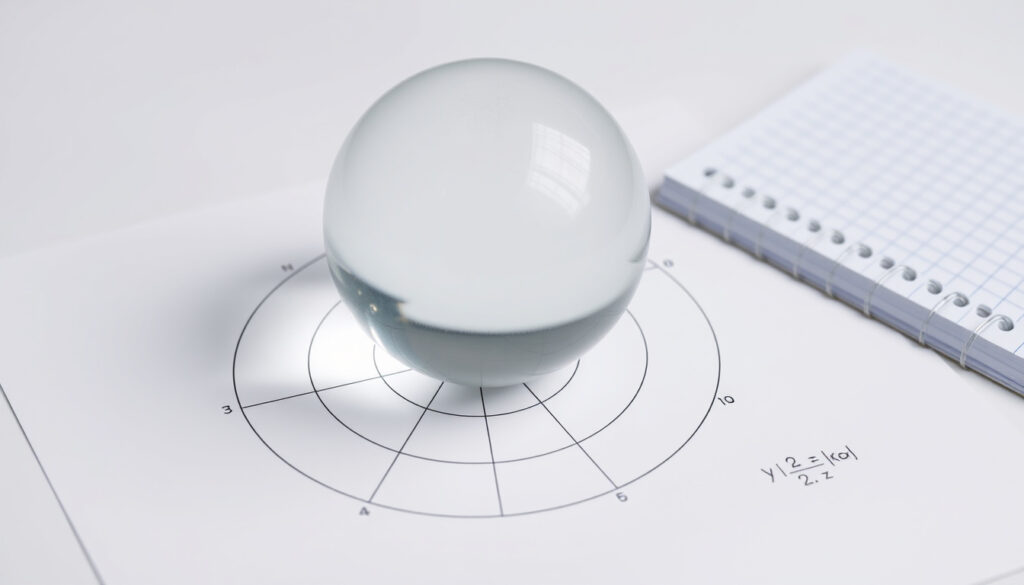
Volume of a Sphere: Formula, Proof, and GCSE Guide
Anyone who has twisted the formula V = 4/3 π r³ through a maths lesson knows the volume of a sphere by heart. But few stop to ask why the 4/3 appears—or that the ancient Greek mathematician Archimedes first cracked it over 2,200 years ago using a clever comparison with a cylinder and a cone, a proof still taught in classrooms today (Wikipedia – historical mathematics).
Formula: V = 4/3 π r³ ·
Radius: r = half the diameter ·
Derived by: Archimedes (3rd century BCE) ·
Cylinder relation: Sphere volume = 2/3 of circumscribed cylinder ·
Common units: cubic units (cm³, m³, in³)
Quick snapshot
- V = 4/3 π r³ (BBC Bitesize – GCSE revision)
- Uses radius, not diameter ((BBC Bitesize – GCSE revision))
- π ≈ 3.14159 ((BBC Bitesize – GCSE revision))
- Comes from comparing sphere to a cylinder (Jamie York Press – Archimedes proof)
- Archimedes proved it ((Jamie York Press – Archimedes proof))
- Volume is 2/3 of circumscribed cylinder ((Jamie York Press – Archimedes proof))
- Higher tier only (BBC Bitesize – GCSE revision)
- Formula may be given ((BBC Bitesize – GCSE revision))
- Practice with past paper questions ((BBC Bitesize – GCSE revision))
- Cubic units
- Convert to litres using 1 L = 1000 cm³
- Use consistent units
| Label | Value |
|---|---|
| Formula | V = 4/3 π r³ |
| Radius | r = d/2 |
| Surface area | A = 4πr² |
| Cylinder relation | V_sphere = (2/3) V_cylinder |
| First derived by | Archimedes |
What is the volume of the sphere formula?
The formula for the volume of a sphere is V = 4/3 π r³, where r is the radius of the sphere. This is the standard expression taught in GCSE maths and used in physics, engineering, and everyday calculations (BBC Bitesize – GCSE revision). The radius is half the diameter, so if you know the diameter just halve it first.
Step-by-step calculation
- Measure the radius (r) of the sphere. If you have the diameter, divide by 2.
- Cube the radius: r × r × r = r³.
- Multiply by π (pi, approximately 3.14159).
- Multiply by 4/3.
- Write the result in cubic units (e.g., cm³, m³, in³).
A worked example: for a sphere with radius 4.2 cm, the volume is 4/3 × π × (4.2)³ = 4/3 × π × 74.088 ≈ 310.4 cm³ (Revision Genie – flashcards).
Using diameter instead of radius
If you know the diameter d, use r = d/2, then apply the formula. Alternatively, you can use V = (π d³)/6, derived by substituting r = d/2 into the standard formula. This is handy when you directly measure the diameter of a ball or planet.
What are the units of volume?
Volume is always expressed in cubic units. Common units include cubic centimetres (cm³), cubic metres (m³), and cubic inches (in³). To convert to litres, remember that 1 litre = 1000 cm³. So a sphere with volume 310.4 cm³ holds 0.3104 litres.
Why is 4:3 used in the volume of a sphere?
The coefficient 4/3 is not arbitrary—it comes from the geometric relationship between a sphere and a cylinder that exactly encloses it. Archimedes showed that the sphere’s volume is exactly two-thirds of the volume of a cylinder with the same radius and height equal to the sphere’s diameter (Jamie York Press – Archimedes proof).
Why is the coefficient 4/3, not 3/4?
The 4/3 comes from the ratio cone:sphere:cylinder = 1:2:3 in the Archimedes construction. The cylinder volume is 2πr³, and the sphere is two-thirds of that: (2/3) × 2πr³ = 4/3 πr³ (Mathematical Etudes – interactive proof). If the coefficient were 3/4, the sphere would be larger than the cylinder, which is impossible since the sphere fits inside.
How Archimedes derived 4/3
Archimedes used a method of exhaustion: he imagined slicing the sphere, cylinder, and cone into thin cross-sections. By comparing the areas of these slices at every height, he proved that the sum of the sphere’s slices equals the sum of the cylinder’s slices minus the cone’s slices. This led to the ratio 1:2:3 and ultimately the 4/3 coefficient (Weber State Physics – Archimedes method).
Relationship to cylinder volume
The circumscribed cylinder has radius r and height 2r, so its volume is πr² × 2r = 2πr³. The sphere occupies exactly two-thirds of that cylinder, giving V_sphere = (2/3) × 2πr³ = 4/3 πr³. This elegant relationship is why Archimedes reportedly asked for a sphere and cylinder to be engraved on his tomb (Wikipedia – On the Sphere and Cylinder).
Do you need to know the volume of a sphere for GCSE maths?
Yes, but mainly for the Higher tier. The volume of a sphere is a standard topic in the GCSE maths curriculum, particularly for AQA, Edexcel, and OCR (BBC Bitesize – GCSE revision). Foundation tier students may encounter it, but it is more common at Higher.
Is volume of a sphere in the GCSE higher tier?
It is typically listed under the “Geometry and Measures” strand. Check your exam board’s specification—most include the formula on the formula sheet, but it’s still wise to memorise it.
What formulas are given in the exam?
Some exam boards provide the formula V = 4/3 π r³ on the formula sheet, while others expect you to recall it. Always confirm with your board’s published materials. Even if given, understanding the formula helps you avoid mistakes when substituting values.
How to calculate volume in GCSE questions
GCSE questions often combine sphere volume with surface area (A = 4πr²) or with density (mass = volume × density). For example, a question might give the volume of a sphere and ask for the radius—you’ll need to rearrange the formula: r = ³√(3V / (4π)). Practice with past papers is essential (PrepWise – worked example).
For GCSE students, the volume of a sphere is a high-yield topic. A single mark can hinge on remembering the 4/3 coefficient. The difference between 4/3 and 3/4 is the difference between a correct answer and a common error.
The pattern: Students who understand the derivation are far less likely to invert the fraction. The catch: Memorising a formula without context leads to preventable mistakes under exam pressure.
Why is the surface area of a sphere 4πr²?
The surface area formula A = 4πr² is directly related to the volume formula. In fact, the surface area is the derivative of the volume with respect to the radius: d/dr (4/3 π r³) = 4πr². This is not a coincidence—it reflects how adding a thin layer to the sphere changes its volume (BBC Bitesize – GCSE revision).
Why is the surface area 4πr²?
The surface area represents the total area of the outer shell. It can be derived by integrating the circumference of circles at different latitudes, or by Archimedes’ own method of projecting the sphere onto a cylinder. The result is exactly four times the area of a great circle (πr²).
Difference between surface area and volume
Surface area is measured in square units and tells you how much material is needed to cover the sphere. Volume is measured in cubic units and tells you how much space it occupies. They scale differently: volume grows with r³, surface area with r². Doubling the radius multiplies volume by 8 but surface area by only 4.
How to derive surface area from volume
Differentiate the volume formula: V = 4/3 π r³ → dV/dr = 4πr². This works because adding a thin shell of thickness dr increases the volume by the surface area times dr. So the surface area is the instantaneous rate of change of volume with respect to radius.
Students often confuse surface area and volume, especially when a question asks for both. The correct strategy: Remember surface area is about the outside (2D measure), volume is about the inside (3D measure).
How did Archimedes prove the volume of a sphere?
Archimedes’ proof is one of the great achievements of ancient mathematics. He used a method of exhaustion combined with a mechanical balance argument, comparing a sphere, a cone, and a cylinder of the same radius (University of Florida – Archimedes’ sphere report).
The cylinder-and-cone proof
Archimedes imagined a sphere of radius r, a cone of the same base radius and height, and a cylinder that encloses the sphere. By slicing the solids horizontally at every level, he showed that the cross-sectional area of the sphere equals the area of the cylinder minus the area of the cone. Integrating these slices gave the volume ratio 1:2:3 for cone:sphere:cylinder (Jamie York Press – Archimedes proof).
What Archimedes asked to be on his tomb
According to the Roman statesman Cicero, who discovered Archimedes’ tomb in 75 BCE, the tomb was marked by a sphere and a cylinder. This was Archimedes’ own request, indicating how proud he was of this theorem (Wikipedia – On the Sphere and Cylinder).
“Cicero later wrote that he found Archimedes’ tomb, which was adorned with the figure of a sphere and a cylinder—the very proof that Archimedes considered his greatest achievement.”
— Cicero, Tusculan Disputations (historical account)
Modern validation of the proof
Archimedes’ method is essentially an early form of integral calculus. Modern mathematicians and physicists confirm that the proof is rigorous and the result exact. The University of Florida’s physics department notes that the mechanical reasoning (balancing cross-sections) prefigures the method of integration (University of Florida – Archimedes’ sphere report).
“Archimedes’ proof of the sphere volume is a masterpiece of geometric reasoning. By comparing the sphere to a cylinder and a cone, he bypassed the need for calculus by nearly two millennia.”
— Weber State Physics, Archimedes Method
Related reading: NCEA Level 2 Maths · How Many Ounces in a kg?
gcsemathsai.co.uk, youtube.com, proofwiki.org, thatsmaths.com
For a deeper look at how the 4/3 factor emerges from integration, see this derivation of the sphere volume formula that walks through each step with worked examples.
Frequently asked questions
How do you find the radius of a sphere from its volume?
Rearrange the formula V = 4/3 π r³ to solve for r: r = ³√(3V / (4π)). For example, if V = 100 cm³, then r = ³√(300 / (4π)) ≈ 2.88 cm.
What is the volume of a hemisphere?
A hemisphere is half a sphere, so its volume is (2/3) π r³. This is exactly half of the full sphere’s volume.
How do you convert sphere volume from cubic centimetres to litres?
Divide by 1000: 1 litre = 1000 cm³. So a sphere with volume 500 cm³ holds 0.5 litres.
Why does the volume of a sphere scale with the cube of the radius?
Volume is a three-dimensional measure, so it scales with the cube of any linear dimension. Doubling the radius results in 2³ = 8 times the volume.
How do you calculate the volume of a sphere using a calculator?
Enter the radius, cube it, multiply by π, then multiply by 4/3. Many calculators have a π button. For example, for radius 3: 3³ = 27, × π ≈ 84.82, × 4/3 ≈ 113.1.
What is the volume of a sphere with a radius of 1 unit?
V = 4/3 π (1)³ = 4/3 π ≈ 4.18879 cubic units.
For anyone studying GCSE maths or simply curious about why the sphere formula looks the way it does, the takeaway is straightforward: the 4/3 coefficient is not a random number—it’s a direct consequence of Archimedes’ elegant comparison with a cylinder. The consequence: For GCSE students, learn the formula, understand the cylinder relation, and practice with past papers. Or risk losing marks on a question that’s almost always the same.
More related posts
 Timaru Herald Deaths: Find Obituaries & Notices
 2026 School Holidays NZ: Full Calendar and Term Dates
 Civil Engineer Salary NZ 2025: Average Pay & Senior Rates
 Te Kaha Stadium Capacity: Seats, Concerts & Roof Details
 TV Repair Near Me: Costs & When to Fix It (Ireland)
 How to Cook a Bolar Roast: Oven & Slow Cooker
 New Zealand Student Final Year Funding: Fees Free Guide
 How to Clean Difficult Stains from Clothes Effectively
