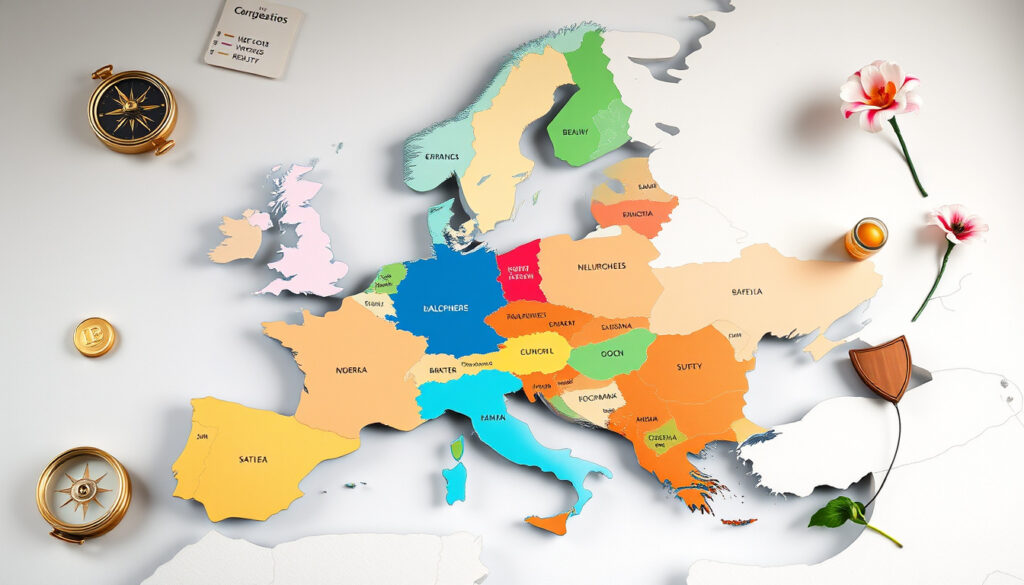
Map of European Countries: Wealth, Safety & Beauty Rankings
Trying to keep a full map of Europe in your head? You’re not alone — the continent’s borders blend geography, politics, and history, and the numbers shift depending on whether you count the European Union, the Council of Europe, or the United Nations. According to Eurostat, the EU alone has 27 member states, but the wider Europe stretches to include transcontinental giants like Russia and Turkey, plus microstates such as Monaco and Liechtenstein.
Countries in Europe: 50 (44 internationally recognized) ·
European Union members: 27 ·
Richest country (GDP per capita): Luxembourg (approx. $140,000) ·
Safest country (Global Peace Index): Iceland ·
Poorest country (GNI per capita): Ukraine (approx. $3,500) ·
Most visited city: Paris, France
Quick snapshot
- Luxembourg is richest European country by GDP per capita (Eurostat)
- Iceland is safest European country (Forbes)
- 44 UN-recognized sovereign states in Europe (Vision of Humanity)
- Exact ranking of ‘most beautiful’ is subjective and varies by survey
- Number of de facto states (e.g., Kosovo recognition varies)
- Crime rate data may be outdated due to reporting delays
- 2022-2025: Russia-Ukraine war pushes Ukraine to poorest in Europe (World Population Review)
- EU enlargement talks with Ukraine, Moldova, and Western Balkan countries
- Potential shifts in GDP rankings as Ireland’s corporate tax policies evolve
- Updated Global Peace Index for 2026 expected to show continued Nordic dominance
Seven key figures, one pattern: the continent’s wealth and safety are heavily concentrated in the northwest, while the east struggles with conflict and lower income.
| Metric | Value |
|---|---|
| Total countries | 50 |
| UN recognized | 44 |
| EU members | 27 |
| Richest (GDP/capita) | Luxembourg |
| Poorest (GNI/capita) | Ukraine |
| Safest (GPI) | Iceland |
| Most visited | France |
Are there 44 or 47 countries in Europe?
How many countries are officially recognized in Europe?
You’ll see different numbers depending on the source. The United Nations recognizes 44 sovereign states in Europe, including all EU members plus non-EU countries like Norway, Switzerland, and the United Kingdom. The Vision of Humanity (global peace index publisher) uses a geopolitical definition that includes 44 European countries in its dataset. However, if you add transcontinental nations like Russia, Turkey, and Kazakhstan — which straddle the border between Europe and Asia — the total climbs to 47. And if you include microstates such as Monaco, San Marino, and Vatican City, the count reaches 50.
What is the difference between geographic and political Europe?
Geographic Europe is defined by physical boundaries: the Atlantic Ocean to the west, the Ural Mountains to the east, the Mediterranean to the south, and the Arctic to the north. Political Europe, though, is shaped by membership in organizations like the European Union. The EU has 27 member states, as confirmed by Eurostat in its 2025 economic reports. The Council of Europe, a separate human-rights body, has 46 members. The discrepancy arises because some countries (like Russia and Belarus) are geographically European but not EU members, and some microstates are not UN members.
The implication: when someone says “map of European countries,” always ask which definition they’re using — it changes the count by up to six countries.
What is the richest country in Europe?
What is the 10 richest country in Europe?
Based on Eurostat 2025 preliminary PPP estimates, Luxembourg is the richest, with a GDP per capita 139% above the EU average. Ireland follows closely at 138% above. The top 10 also includes Switzerland, Norway, Denmark, the Netherlands, Austria, Sweden, Germany, and Belgium. StatisticsTimes projects that Ireland will add $16,775 to its nominal GDP per capita in 2025, the largest increase among EU economies. Meanwhile, TheGlobalEconomy lists Monaco as the highest in Europe at $288,001.56 per capita, though Monaco is not a UN member and is often excluded from standard rankings.
Ireland’s high GDP per capita doesn’t necessarily reflect the wealth of the average Irish citizen — it’s a known statistical distortion driven by multinational corporate tax policies.
The trade-off: Ireland’s ranking looks impressive on paper, but median household income tells a more modest story.
Luxembourg’s wealth is real but concentrated in its financial sector, while Ireland’s ranking is a statistical mirage driven by corporate tax rules. For travelers and investors, looking at GDP per capita alone masks the everyday reality of living costs and wage inequality.
What is the safest country in Europe?
Which country in Europe has the highest crime rate?
Iceland has been ranked the safest country in Europe for 15 consecutive years, according to the Forbes report on a 2025 expat safety ranking. The Vision of Humanity 2024 Global Peace Index places Iceland, Ireland, Austria, New Zealand, and Singapore as the top five most peaceful worldwide. European countries dominate the top 10: Euronews reports that eight European countries — Iceland, Ireland, Austria, Switzerland, Portugal, Denmark, Slovenia, and Finland — are in the 2025 GPI top 10. As for the highest crime rate, data is less clear. Euronews notes that Luxembourg has the lowest homicide rate in Europe (0.32 per 100,000), while Belgium and France often report higher rates of theft and assault, though reporting delays can skew comparisons.
The pattern: safety in Europe is a Nordic and Central European story, with the Mediterranean and Balkan regions showing higher crime rates, especially in urban areas.
Which part of Europe is most beautiful?
What are the top 3 most beautiful countries?
Beauty is subjective, but survey after survey points to the same trio: Switzerland, Italy, and Norway. Switzerland’s alpine landscapes, Italy’s Renaissance cities and coastline, and Norway’s fjords and northern lights consistently top travel polls. Forbes has ranked Iceland as the safest, but beauty is a different metric — and the Swiss Alps, the Amalfi Coast, and the Norwegian fjords rarely argue.
What is the best country to visit in Europe?
It depends on what you’re after. For history and culture, Italy and Greece are unbeatable. For nature, Norway and Switzerland. For a mix of city life and scenery, France and Spain. Euronews notes that the safest countries also tend to be among the most visited, but that doesn’t mean less safe countries lack beauty. TheGlobalEconomy data shows that even the poorest countries, like Ukraine, have stunning landscapes — though travel advisories currently caution against visiting due to war.
The catch: “most beautiful” is a popularity contest, and the winners are often the ones with the most marketing dollars. Eastern Europe offers incredible beauty at a fraction of the crowds.
What is the poorest country in Europe?
Ukraine is the poorest country in Europe by GNI per capita at approximately $5,759, according to World Population Review in its 2026 ranking. Moldova ($8,161) and Bosnia and Herzegovina ($8,668) also fall below $10,000. TheGlobalEconomy lists Ukraine at $5,391.62, confirming the bottom spot. The contrast with Luxembourg, at over $140,000 per capita, is stark. The war with Russia has devastated Ukraine’s economy, and the country’s poverty is a direct consequence of the conflict that began in 2022.
What this means: the wealth gap in Europe is not just a statistic — it’s a lived reality that affects travel safety, infrastructure, and quality of life. For the poorest countries, economic recovery depends on peace and EU integration.
Where to live in Europe if you only speak English?
If you’re an English-only speaker, your options are better than you might think. Ireland and Malta have English as an official language. In Ireland, you’ll find a thriving tech scene and a high standard of living, though housing costs are steep. Malta offers a Mediterranean climate and a lower cost of living, with English widely spoken. The Nordic countries — the Netherlands, Sweden, Denmark, Finland — have consistently high English proficiency. Forbes notes that three of the top four safest countries for expats are English-friendly (Ireland, Austria, Iceland). Major cities like Amsterdam, Berlin, Copenhagen, and Stockholm have large expat communities where English is the lingua franca. Portugal and Spain are also popular among English-speaking retirees, though you’ll need to learn some local language for deeper integration.
The trade-off: Ireland and Malta are the easiest for English-only speakers, but they come with higher costs. Nordic countries are nearly as easy language-wise, but winters are long and dark. For a balance, consider the Netherlands — high English proficiency, central location, and a strong economy.
“Luxembourg and Ireland recorded the highest GDP per capita in the EU, at 139% and 138% above the EU average, respectively.”
— Eurostat
“Iceland, Ireland, Austria, New Zealand, and Singapore were the top five most peaceful countries in the world in its 2024 Global Peace Index.”
“Four of the world’s top five safest countries in the 2025 Global Peace Index were European: Iceland, Ireland, Austria, and Switzerland.”
— Euronews
For anyone planning to move, invest, or simply travel through Europe, the map is more than a collection of borders. The wealth concentrates in the northwest, safety in the north, and beauty in the center and south. The richest country in the world (Luxembourg) is a tiny speck on the map, while the largest country in the world (Russia) spans two continents. The choice for the English-speaking traveler or expat is clear: pick a country that matches your priorities — safety, wealth, beauty, or language ease — and use the data to decide, not just the brochure.
worldpopulationreview.com, statisticstimes.com, en.wikipedia.org, ec.europa.eu, numbeo.com, bbc.com, expatriatehealthcare.com
Frequently asked questions
What is the largest country in Europe by area?
Russia is by far the largest, covering about 40% of Europe’s land area. However, only the western part of Russia is considered geographically European. If you exclude Russia, the next largest is Ukraine, followed by France and Spain.
What is the smallest country in Europe?
Vatican City is the smallest, at just 0.44 square kilometers. Monaco, San Marino, and Liechtenstein are also microstates. All four are among the richest per capita but are often excluded from European country counts.
How many countries in Europe use the euro?
20 European Union member states use the euro as their official currency, known as the Eurozone. Non-EU countries like Montenegro and Kosovo also use the euro unilaterally.
Which European country has the highest population?
Russia has the highest population in Europe, with about 144 million people. If you consider only EU countries, Germany leads with around 84 million.
What is the most visited country in Europe?
France consistently tops the list, with over 100 million tourist arrivals per year. Spain, Italy, and the United Kingdom also rank high. The most visited city is Paris, followed by London and Rome.
Is the UK still part of Europe after Brexit?
Geographically, yes — the United Kingdom remains a European country. Politically, it left the European Union in 2020 and is no longer an EU member state. It is still a member of the Council of Europe and other European organizations.
What is the best time to visit Europe?
Late spring (May-June) and early autumn (September-October) offer mild weather, fewer crowds, and lower prices. Summer (July-August) is peak season for beaches and festivals, but popular destinations can be overcrowded. Winter is ideal for skiing in the Alps and Christmas markets in Central Europe.
More related posts
 To Be or Not to Be: Meaning, Context & Psychological Analysis
 New Zealand Student Final Year Funding: Fees Free Guide
 Best Knock Knock Jokes: 100+ Funny Jokes for All Ages
 Where to Find Free Music: Best Sites & Apps
 NZ vs France Rugby: History, Results, and How to Watch (2026)
 Harper Vivienne Ann Lockwood: Biography, Custody & Facts
 Flights to Auckland from Christchurch: Direct & Cheap Options
