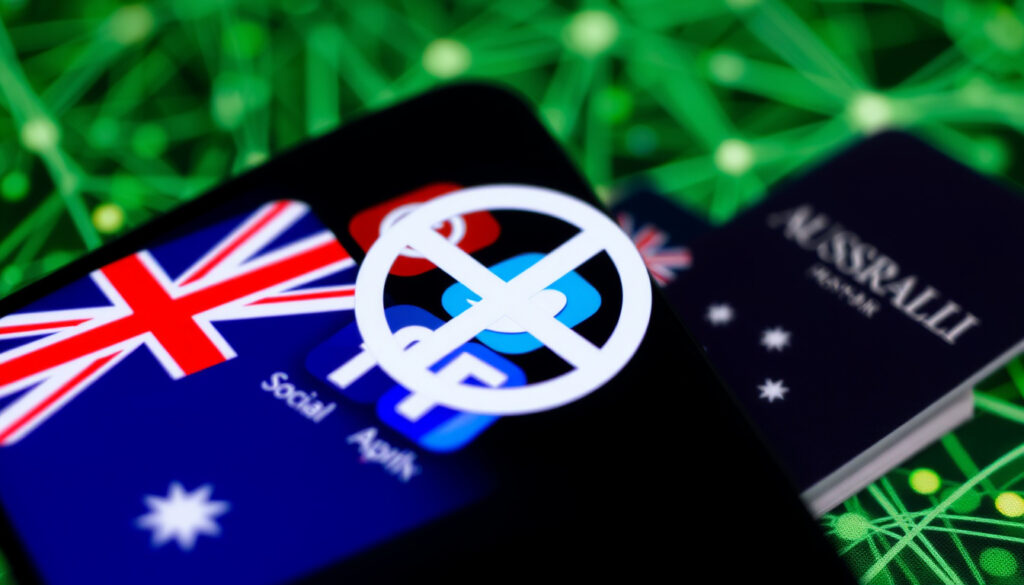
Australia Social Media Ban: What’s Banned and How It Works
When Australia passed the world’s first social media ban for under-16s in late 2024, it felt like a bold experiment to curb youth mental health risks. Now, six months after the law took effect on December 10, 2025, the reality on the ground is revealing enforcement gaps, platform workarounds, and a mix of relief and frustration among families.
Effective date: 10 December 2025 · Age cutoff: under 16 · Platforms covered in initial draft: TikTok, Instagram, YouTube, Snapchat · Exempt platforms: WhatsApp, Messenger Kids, YouTube (educational contexts) · Enforcement body: eSafety Commissioner
Quick snapshot
- The ban prohibits under-16 accounts on named social media platforms (Australian Department of Infrastructure fact sheet)
- Effective from December 10, 2025 (Reuters report)
- Enforced by the eSafety Commissioner (BBC News)
- How effective age-verification methods will be at scale
- Whether additional platforms will be added after review
- Long-term impact on teenage mental health and social connection
- November 2024: legislation passed by Australian Parliament
- 10 December 2025: ban takes effect for under-16 accounts
- June 2026: six-month review reveals enforcement challenges
The table below captures the core legal and enforcement parameters.
| Legislation name | Online Safety Amendment (Social Media Minimum Age) Act 2024 |
| Age restriction | Under 16 |
| Effective date | 10 December 2025 |
| Enforcement body | eSafety Commissioner |
| Penalties for platforms | Up to AUD 50 million for non-compliance (current); proposed increase to AUD 99 million |
Is there going to be a social media ban in Australia?
What does the law say?
- The Online Safety Amendment (Social Media Minimum Age) Act 2024 requires age-restricted platforms to take reasonable steps to prevent Australian users under 16 from having accounts, according to the Australian Department of Infrastructure fact sheet.
- It is a world-first national law, as reported by Reuters.
When does it start?
- The obligation began 12 months after Royal Assent — on 10 December 2025, as confirmed by the Australian Department of Infrastructure fact sheet.
- Nearly six months later, in June 2026, the BBC reported that children under 16 had been prevented from 10 major platforms.
The implication: The ban is real and actively enforced from day one, but the six-month review shows it’s far from a silver bullet.
Platforms face a dilemma: enforce strict age checks and risk losing young users’ engagement, or under-enforce and face penalties now proposed at A$99 million.
What social medias were banned in Australia?
Platforms covered
- Ten platforms were initially required to block under-16 access, as reported by Reuters. The government’s fact sheet names TikTok, Instagram, YouTube, and Snapchat as key targets.
- The BBC confirmed that these platforms are among those subject to the restriction.
Exempt platforms
- Messaging services like WhatsApp and Messenger Kids are exempt, as confirmed by the Australian Department of Infrastructure fact sheet.
- Educational platforms and YouTube when used for school purposes are also carved out.
Why Snapchat is a ‘weak link’
- Meta (Facebook) has publicly flagged Snapchat as a weak link in enforcement, arguing that Snapchat lacks robust age-verification. This was highlighted in a CBC News report on the 2026 enforcement bill.
- A study cited by Reuters found that platforms sought no age proof for any of 50 test accounts, underlining the enforcement gap.
The pattern: The ban’s success hinges on the weakest link — and that gap appears to be age verification itself.
Why is Australia banning social media for under 16?
Mental health concerns
- The Australian government cites harm to young people’s mental health as the primary motivation, according to the Department of Infrastructure fact sheet.
- The BBC notes that the world-first law was designed to protect children from risks like online bullying, exposure to harmful content, and addiction.
Pressure on tech companies
- The government has introduced new legislation in 2026 to strengthen enforcement, including doubling maximum penalties and empowering the eSafety Commissioner to compel internal documents, as reported by CBC News.
Why this matters: The ban is not just a symbolic move; the escalating penalties signal a genuine push to force tech companies to comply, but the six-month review suggests the pressure hasn’t yet translated into airtight enforcement.
How does Australia’s under-16 social media ban work?
Age verification methods
- The government recommends multiple checks to determine users’ ages, but does not prescribe a single method, as reported by Reuters.
- Despite these recommendations, a study found that platforms requested no age proof for any of 50 test accounts — meaning self-declaration remains the default.
Platform obligations
- Platforms must take “reasonable steps” to prevent under-16 accounts, as stated in the Australian Department of Infrastructure fact sheet. What constitutes “reasonable” is still being tested.
Penalties for non-compliance
- A breach can currently trigger a maximum penalty of 30,000 penalty units (about A$9.9 million), per the Department of Infrastructure fact sheet.
- The government has introduced legislation to double this to A$99 million, as reported by CBC News.
The catch: Without robust age checks, penalties alone can’t close the enforcement gap — and the six-month review shows that gap is wide.
The eSafety Commissioner’s new document-compelling powers, if passed, could force platforms to show internal compliance data — turning vague promises into accountable action.
Is YouTube getting banned in Australia for under 16?
YouTube educational use exemption
- YouTube is covered by the ban, but with carve-outs for educational content. The Australian Department of Infrastructure fact sheet notes that services used primarily for educational purposes may be exempt.
- This creates confusion: is YouTube Kids allowed? The exemption language suggests that YouTube itself can be accessed under supervised school use.
Confusion around the ban
- Many parents and educators are unsure whether classroom use of YouTube is prohibited. The government has yet to issue clear guidelines on the educational carve-out, leading to inconsistent implementation across schools.
The implication: YouTube’s ambiguous status means the ban’s biggest test may be in schools, not bedrooms.
Is the Australia social media ban working?
Young people’s feedback
- An ABC report in June 2026 quoted Australian teenagers saying the ban “is not working” — many found ways around age checks or continued using platforms through friends’ devices.
- The BBC noted that children under 16 had been prevented from 10 platforms, but enforcement data on bypass rates remains scarce.
Enforcement challenges
- The study reported by Reuters found that 50 test accounts were created with no age proof requested, showing that platforms are not yet meeting the “reasonable steps” standard.
Six-month review
- The review, covered by The Guardian (Australian edition), highlighted mixed family impact: some parents saw reduced screen time, but others reported increased tension as kids circumvented the ban.
The trade-off: The ban has symbolic value as a world-first, but its practical effect so far is minimal for teens determined to stay connected.
What social media is not getting banned in Australia?
Exempt platforms explained
- WhatsApp and Messenger Kids are exempt because they are classified as messaging tools rather than public social networks, per the Department of Infrastructure fact sheet.
- Educational services like Google Classroom and some learning apps are also exempt.
Why certain apps are excluded
- The government’s rationale: private messaging does not carry the same public exposure risks as algorithmic feeds. However, critics argue that bullying and harmful content can still occur in private chats.
- Gaming platforms like Roblox and Fortnite are not explicitly banned, but the government is considering including them in future reviews.
The pattern: The exemption list reveals a narrow definition of “social media” — excluding the very apps where many teens already spend their time.
Timeline: How the ban unfolded
- November 2024: Legislation passed by Australian Parliament.
- 10 December 2025: Ban takes effect for under-16 accounts on covered platforms.
- June 2026: Six-month review; young people report the ban is not working effectively.
- July 2026: Government introduces bill to raise penalties to A$99 million and grant eSafety Commissioner new powers.
Why this matters: The timeline shows a fast-moving policy cycle — from law to review to escalation in under two years — but enforcement remains the weakest link.
Confirmed facts vs. what’s unclear
Confirmed facts
- The ban is law from December 2025 (Australian Department of Infrastructure fact sheet)
- Applies to under-16 accounts (Reuters)
- Enforced by eSafety Commissioner (BBC News)
- Maximum penalties currently A$9.9 million, proposed increase to A$99 million (CBC News)
- Platforms sought no age proof for 50 test accounts in a study (Reuters)
What’s unclear
- How effective age verification will be once platforms implement robust checks
- Whether other platforms (e.g., Roblox, Fortnite) will be added
- Long-term impact on teenage mental health and social well-being
- What constitutes “reasonable steps” in practice for platform compliance
Voices from the ground
“We expect platforms to take their obligations seriously. The eSafety Commissioner will be monitoring compliance and will not hesitate to take action where necessary.”
— eSafety Commissioner (statement to BBC News)
“It’s not working. We all just share passwords or use our parents’ phones. It’s pretty easy to get around.”
— Australian teen interviewed by ABC News
The ban has created a weird dynamic — some parents love the reduced screen time, but others are now fighting with their kids about secret accounts. It’s family tension we didn’t see before.
— Journalist at The Guardian (Australian edition)
Australia’s social media ban for under-16s is a landmark experiment, but six months in, the gap between legal prohibition and practical enforcement is stark. For Australian families, the choice is clear: adapt to increasingly creative workarounds, or push for stronger verification tools that can actually block the determined teen.
en.wikipedia.org, facebook.com, fiscalnote.com, cnbc.com, accan.org.au, reuters.com, youtube.com, chisholm.wa.edu.au
For a detailed enforcement timeline of the ban, see detailed enforcement timeline.
Frequently asked questions
Is there going to be a social media ban in Australia?
Yes, it is already in effect. The ban passed parliament in November 2024 and took full effect on 10 December 2025.
What social medias were banned in Australia?
The initial list includes TikTok, Instagram, YouTube, Snapchat, and six other unnamed platforms. The government has not released the full list, but Reuters reported ten platforms are covered.
Why is Australia banning social media for under 16?
The government cites harm to young people’s mental health as the primary reason, including risks of bullying, harmful content, and addiction.
How does Australia’s under-16 social media ban work?
Platforms must take reasonable steps to prevent under-16 accounts. Age verification methods are recommended but not prescribed. Enforcement is by the eSafety Commissioner.
Is YouTube getting banned in Australia for under 16?
YouTube is covered but with an exemption for educational content, creating confusion about classroom use and YouTube Kids.
Is the Australia social media ban working?
Early reports suggest it is not fully effective. A study found that platforms requested no age proof for test accounts, and teenagers report easy workarounds.
What social media is not getting banned in Australia?
WhatsApp, Messenger Kids, and educational services like Google Classroom are exempt. Gaming platforms like Roblox and Fortnite are not currently banned but are under review.
Related reading
- We Become What We Behold: Meaning, Endings, and Message – a game that explores social media dynamics and virality
- Rainbow Six Siege X: Free Access & Rebranding Explained – covers digital platform access rules
More related posts
 How Are You in Japanese – Formal and Casual Phrases
 Canterbury Red Wind Warning – No Active Alerts in Kent
 Do Not Disturb on iPhone: What It Does & How to Turn Off
 Take Home Pay NZ: Calculate Your Net Salary After Tax
 Game of Thrones Books: How Many Are There & Reading Order
 Big White vs Whistler: Which BC Ski Resort Wins
 Part Time Jobs New Plymouth: Student, Weekend & No Experience
 Right Eye Twitching Female: Medical, Superstition & Spiritual
