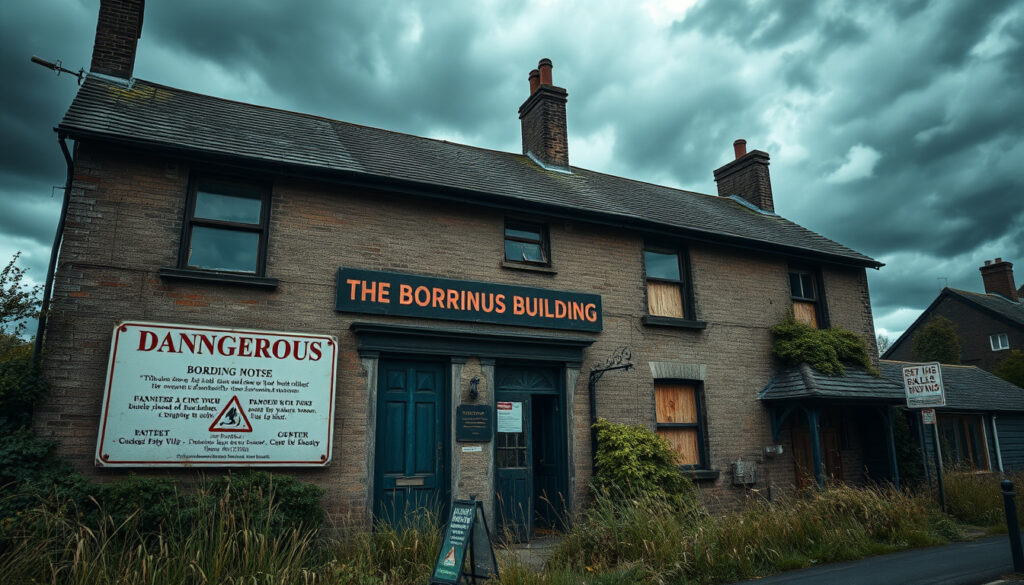
Carterton Pub Boarding House Fire Risk: Dangerous Building Notice
A small-town New Zealand couple converted a storage building at 140 Belvedere Road, Carterton into a boarding house, hoping to give it a new chapter. Instead, they’ve ended up at the center of a high-stakes regulatory dispute over fire safety. Now an official determination from the Ministry of Business, Innovation & Employment has confirmed what authorities have been saying since October 2024: the building poses a real risk to anyone inside.
Location: 140 Belvedere Road, Carterton ·
Notice Issued: 10 October 2024 ·
Determination: 2025/046 ·
Authority: MBIE (Building Performance)
Quick snapshot
- Belvedere House Ltd owns the building at 140 Belvedere Road, Carterton (MBIE Determination 2025/046)
- Carterton District Council issued dangerous building notice under s124(2)(c)(i) on 10 Oct 2024 (MBIE)
- FENZ assessment: fire would likely result in loss of life or serious injury (MBIE Determination)
- Exact start date of conversion from storage to residential use
- Current occupancy status and whether tenants remain in the building
- Whether the dangerous building notice has since been lifted or modified
- Joint inspection: 9 Oct 2024 (Building Performance Register)
- Notice issued: 10 Oct 2024 (Building Performance Register)
- Determination issued: 16 Sept 2025 (Building Performance Register)
- Building must undergo remedial work to satisfy s124 requirements
- Owners may need building consent for change-of-use from storage to residential
- Further FENZ inspections likely before any occupancy can resume
The key facts table summarises the core details of the case as recorded in the official determination and council records.
| Label | Value |
|---|---|
| Primary Location | 140 Belvedere Road, Carterton |
| Building Type | Former storage building, converted to boarding house |
| Main Issue | Fire risk to occupants |
| Key Document | Determination 2025/046 (ref: 3805) |
| Date Published | 16 September 2025 |
| Owner | Belvedere House Ltd (P and S Davy, directors) |
| Consent Use | Storage (annotated: “Controlled light storage only”) |
| Authority Role | Carterton District Council (territorial and building consent authority) |
What is the fire risk at the Carterton boarding house?
Fire and Emergency New Zealand (FENZ) conducted a joint inspection with Carterton District Council on 9 October 2024 and delivered a stark assessment. According to the FENZ opinion letter dated that same day, the building at 140 Belvedere Road is “likely to result in the loss of life or serious injury, either to people in the building or people on other property, should a fire occur.”
The building in its current state is likely to result in the loss of life or serious injury, either to people in the building or people on other property, should a fire occur.
Fire and Emergency New Zealand (FENZ) opinion letter, 9 October 2024
Background on the conversion
The building was originally consented for storage use, with the first floor annotated as “Controlled light storage only” and required to maintain “One complete fire cell.” A code compliance certificate was issued for those original works. The dispute centers on whether the current residential use as a boarding house constitutes an unconsented change of use from the consented storage purpose. Directors P and S Davy of Belvedere House Ltd reside in the building while operating it as a boarding house.
FENZ assessment details
The FENZ assessment identified multiple fire safety deficiencies that distinguish this case from ordinary residential risk:
- Lack of suitable fire warning system
- No fire separations within the structure
- Removal of external escape ladders
- Only one exit path from the upper floor
- Insecure handrails on escape routes
- No emergency lighting installed
- Combustible materials stored on ground floor
- Non-fire-rated openings in walls and floors
FENZ confirmed its original opinion after reviewing site photographs, maintaining that the building is likely to cause loss of life or serious injury in the event of fire.
Why was the historic building declared a dangerous building?
Carterton District Council, acting in its capacity as both territorial authority and building consent authority, issued the dangerous building notice on 10 October 2024 under section 124(2)(c)(i) of the Building Act 2004. This section empowers councils to require work that will “reduce or remove danger” when a building poses imminent risk.
Building authority decision
The council’s position, as recorded in the determination, states that “the building has insufficient life safety features to protect residents, and in the event of fire, injury or death to any persons in the building or to persons on other property is likely.” This directly mirrors the language in section 121(1)(b) of the Building Act 2004, which defines a dangerous building as one where injury or death to persons in the building or on other property is likely in the event of fire.
The building has insufficient life safety features to protect residents, and in the event of fire, injury or death to any persons in the building or to persons on other property is likely.
Carterton District Council, as recorded in Determination 2025/046
Section 124 notice details
The notice requires Belvedere House Ltd to undertake work to address the identified dangers. Under section 124(2)(c)(i), the authority can issue a notice requiring the owner to “reduce or remove the danger.” The building is described as “one large firecell with no obvious fire separations,” meaning a fire could spread unchecked throughout the structure.
The determination, issued under MBIE reference 3805 on 16 September 2025, considers whether the building was dangerous at the time the notice was issued and whether the council properly considered the change of use implications. The MBIE Chief Executive has authority to make such determinations under section 185(1)(a) of the Building Act 2004.
Section 121(1)(b) requires particular features creating “likely” risk beyond general fire risk. The determination references prior case Determination 2015/014, which established how this test applies to residential buildings.
What does Determination 2025/046 cover?
The determination addresses two core questions: whether the building was dangerous under section 121(1)(b) at the time the notice was issued, and whether the authority properly considered the change of use from storage to residential boarding house.
Risk group SH for boarding houses
The building falls under risk group SH (boarding houses), which applies to residential buildings with fewer than six occupants in certain configurations. This classification carries specific Building Code requirements for fire safety that differ from storage use. The key compliance areas examined include fire outbreak and spread, escape means, warning systems, use classification, and occupancy characteristics.
Layout considerations
The building’s layout contributed to the risk assessment. With only one exit path from the upper floor, residents on upper levels face a potential bottleneck if a fire blocks the primary escape route. The removal of external escape ladders—which would have provided secondary egress—was noted as a specific deficiency that worsened the overall risk profile.
A building can be legally compliant for one use (storage) and dangerously inadequate for another (residential) without any physical modifications. The conversion itself, without building consent, triggered the dangerous building analysis.
Where does the case stand now?
The determination was published on the MBIE Building Performance website on 16 September 2025, marking a significant milestone in the dispute between Belvedere House Ltd and Carterton District Council. The MBIE CodeHub entry confirms the determination relates to the authority’s decision on the dangerous building notice at 140 Belvedere Road.
Property history
Carterton has seen previous fire-related incidents. A hotel fire blamed on an electrical fault destroyed one owner’s dream of running a hospitality business in the town. While unrelated to the current determination, this context underscores the heightened sensitivity to fire safety in the community.
The Carterton District Council issued building updates in December 2024 that introduced stricter requirements for new consents, including compliance with updated acceptable solutions for interconnected fire alarms. These policy changes reflect the council’s response to broader building safety concerns in the district.
The 2025/046 determination sets precedent for how New Zealand authorities assess fire risk in converted buildings. For other property owners considering repurposing storage or commercial structures for residential use, the case signals that proper change-of-use consent is non-negotiable.
Timeline of events
A sequence of official actions spans over a year, from initial inspection to final determination.
| Date | Event |
|---|---|
| Prior to 2024 | Building consent issued for storage use; code compliance certificate issued |
| 9 Oct 2024 | Joint inspection by Carterton District Council and FENZ |
| 9 Oct 2024 | FENZ issues fire risk opinion letter |
| 10 Oct 2024 | Carterton District Council issues dangerous building notice under s124 |
| 16 Sept 2025 | MBIE issues Determination 2025/046 (reference 3805) |
The implication: the nearly year-long gap between the dangerous building notice and the final determination reflects the formal resolution process available to property owners who dispute council decisions.
What’s confirmed and what’s still unclear
The determination provides clear answers on some points while leaving others unresolved.
Confirmed facts
- Dangerous building notice issued under s124(2)(c)(i) on 10 Oct 2024
- FENZ assessment confirmed loss-of-life risk in fire event
- Building was consented for storage, not residential use
- Multiple fire safety deficiencies identified
- Risk group SH applies to the boarding house use
- No fire separations within the structure
- Only one exit path from upper floor
Unclear points
- When exactly the conversion from storage to residential began
- Whether tenants are currently occupying the building
- Whether the notice has been satisfied or remains in effect
- What specific remedial works were required
- Outcome of any remediation efforts
- Whether building consent for change of use has been sought
What the law says
The Building Act 2004 provides the framework for this dispute. Section 121(1)(b) defines a dangerous building as one where “in the event of fire, injury or death to any persons in the building or to persons on other property is likely.” Section 121(2)(a) allows territorial authorities to seek FENZ advice on dangerous status—authority that was exercised here through the joint inspection process.
A building is dangerous for the purposes of this Act if… in the event of fire, injury or death to any persons in the building or to persons on other property is likely.
Section 121(1)(b), Building Act 2004
The pattern: New Zealand building law draws a clear line between “fire risk that exists everywhere” and “fire risk that makes a specific building dangerous.” The determination confirms this distinction, with FENZ’s opinion serving as the technical basis for the council’s action.
Related reading: Free Healthy Homes Assessment · Tsunami Warning Today NZ
Historic pubs like Carterton’s face ongoing fire dangers, much like Wexford pub fire survival at The Sky and the Ground after its blaze and rebuild.
Frequently asked questions
Is the Carterton boarding house still operating?
The determination does not specify the current occupancy status. The dangerous building notice under section 124(2)(c)(i) legally requires work to reduce or remove danger, which would typically prevent lawful occupancy until remedied.
What fire safety rules apply to New Zealand boarding houses?
Boarding houses fall under risk group SH of the Building Code, which has specific requirements for fire warning systems, escape routes, fire separations, and emergency lighting. Buildings must meet these standards before they can be lawfully used for residential accommodation.
How can owners appeal a dangerous building notice?
Owners can apply to MBIE for a determination under section 185(1)(a) of the Building Act 2004. The MBIE Chief Executive can review whether the authority’s decision was correct. This is the path Belvedere House Ltd pursued, resulting in Determination 2025/046.
What caused the previous Carterton hotel fire?
Previous fire incidents in Carterton were reportedly caused by electrical faults. While unrelated to Determination 2025/046, such incidents contribute to heightened attention on fire safety in the district’s hospitality and accommodation sector.
What is risk group SH in building determinations?
Risk group SH (Sleeping – Household) applies to residential buildings with small numbers of occupants, including boarding houses with fewer than six people. It triggers specific Building Code compliance requirements for fire safety that differ from storage or commercial uses.
Who regulates boarding houses in New Zealand?
Territorial authorities (district councils) are the primary regulators, issuing building consents and dangerous building notices. FENZ provides technical fire safety advice on request. MBIE issues determinations and maintains the Building Code framework.
For Carterton property owners considering conversions, the message from Determination 2025/046 is unambiguous: seek proper building consent before changing a building’s use, or face potential dangerous building notices that can override any investment in the property.
More related posts
 Import Cars from Japan to Ireland: Costs, Rules & Is It Worth It
 Mother’s Day UK 2025: Date, History, and Why It’s Different
 Dubai Currency to NZD: Exchange Rate, Conversion & Tips
 Timaru Herald Deaths: Find Obituaries & Notices
 Michael Kors Bags NZ: Deals, Outlets & Prices
 Octopus Riding a Mako Shark: Rare Footage Explained
 Cast of The Fantastic Four: First Steps – Full Character Guide
 New Balance Sale Shoes Ireland: Best Deals 2025
