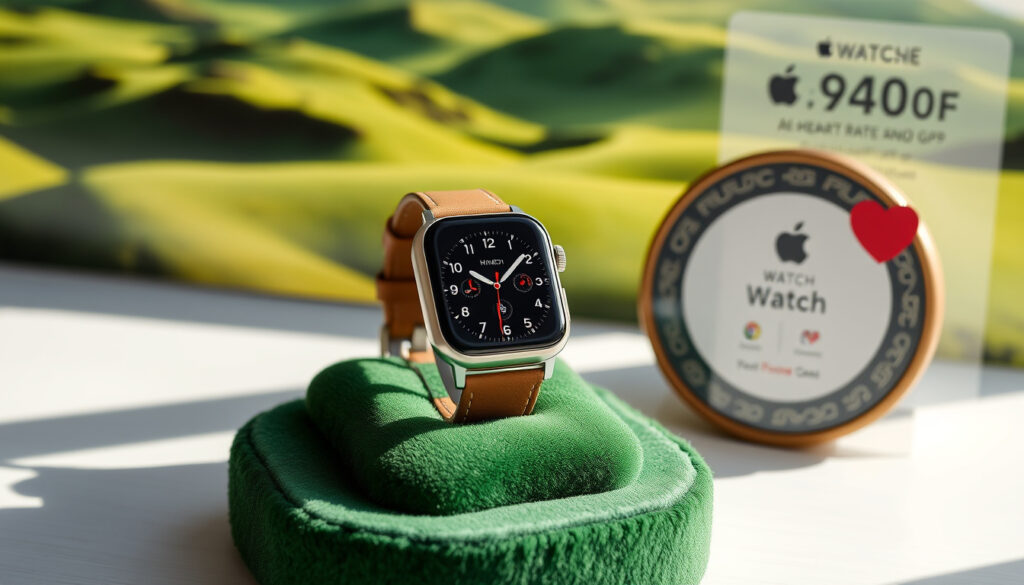
Apple Watch SE 40mm: Price, Specs & Ireland Buy Guide
If you’re eyeing an Apple Watch SE 40mm in Ireland, you probably have questions — not just about specs and prices, but whether it’s actually the right call over a newer Series model. The third-generation SE lands at €269 for the GPS version, and it’s packed with features that might surprise you for the price. Let’s break down everything you need to know before you buy.
Case Size: 40mm · Starting Price (GPS): €269 · Key Features: GPS, Crash Detection, Heart Rate Monitoring · Available in Ireland: Yes, via Apple, Currys, Harvey Norman · Refurbished Option: Available at refurbed.ie
Quick snapshot
- GPS model starts at €269 on Apple Ireland (Apple Ireland Store)
- S10 chip powers wrist flick and double tap gestures (Apple Newsroom)
- Crash Detection and Fall Detection included (Apple Ireland Store)
- Exact cellular model price for 40mm in Ireland not publicly listed
- Current 2026 promotional discounts from retailers
- Long-term battery performance reviews post-release
- SE 3 released September 19, 2025 (Apple Newsroom)
- SE 2nd gen discontinued September 9, 2025 (Apple Wiki)
- watchOS 26 required, launched September 15, 2025 (Apple Newsroom)
- SE 3 remains in production as of 2026 (endoflife.date)
- Software support expected through at least 2027–2028 (endoflife.date)
- Potential price drops as Series 12 approaches (endoflife.date)
| Specification | Detail |
|---|---|
| Case Size | 40mm Aluminium |
| Display | Retina LTPO OLED |
| Battery | Up to 18 hours |
| Water Resistance | 50m |
| Ireland Price (GPS) | From €269 |
Is it worth buying the Apple Watch SE now?
The Apple Watch SE 3 delivers the core Apple Watch experience at a price that won’t require a second mortgage. The GPS model starts at €269 in Ireland, and for that money you’re getting Crash Detection, high and low heart rate notifications, irregular rhythm alerts, and Sleep Tracking — features that used to be exclusive to more expensive models.
The catch? Series 11 starts at €449. That €180 difference gets you a brighter display (2,000 nits versus the SE’s 1,000 nits), ECG capability, hypertension notifications, and faster 30-minute charging versus 45 minutes for the SE. For most people wearing an Apple Watch day to day, those extras matter less than the €180 savings, which is why reviewers describe the SE 3 as “probably the best smartwatch for most people.”
Irish buyers can grab the SE 3 from Apple Ireland, Harvey Norman, or Currys. Refurbished options through Back Market offer SE 2 models for around €180 if you want to save even more, though the older S8 chip means missing out on the newer gestures and health features.
Pricing in Ireland
The 40mm GPS model at €269 is the entry point. Apple’s official store lists the Starlight and Midnight aluminium finishes for this size. Cellular variants cost more and require an eSIM setup through your Irish carrier — check with Three, Vodafone, or Eir for current eSIM plans.
Irish buyers face higher prices than US customers due to VAT. The €269 Ireland price versus $249 US translates to roughly €20–25 in tax differences — still reasonable compared to the UK or mainland Europe.
Key features vs cost
The S10 chip inside the SE 3 enables the wrist flick gesture for answering calls and the double tap for controlling music or timers. These features previously required a newer processor, so the SE 3 doesn’t feel outdated even a generation later. On-device Siri processing works here too, meaning your health queries get answered faster without pinging Apple’s servers.
Trade-in value
If you’re upgrading from an SE 2 or older model, Apple’s trade-in program in Ireland offers credit toward a new purchase. Trade-in values for a working SE 2nd gen in good condition typically range from €80–120, which helps offset the €269 price tag.
Apple’s trade-in values change frequently. If you’re timing a purchase around a new iPhone upgrade, check Apple’s site closer to your buying date for current offers.
How old is the Apple Watch SE 40mm?
The SE line started in 2020 with the original model, then the 2nd generation arrived September 16, 2022, and was discontinued September 9, 2025. The current SE 3 launched September 19, 2025 — just ten days after its predecessor vanished from stores. So while “SE” sounds like an older product line, the SE 3 is practically brand new.
The 40mm case size has been consistent across all three generations, though the 44mm option appeared with the 2nd gen and carries forward. If you’re buying used or refurbished, make sure you’re getting the screen size you want — Apple only offers 40mm now for the SE 3.
Release history
Here’s the quick rundown: SE 1st gen (2020) → SE 2nd gen (September 2022) → SE 3 (September 2025). The 2025 release date means the SE 3 is the current entry-level Apple Watch, sitting alongside Series 11 and Ultra 3 in Apple’s lineup.
End-of-life status
The SE 3 is actively in production as of 2026, according to endoflife.date tracking. Apple typically supports each Apple Watch with watchOS updates for 4–5 years, so expect software updates through at least 2028 or 2029.
Support timeline
The SE 3 runs watchOS 26 and requires iOS 26 on a paired iPhone 11 or later. This means it will stay current with Apple’s health and fitness features for several years. Apple doesn’t officially announce end-of-support dates, but historical patterns suggest the SE 3 will receive updates until roughly 2029.
What are the disadvantages of the Apple Watch SE?
No smartwatch is perfect, and the SE makes some deliberate trade-offs to hit its price point. The missing always-on display is the most noticeable daily — your watch face dims when your wrist drops, which can be frustrating if you’re used to glancing at the time without moving. Series 11 owners get 2,000 nits brightness in always-on mode; the SE maxes out at 1,000 nits with the display fully awake.
The processor is one generation behind Series 11, which matters more than it sounds. App loading times run slightly slower, and future watchOS features that require more processing power may arrive later on the SE than on newer hardware. Battery life remains at 18 hours across all Apple Watch models, which is fine for a day but frustrating if you forget to charge overnight.
Compared to Series models
Series 11 adds ECG functionality, blood oxygen sensing (on cellular models), and temperature sensing for cycle tracking. The SE skips all of these. If you want the full suite of Apple’s health monitoring features, Series 11 at €449 is the minimum entry point.
Missing features
Beyond the display and health sensors, the SE lacks the precision depth gauge and water temperature sensors that come with Ultra 3. It won’t show underwater metrics during your swim laps the way an Ultra can. For casual pool sessions, the SE’s 50m water resistance is sufficient — but serious swimmers notice the difference.
Battery life
Eighteen hours is Apple’s standard claim, with Low Power Mode stretching that to 32 hours. In real-world use, heavier always-on display users see closer to 14–16 hours. The SE charges from 0–80% in about 45 minutes with its included magnetic cable — slower than Series 11’s 30-minute fast charge.
If you’re coming from a Series 5 or later, the SE’s slower processor and dimmer display will feel like a step backward. If you’re upgrading from anything older or buying your first Apple Watch, these limitations won’t register until you try a pricier model.
Can the Apple Watch SE take calls?
Yes, but with an important distinction: the GPS model needs your iPhone nearby to make or answer calls over Bluetooth. Leave your phone at home and your wrist goes silent for calls. The GPS + Cellular model changes that equation entirely — it connects independently through an eSIM, so you can take calls during a run without your phone.
Setting up cellular on the SE 3 in Ireland requires an eSIM from your carrier. Three, Vodafone, and Eir all support Apple Watch cellular, though you’ll pay an additional monthly fee — typically €5–10 depending on your plan. The convenience of leaving your phone behind for workouts is genuine, but not free.
GPS vs Cellular
The €269 GPS model is the right choice if your phone rarely leaves your side. The Cellular variant costs more upfront and adds a monthly charge, which only makes sense if you’re regularly doing workouts without your phone. Irish retailers like Harvey Norman stock the Starlight GPS model; check Apple Ireland for current cellular availability and pricing.
Setup requirements
Pairing your SE 3 with an iPhone takes about five minutes through the Watch app. Cellular setup adds carrier verification steps — you’ll scan a QR code from your carrier’s app or website to activate the eSIM. YouTube guides from Apple Support walk through the process step-by-step if you hit snags.
Ireland availability
Both GPS and GPS + Cellular SE 3 models are available in Ireland through Apple’s online store and physical locations, plus third-party retailers. The cellular option is less commonly stocked in stores, so ordering online often gives you more configuration choices.
Why is the Apple SE so cheap?
Apple positions the SE as the “good enough” option — the watch that covers essential features without bleeding-edge extras. The aluminium case keeps costs down versus the stainless steel or titanium used in Series and Ultra models. The display tech is solid but not flagship, the processor is last-generation, and some health sensors are omitted deliberately. For those curious about the specific details, you can find the Apple Watch SE 40mm price and specs at Makeup by Mario Irlanti.
That €180 gap between SE 3 (€269) and Series 11 (€449) is where Apple draws the line. For buyers who just want notifications, fitness tracking, Apple Pay, and safety features like Crash Detection, the SE delivers 90% of the experience at 60% of the price. Apple’s not hiding this calculation — they’re targeting different buyer personas.
Positioning in lineup
Think of the SE 3 as the Honda Civic of smartwatches. Reliable, capable, affordable. Series 11 is the Accord — more features, higher price. Ultra 3 is the sports sedan — premium materials, maximum performance. Apple needs an entry point for budget-conscious buyers, and the SE fills that role while keeping the overall lineup profitable.
Feature trade-offs
The Always-On display alone accounts for meaningful cost savings on the display components. ECG and blood oxygen sensors require additional hardware Apple excludes from the SE. These aren’t arbitrary cuts — they’re calculated decisions that let Apple price the SE at €269 without undercutting Series 11 sales.
Value proposition
For Irish buyers, the SE 3 at €269 represents solid value. You’re getting Crash Detection, heart health notifications, sleep tracking, and the S10 chip for smooth performance. The refurbished market offers SE 2 models for €180 — a steeper discount but with older hardware and shorter remaining support life. New versus refurbished depends on your budget and how long you plan to keep the watch.
Irish buyers get a capable smartwatch at €269 that won’t feel outdated for years. The SE 3 is Apple’s value play — not a compromised product, but a focused one.
| Model | Starting Price (Ireland) | Display | Key Health Features |
|---|---|---|---|
| Apple Watch SE 3 | €269 | 1,000 nits Retina OLED | Crash Detection, Heart Rate, Sleep |
| Apple Watch Series 11 | €449 | 2,000 nits Always-On | ECG, Blood O2, Hypertension |
| Apple Watch Ultra 3 | €899 | 3,000 nits Always-On | Depth gauge, temp sensing, dual freq GPS |
The implication: the €180 premium for Series 11 isn’t just about a brighter screen — it’s a deliberate feature segmentation Apple uses to justify the price jump.
Three Apple Watch tiers, three price points: the SE 3 prioritizes affordability, Series 11 adds health sensors and display quality, and Ultra 3 targets athletes with rugged hardware and maximum brightness.
| Specification | Apple Watch SE 3 40mm |
|---|---|
| Case Material | Aluminium |
| Display Size | 40mm |
| Display Type | Retina OLED, up to 1,000 nits |
| Chip | S10 |
| Battery Life | Up to 18 hours (32h Low Power Mode) |
| Charging | 0–80% in ~45 minutes |
| Water Resistance | 50m (swimproof) |
| Connectivity | GPS or GPS + Cellular |
| Health Features | Crash Detection, Fall Detection, Heart Rate, Sleep, Workout Buddy |
| Compatibility | iPhone 11 or later, iOS 26, watchOS 26 |
| Colors | Midnight, Starlight |
| Weight | ~26.4g (40mm GPS, similar to SE 2) |
Seven key specs define the SE 3 experience: the S10 chip handling gestures, 18-hour battery managing daily use, and water resistance handling pool sessions. The display isn’t always-on, and ECG is missing, but the core feature set covers what most users need.
Upsides
- Affordable entry at €269 for Irish buyers
- S10 chip enables modern gestures
- Crash Detection and Fall Detection included
- Water resistant to 50m
- Active production with multi-year support ahead
- Available from multiple Irish retailers
Downsides
- No always-on display
- No ECG or blood oxygen sensing
- Slower charging than Series 11
- One-generation-behind processor
- Cellular model pricing unclear in Ireland
- Missing advanced swim metrics
What people are saying
“The new Apple Watch SE delivers the core Apple Watch experience at a more affordable price of $249 (US).”
— Apple (on prior SE generations, Apple Newsroom)
“This is probably the best smartwatch for most people.”
— YouTube Reviewer (YouTube Review)
The pattern is consistent: reviewers praise the SE 3 for delivering Apple’s core smartwatch experience without the flagship price tag. Apple frames the SE as the accessible entry point — and for most buyers, that’s accurate.
For Irish consumers weighing the SE 3 against Series 11, the decision hinges on whether ECG and a brighter display justify €180 extra. The implication is clear for most people: the SE 3 at €269 covers the essentials without compromise, while Series 11 is the upgrade for those who want Apple’s full health monitoring suite or the best possible display. With trade-in values and refurbished options softening the entry cost further, there’s a financially sensible path regardless of which model you choose.
Related reading: Apple Watch SE 40mm: Price, Specs & Worth It in 2025 · How Far Did I Run – Check Strava, Garmin, Apple Watch
apple.com, apple.com, apple.com, youtube.com, en.wikipedia.org, backmarket.ie
The 40mm SE delivers strong value at €269 with Crash Detection, though the Apple Watch SE 3 preview reveals hardware upgrades coming to the next budget model soon.
Frequently asked questions
Is the Apple Watch SE 40mm compatible with iPhone?
Yes. The SE 3 requires iPhone 11 or later running iOS 26. If you have an older iPhone, you’ll need to upgrade before pairing the SE 3.
What bands fit Apple Watch SE 40mm?
All bands compatible with 40mm Apple Watch models work with the SE 3. This includes Sport Band, Sport Loop, Braided Solo Loop, Leather Link, and Milanese Loop in the 40mm size. Apple’s store and third-party retailers carry options from €49 for sport bands up to €299 for premium leather options.
Does Apple Watch SE 40mm have ECG?
No. ECG (electrocardiogram) functionality is exclusive to Apple Watch Series 4 and later, including Series 11. The SE 3 skips this sensor to maintain its lower price point.
How to set up Apple Watch SE Cellular in Ireland?
You’ll need an eSIM-enabled plan from Three, Vodafone, or Eir. Open the Watch app on your paired iPhone, go to Cellular → Set Up Cellular, and follow your carrier’s activation steps — typically involving their app or a QR code. Monthly fees run €5–10 depending on your provider and plan.
What colors are available for Apple Watch SE 40mm Starlight?
The SE 3 40mm comes in Midnight and Starlight aluminium. Starlight is a warm gold-beige tone; Midnight is a dark blue-black. Both pair with matching Sport Bands or can be customized with other band options.
Is Apple Watch SE 3 available refurbished in Ireland?
Refurbished SE 3 models are emerging as supply grows. Back Market stocks refurbished SE 2 models around €180 with warranty. Refurbished SE 3 availability is expected to increase through 2026 as more trade-ins and returns enter the secondary market.
Can Apple Watch SE track sleep?
Yes. Sleep Tracking is included on the SE 3 and works with watchOS 26. The Watch monitors your sleep duration and patterns, displaying results in the Health app on your iPhone. You’ll need to wear the watch overnight, so consider charging during your evening routine rather than while sleeping.
More related posts
 Atlético Madrid vs Real Madrid Predicted Lineups & Preview
 West Coast Wildlife Centre – Hours, Map, Animals & Guide
 Where to Watch Tina Movie NZ on Netflix, Prime, Angel
 Headache Back of Head: Causes, Red Flags & Relief Guide
 Are We There Yet? (2005) Movie: Cast, Sequel & Reviews
 Best Currency Exchange Near Me in Dublin & Galway – Fees Compared
 Mount Lyford Ski Field Guide: Snow, Prices & Shuttle Info
 The Athlete’s Foot NZ: Store Locations & Treatment Guide
