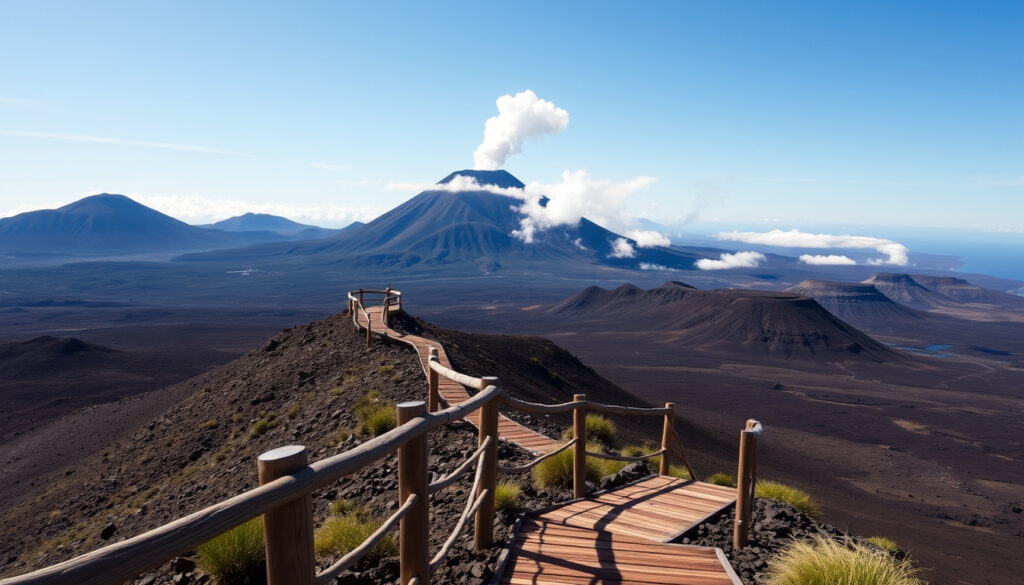
Best Places to See Volcanoes: Safety, Tours & Top Destinations
There’s a moment on any volcano trip when the ground stops being scenery and starts being geology — the mountain you’re standing on is still deciding what to do next. That uncertainty is the draw, so the best volcano-viewing spots shift with every eruption cycle.
Potentially active volcanoes on land: ~1,350 ·
Potentially active U.S. volcanoes: 161 ·
Volcanoes in the Ring of Fire: ~75% ·
Fatalities in the 1980 Mount St. Helens eruption: 57
Quick snapshot
- Mount Etna is Europe’s most active volcano (Quartz)
- Whakaari/White Island erupted on 9 December 2019, killing 22 tourists and injuring 25 others (National Geographic)
- A 2024 Reykjanes eruption sent lava toward the Blue Lagoon area (Quartz)
- Which specific volcano will erupt in 2026 — observatories publish probabilities, not fixed forecasts
- Whether Campi Flegrei is moving toward an eruption or just long-term ground deformation
- The exact number of unrecovered climbing victims on Mount Rainier, which has not been publicly confirmed
- Check webcams and the USGS daily update before visiting Kīlauea (National Park Service)
- Confirm official access and local guide rules before booking any volcano tour (National Park Service)
Six numbers, one pattern: the places worth traveling to are the ones with the most monitoring, not just the most dramatic silhouette.
| Fact | Value | Source |
|---|---|---|
| Potentially active volcanoes worldwide | ~1,350 | National Geographic |
| Potentially active U.S. volcanoes | 161 | U.S. Geological Survey |
| Europe’s most active volcano | Mount Etna, Italy | Quartz |
| Ring of Fire volcano share | ~75% | U.S. Geological Survey |
| Mount Rainier USGS threat level | Very High | U.S. Geological Survey |
| Kīlauea caldera rim | Closed to the public since late 2007 | U.S. Geological Survey |
What are some good holiday destinations with volcanoes?
The honest answer is that the best destination depends on the kind of show you want. A volcano holiday can mean a perfect cone, a steaming crater you walk around, or an active vent you watch from a lookout that someone with a gas mask has already checked.
What are the best places to see volcanoes in the world?
- Hawaiʻi, USA — Kīlauea and Mauna Loa inside Hawaiʻi Volcanoes National Park
- Italy — Mount Etna in Sicily, Stromboli’s island, and Vesuvius above Naples
- Iceland — Reykjanes Peninsula and the Vatnajökull region
- Costa Rica — Arenal Volcano National Park
- United States — Mount Rainier for the classic glaciated postcard
- Japan — Mount Fuji for symmetry, if not for lava
The destinations that keep showing up are the ones with formal visitor access: national parks, observatories, and licensed tour operators. In Hawaiʻi, that reality is literal — Kīlauea’s active eruption area is closed because of volcanic gas, unstable cliffs, ground cracks, and falling tephra, according to the National Park Service’s eruption-viewing guidance.
If you want geothermal scenery without the crater-edge stakes, New Zealand’s Rotorua field is a gentler entry point. Our guide to the best natural pools in Rotorua sorts the managed hot springs from the ones you should skip.
The best volcano destinations are the ones with the strongest safety infrastructure — which is also why their rules are non-negotiable.
What this means: a destination without an official access system is a destination that hasn’t decided how to keep you safe.
The implication: the most reliable volcano trip is the one that starts with a monitoring update.
What are the best places to see volcanoes in Europe?
Europe is the easiest continent for volcano sightseeing because the volcanoes are old, mapped, and mostly served by good roads. The flip side is that the most famous ones are also the most crowded.
Which European volcanoes are the most active and easiest to visit?
- Mount Etna (Sicily) — Europe’s most active volcano; cable car plus guided crater walk
- Stromboli (Aeolian Islands) — guided sunset hike to a safe viewing platform
- Vesuvius (Naples) — short crater-rim path with a view over Pompeii
- Reykjanes Peninsula (Iceland) — road-accessible lava fields near the Blue Lagoon
Etna’s moods are routine enough that local guides treat them as part of the job. A licensed guide is the smart move because permitted routes depend on volcanic and weather conditions, as Quartz’s volcano-destination roundup notes.
Europe’s easiest volcano views are its most crowded. The quieter, more memorable experience is usually Stromboli’s guided night hike.
Stromboli runs on a different rhythm. Its summit is reachable only with a licensed guide, and the classic trip is a guided hike to a safe viewing platform near sunset, as National Geographic’s explorer guide to volcanoes describes. Vesuvius is the easy one: a paved crater path with a view over the ruins of Pompeii, which makes it the best volcano for travelers who want the story without the expedition.
Iceland’s Reykjanes Peninsula is the wildcard. It has produced multiple eruptions since 2021, and according to Quartz’s destination guide, routes and infrastructure can be affected by eruptions — a 2024 lava advance crossed land near the Blue Lagoon. The access is real, but the rules can change mid-trip.
What are the best volcanoes to visit in Central America?
Central America is where volcano travel stops being a viewing experience and becomes a negotiation with the mountain.
Which Central American volcano has the best lava view?
- Masaya (Nicaragua) — drive-up overlook with an active lava lake, when the park is open
- Arenal (Costa Rica) — the classic cone, now better for hiking than lava
- Pacaya (Guatemala) — guided hike near Antigua over recent lava fields
- Volcán de Fuego (Guatemala) — dramatic eruptions, but access depends on the day
Masaya’s lookout is the rare place where you can stand on a rim and see an active lava lake glow after dark — when the park opens it. Arenal is the opposite energy: the cone is quiet, the rainforest has taken over the slopes, and the national park trails are the main event.
Ballistic blocks, ashfall, and lahar risk after heavy rain are part of the Central American package. Local guide rules and national park closures decide what’s reachable, often by the day.
The hubs are workable: Arenal is roughly three hours from San José, Pacaya and Fuego are day-trip range from Antigua, and Masaya is under an hour from Managua.
The pattern: Central America rewards flexible travelers — the lava is real, but the access rules get rewritten by the week.
What are the top 10 most beautiful volcanoes in the world?
Beauty lists go viral for a reason: a perfect volcano is the closest most travelers get to a real-life fantasy landscape. But no official ranking exists.
What is the prettiest volcano in the world?
- Mount Fuji, Japan — near-perfect symmetry
- Mayon, Philippines — the world’s most perfect cone
- Cotopaxi, Ecuador — snow cone over high-altitude plains
- Kilimanjaro, Tanzania — a dormant giant you can climb
- Mount Rainier, USA — glaciated bulk over Seattle
- Mount Etna, Italy — active and photogenic
- Mount Teide, Spain (Canary Islands) — Mars-like landscape
- Arenal, Costa Rica — jungle-framed cone
- Stromboli, Italy — the glowing lighthouse of the Mediterranean
- Kīlauea, Hawaiʻi — the most watched lava glow on Earth
What the lists are really measuring is symmetry, setting, color, and whether the mountain owns its skyline. Fuji and Mayon win on geometry; Cotopaxi and Kilimanjaro win on altitude drama; Rainier and Etna win on sheer presence.
What beauty rankings rarely tell you is how visitable the mountain is right now. Mayon is stunning and restless; Rainier is stunning and heavily monitored. Beauty and hazard exposure are separate questions.
A beauty ranking is a postcard list. The visitability ranking — open access, clear monitoring, professional guides — is the one that gets you home for dinner.
The catch: the prettiest volcano in the world by almost any vote is also one of the most carefully watched.
What are the top 3 active volcanoes in the world?
Define “top” by frequency of activity rather than size or death toll, and the same three names keep appearing in Smithsonian and USGS records: Kīlauea, Etna, and Stromboli.
Where are the best places to see lava?
- Kīlauea, Hawaiʻi — the most watched lava system on Earth; best seen from managed lookouts and webcams
- Mount Etna, Italy — lava fountains visible from the upper slopes
- Stromboli, Italy — continuous small explosions; glow visible from the sea or a guided platform
Kīlauea is the most honest of the three. Visitors can scan the caldera rim and watch the glow from designated viewpoints, but the active eruption area remains closed because of volcanic gas, unstable cliffs, ground cracks, and falling tephra, per the National Park Service eruption-viewing page. The caldera rim around Halemaʻumaʻu has been closed since late 2007.
Etna and Stromboli offer the European version of the same lesson: the lava is real, and the access is managed. The gas is the part you can’t see coming — volcanic gases such as sulfur dioxide can damage the lungs, even at sites where lava looks reachable, and BBC’s volcano-tourism risk report lists toxic gases among the core hazards.
The best lava view on Earth is the one a monitoring agency clears you to see, not the one a postcard promises.
What this means: the “top” active volcano is the one with the best webcam, because that is the one you can actually watch safely.
What is the most feared volcano in the world?
The most feared volcano in the world is not the deadliest one, and it is not the prettiest one. It is the one whose next move would land on people.
What are the top 3 deadliest volcanoes?
- Tambora, Indonesia (1815) — the deadliest eruption in recorded history; global climate cooled the following year
- Krakatoa, Indonesia (1883) — its collapse generated deadly tsunamis
- Mount Pelée, Martinique (1902) — a pyroclastic flow destroyed Saint-Pierre in minutes
The modern case that changed volcano travel was Nevado del Ruiz in 1985, where a lahar — not lava — buried the town of Armero. That is the key distinction: fear tracks impact on people, and lahars are the quietest way a volcano reaches a city.
Who is at risk if Mt. Rainier erupts?
Rainier’s risk is a valley problem, not a summit problem.
The USGS lists Mount Rainier as a Very High Threat volcano because potential lahars would travel down river valleys that now hold homes — valleys such as the Puyallup and Nisqually are the most mapped at-risk routes. The 1980 Mount St. Helens eruption killed 57 people, and that number is the reason the Pacific Northwest treats lahar drills as seriously as fire drills.
Rainier is monitored closely, and none of the monitoring points to an imminent eruption. For a safer way to enjoy the mountain’s backyard, our guide to the best scenic hikes near Seattle covers trails well outside the mapped hazard zones.
Is Mount Rainier likely to erupt again?
- Yes, it is an active volcano — but “active” in geologic time, not next-weekend time
- Current monitoring data does not suggest an imminent eruption
Rainier’s eruptions have been separated by centuries to millennia. The monitoring exists because the hazard is permanent, not because an eruption is scheduled.
What was the tragedy on Mount Rainier in 2012?
Climbing is the real hazard on Rainier, not the volcano.
The 2012 tragedy happened in the mountain’s glaciated upper slopes, where storms and ice defeat even experienced climbers. Park records describe rescue and recovery efforts that were constrained by extreme conditions.
How many bodies are on Mount Rainier?
- The exact number has not been publicly confirmed
Recovery in glacial terrain can be impossible; remains become part of the ice and move with it. The National Park Service has not published a verified total, so any round number online is speculation.
What this means: fear of Rainier is really fear of lahar, and lahar risk is a zoning problem, not a summit problem.
The pattern: fear and beauty are separate filters; monitoring is the only one that matters.
What volcano is most likely to erupt in 2026?
The honest 2026 forecast is a probability table, not a prophecy. Volcanologists publish odds and alert levels — and the alert levels are the part you should book around.
What supervolcano is waking up?
- Campi Flegrei, Italy — the restless caldera west of Naples
- Reykjanes Peninsula / Svartsengi, Iceland — the system that has erupted several times since 2021
- Yellowstone, USA — monitored continuously; no current sign of imminent eruption
Campi Flegrei has been deforming for years. INGV scientists track the ground movement and keep evacuation plans current, but ground deformation alone does not mean an eruption is coming.
Iceland’s Svartsengi system is the closest thing to a “likely” active travel destination: it has erupted repeatedly since 2021, which makes it both the best-monitored and the most probable scene of a 2026 eruption. Yellowstone, the supervolcano everyone asks about, is monitored continuously, and current data does not suggest an imminent eruption.
The volcanoes most likely to erupt in 2026 are also the best monitored, so the danger zone is usually the best-mapped part of the map.
Before you book, check the USGS, INGV, and Iceland Met Office updates. That is the real 2026 forecast: conditional, monitored, and subject to change.
What this means: planning around a specific eruption is a gamble; planning around a monitored volcano is smart logistics.
Volcano destinations compared
Five destinations, one pattern: the best view depends less on beauty rankings and more on what the monitoring agencies reported this morning.
| Destination | Best for | Access reality | Current signal |
|---|---|---|---|
| Kīlauea, Hawaiʻi | Watching an active vent from managed lookouts | Eruption area closed; check NPS and USGS alerts | Ongoing eruption in closed zone; caldera rim off-limits since 2007 |
| Mount Etna, Italy | Europe’s most active volcano | Cable car plus guided crater access | Frequent activity; routes shift with weather and eruptions |
| Reykjanes Peninsula, Iceland | Recent lava fields by rental car | Roads and infrastructure can be affected | Multiple eruptions since 2021; 2024 lava reached Blue Lagoon area |
| Arenal, Costa Rica | Classic cone and rainforest hikes | Park trails with local guide rules | No recent lava activity; better for hiking than lava |
| Mount Rainier, USA | Glaciated stratovolcano scenery | No lava viewing; lahar hazard zones mapped | USGS Very High Threat; no imminent eruption indicated |
The pattern: every destination here is conditional — the only fixed variable is how well the hazard is mapped.
Upsides and downsides of volcano tourism
Upsides
- Volcano parks concentrate hiking, geothermal scenery, and wildlife in one place
- Active sites offer a front-row seat to geology — Kīlauea’s glow, Stromboli’s nightly bursts
- Managed overlooks and licensed guides keep most visitors at safe distances
- Monitoring is excellent at the most popular sites, so warnings usually arrive before danger
Downsides
- Access can close without notice; Kīlauea’s eruption area has been off-limits for years
- Gas and tephra are health hazards even when lava looks far away
- Tourist infrastructure can sit in hazard zones — a 2024 flow reached the Blue Lagoon area
- The worst accidents happen where danger was not obvious: Whakaari in 2019, Mount Shirane in 2018
The trade-off: you trade a small, well-monitored risk for an unmatched view — but the monitoring only helps if you check it before you go.
How to plan a safe volcano trip in five steps
Five steps, one logic: treat the volcano as an active system, not a backdrop.
- Check the monitoring updates before you go. USGS daily updates, webcams, and local observatory alerts tell you whether yesterday’s view is still today’s reality.
- Verify park and trail status. Closures happen at the park level, sometimes for years — Kīlauea’s caldera rim is the proof.
- Book a licensed local guide for anything above the safe zone; routes depend on volcanic and weather conditions and can change by the hour.
- Pack for gas and tephra. Long clothing, sturdy shoes, eye protection, and a dust mask are the basics, according to the National Park Service’s tephra guidance.
- Build a backup plan. If the crater closes or the road is cut, you still want a trip worth taking.
The implication: the best volcano trip is the one that ends with too many photos and zero rescue stories.
Eruptions that shaped volcano travel
The eruption record below, from Vesuvius in 79 CE to Hunga Tonga in 2022, is why volcano tourism is managed the way it is today — as BBC’s volcano-tourism risk report notes, the hazards include toxic gases, ejected material, lava flows, wildfires, landslides, and coastal tsunamis.
- — Vesuvius erupts and buries Pompeii and Herculaneum.
- — Mount Tambora erupts in Indonesia; global climate cools the following year.
- — Krakatoa erupts and generates deadly tsunamis.
- — Mount St. Helens erupts and kills 57 people.
- — Hunga Tonga–Hunga Haʻapai erupts and sends a pressure wave around the globe.
- — Monitoring continues for Campi Flegrei, Reykjanes Peninsula, and other restless volcano systems.
Why this matters: every one of these events rewrote the rules for the next generation of visitors.
What’s confirmed, what’s not
Confirmed facts
- Mount Etna is Europe’s most active volcano. (Quartz)
- Mount Rainier is listed as a Very High Threat volcano by the USGS because of lahar potential and nearby communities. (U.S. Geological Survey)
- The 1980 Mount St. Helens eruption killed 57 people. (National Geographic)
- Kīlauea’s caldera rim has been closed to the public since late 2007. (U.S. Geological Survey)
What’s unclear
- Which specific volcano will erupt in 2026.
- Whether Campi Flegrei is moving toward an eruption or long-term ground deformation.
- The exact number of unrecovered climbing victims on Mount Rainier.
- Whether a “supervolcano” is waking up — current monitoring at Yellowstone shows no imminent eruption, but long-term forecasts remain open.
- The exact timing of the next Reykjanes eruption — the system is clearly active, but no observatory will pin a date.
The takeaway: the confirmed facts tell you where the risk is mapped; the unclear items tell you where to keep your plans flexible.
What the experts say
Four experts, one message: the risk is knowable, and the monitoring only works if travelers use it.
“You don’t have to live inside the blast zone to be at risk. The lahar hazard around Mount Rainier reaches into river valleys that look peaceful on a sunny day.”
— USGS volcano hazard communication specialist
“Stromboli has been called the lighthouse of the Mediterranean for good reason — on a clear night, the glow from its crater is visible from the sea.”
— National Geographic travel editor
“We count about 1,350 potentially active volcanoes on land. Most people can name a handful; the gap between perception and monitoring is the real story.”
— Smithsonian Global Volcanism Program analyst
“Ground deformation does not equal eruption. It means we have to watch, measure, and be ready to change the evacuation plan if the signal changes.”
— INGV monitoring scientist, Italy
What the experts share: the hazard is mapped, the data is public, and the only unpredictable part is whether visitors check it before they go.
The takeaway
The best places to see volcanoes in 2026 are the ones that respect the contract between visitors and monitoring agencies. That contract goes both ways: the agencies keep publishing webcams, alert levels, and hazard maps, and travelers agree to check them before they book and again before they drive. For a traveler planning a volcano holiday this year, the choice is clear: build the trip around a monitored destination with a licensed guide and a flexible date, or watch the same volcano through a webcam from a safe distance.
nationalgeographic.com, nationalgeographic.com, lonelyplanet.com
Frequently asked questions
What is the difference between active, dormant, and extinct volcanoes?
An active volcano has erupted in recent history and can erupt again. A dormant volcano is an active volcano that is quiet right now. An extinct volcano has not erupted in recorded history and is not expected to. The lines can shift as monitoring improves.
Do I need a permit or guide to visit a volcano?
Rules differ by destination. Kīlauea’s open trails need no permit, but its closed crater area is off-limits. Etna and Stromboli require licensed guides for the upper routes. Vesuvius is a public crater-rim walk. Always check the local park or observatory before departure.
Are volcano tours safe when an eruption is ongoing?
Managed tours can be safe when access is controlled. The 2019 Whakaari disaster involved an active crater with no safe exclusion zone; Kīlauea’s current activity is watched from closed rims and webcams. The key is whether monitoring agencies can keep a safe distance.
What should I pack for a volcano trip?
Long clothing, sturdy shoes, eye protection, and a dust mask cover the basics for tephra and rough trails. Layers help at altitude, and a headlamp is useful for sunset hikes such as Stromboli’s.
How can I check the current eruption status before traveling?
Use the official sources: USGS volcano updates for the United States, INGV for Italy, and the Icelandic Met Office for Iceland. They publish daily or weekly updates, webcams, and alert levels.
What is the best time of year to visit volcano destinations in Iceland?
Summer gives long daylight and easier roads. Winter can offer eruptions visible against dark skies, with aurora potential, but weather and road closures are more disruptive. Check the Icelandic Met Office and road authority before a winter trip.
If your question is not here, the monitoring agencies will answer faster than any forum — check their updates before you trust a comment thread.
More related posts
 37 USD to NZD – Convert US Dollars to New Zealand Dollars Today
 Dunedin to Auckland Flights: Time, Price & Schedule
 Life Insurance Comparison NZ 2026: Best Policies, Quotes & Costs
 Mirrou Shop Online Sale NZ: 9 Auckland Stores Guide
 Truck Hire Wellington NZ: Prices, Best & Small Options
 MKR Australia 2025 Winner – NSW Duo Wins by One Point
 Where to Learn Languages for Free: Best Apps & Sites
 Fo Guang Shan Temple Auckland: Photos, Dress Code & Cafe Guide
