Early Stages of Scabies: Symptoms, Treatment & Key Facts
Few things are as frustrating as an itch you can’t explain — especially when it gets worse just as you’re trying to fall asleep. That pattern is the hallmark of early scabies, a contagious skin condition caused by microscopic mites.
Incubation period (first-time infection): 4–8 weeks ·
Incubation period (re-infection): 1–4 days ·
Global prevalence: Over 200 million cases annually ·
Treatment success with permethrin: >90% after single application
Quick snapshot
- Scabies is caused by the mite Sarcoptes scabiei (CDC (U.S. public health authority))
- Intense itching at night is the hallmark symptom (CDC (U.S. public health authority))
- Prescription scabicides are the only effective treatment (CDC (U.S. public health authority))
- Exact global prevalence figures are underreported in many countries (WHO (global health authority))
- The role of shared fomites beyond bedding in transmission is still debated (WHO (global health authority))
- Why some people develop crusted scabies and others don’t is not fully understood (WHO (global health authority))
- First exposure: symptoms appear 4–8 weeks later (Wirral Community Health and Care NHS Foundation Trust)
- Re-infection: symptoms appear within 1–4 days (Wirral Community Health and Care NHS Foundation Trust)
- After treatment: contagious for 24 hours after first application (Wirral Community Health and Care NHS Foundation Trust)
- See a healthcare provider for prescription treatment (CDC (U.S. public health authority))
- Treat all household contacts simultaneously (CDC (U.S. public health authority))
- Wash bedding and clothing in hot water (CDC (U.S. public health authority))
Five key numbers, one pattern: the timeline of scabies depends entirely on whether your immune system has seen the mite before.
| Fact | Value |
|---|---|
| Incubation period (first infection) | 4–8 weeks |
| Incubation period (reinfection) | 1–4 days |
| Global cases per year | Over 200 million |
| Treatment of choice | Permethrin 5% cream (first-line) |
| Time to non-contagious after treatment | 24 hours after first application |
| Causative agent | Sarcoptes scabiei mite |
| Primary mode of transmission | Prolonged skin-to-skin contact |
| Diagnostic method | Clinical exam + microscopy or dermoscopy (NCBI Bookshelf) |
How do you tell if you have early scabies?
The earliest sign of scabies isn’t a rash — it’s the itch. The CDC (U.S. public health authority) states that intense itching, especially at night, is the most common early symptom. This happens because your immune system mounts an allergic response to the mites, their eggs, and their waste. The East Sussex Healthcare NHS Trust (NHS guidance) confirms that the rash itself is a delayed hypersensitivity reaction — meaning the itching can start before you see anything on your skin.
Night-time itching is your immune system’s early-warning signal. The sooner you act on it, the faster you can stop the infestation from spreading across your body.
What does a mild case of scabies look like?
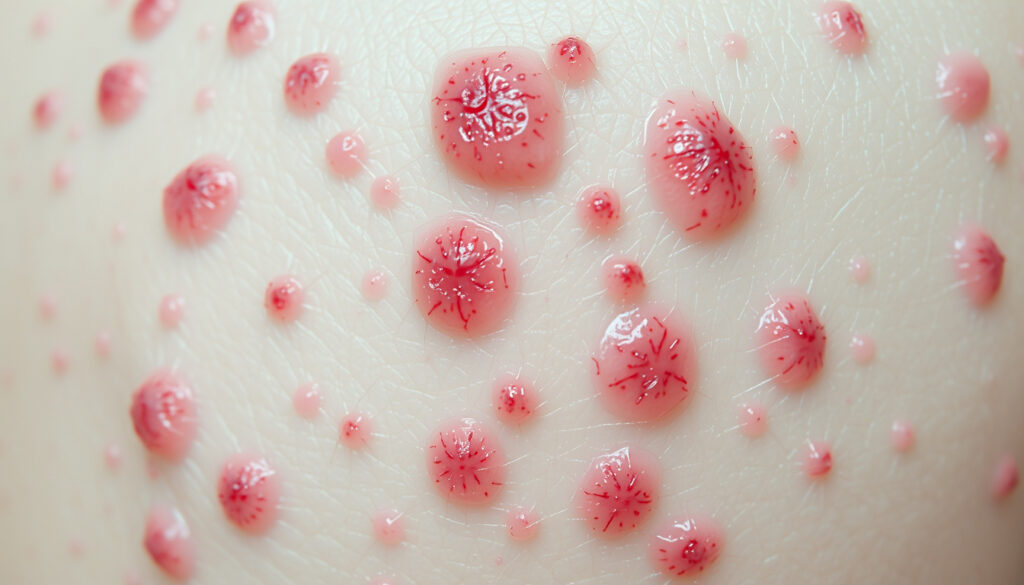
- Tiny, thin, wavy burrows — raised lines with a small dot at one end — typically appear in the webbing between fingers, on the inner wrists, elbows, armpits, waist, and belt line. The WHO (global health authority) describes these as “itchy linear burrows and bumps.”
- Small red bumps or pimple-like lesions may cluster in the same areas. The CDC (U.S. public health authority) notes that scabies commonly causes a “pimple-like itchy rash.”
- In infants and young children, the WHO (global health authority) adds that the rash can also appear on the palms, soles of the feet, ankles, and scalp — areas less common in adults.
The implication: a mild case looks like a few scattered insect bites or a minor eczema patch. The burrows are the giveaway — they’re the physical tunnel the mite has carved under your skin.
What gets mistaken for scabies?
- Eczema (atopic dermatitis): Both cause red, itchy patches, but eczema doesn’t produce burrows and rarely targets the finger webs specifically.
- Bed bug bites: Bed bugs often leave a line of bites on exposed skin (arms, legs, neck) but don’t cause burrows, and the itching isn’t uniquely nocturnal.
- Contact dermatitis: An allergic reaction to soap, detergent, or jewellery can mimic scabies, but it usually resolves when the irritant is removed.
- Folliculitis: Inflamed hair follicles look like small red bumps, but they lack the linear burrow pattern.
How did I get scabies if no one else has it?
This is the question that carries the most confusion — and the most shame. The answer is straightforward: scabies mites are passed through prolonged skin-to-skin contact, which means you don’t need an outbreak in your household to get it. A single sleepover, a shared bed during travel, or even holding hands for an extended period can be enough. The WHO (global health authority) states that the mite is transmitted through “prolonged, direct skin-to-skin contact” — a quick handshake or hug is very unlikely to pass it.
Where do scabies mites come from to begin with?
Scabies mites are human-specific parasites. They don’t come from pets, soil, or food — they come from another person who has the infestation. The mites can live up to 48 hours away from human skin, according to the CDC (U.S. public health authority), which means shared bedding, towels, or clothing can transmit the mite even without direct contact. But the primary route is always person-to-person.
How long is scabies contagious?
- A person is contagious from the moment the female mite begins burrowing — which can be weeks before any symptoms appear.
- After treatment, the CDC (U.S. public health authority) states that a person is no longer contagious about 24 hours after the first application of an effective scabicide.
- If untreated, the infestation persists indefinitely, and the person remains contagious the entire time.
Is scabies dangerous?
For most people, scabies is an intensely uncomfortable nuisance rather than a medical danger. The WHO (global health authority) classifies scabies as a neglected tropical disease but notes that complications are rare in otherwise healthy individuals. The real risks come from:
- Secondary bacterial infection: Scratching breaks the skin and allows bacteria like Staphylococcus aureus to enter, causing impetigo or cellulitis.
- Crusted (Norwegian) scabies: A severe form that occurs in immunocompromised individuals, the elderly, or people with disabilities. It involves thick crusts of skin containing thousands of mites and is highly contagious.
How to cure scabies fast?
The short answer is: you can’t cure it overnight, but you can stop the infestation within 24 hours of proper treatment. The CDC (U.S. public health authority) is clear that over-the-counter products do not work — only prescription scabicides are effective. Here is the step-by-step protocol that gives the fastest results:
- Get a prescription. See a healthcare provider for a scabicide cream or lotion. First-line treatment is permethrin 5% cream, applied from the neck down to the soles of the feet. The WHO (global health authority) also lists 0.5% malathion, 10–25% benzyl benzoate, and 5–10% sulphur ointment as alternatives.
- Apply correctly. Cover every inch of skin — between fingers and toes, under nails, the back, the waist, and the soles. Pay special attention to skin folds. Leave the cream on for 8–14 hours (overnight is ideal).
- Wash off thoroughly. Shower to remove the cream completely.
- Treat all close contacts. Everyone in your household, including sexual partners, should be treated at the same time — even if they have no symptoms. The CDC (U.S. public health authority) emphasizes that simultaneous treatment prevents reinfestation.
- Wash everything in hot water. Bedding, towels, clothing, and any fabric you’ve used in the past 48 hours should be washed in hot water (at least 50°C) and dried on high heat. Items that can’t be washed should be sealed in a plastic bag for at least 72 hours.
- Vacuum thoroughly. Carpets, upholstered furniture, and mattresses should be vacuumed. The CDC (U.S. public health authority) notes that mites can’t survive more than 48 hours away from human skin, so environmental cleaning is important but less critical than treating people.
- Repeat if needed. Some guidelines recommend a second application one week later, especially in crusted scabies or if symptoms persist.
The itching will continue for 2–4 weeks after successful treatment. This does not mean the treatment failed — it means your immune system is still reacting to the dead mites and their waste. The Wirral Community Health and Care NHS Foundation Trust (NHS guidance) advises that post-treatment itch is normal and can be managed with antihistamines or mild steroid creams.
Do scabies ever fully go away?
Yes — scabies is fully curable with proper treatment. The CDC (U.S. public health authority) states that permethrin cream has a success rate above 90% after a single application when used correctly. The only reasons for persistent infestation are:
- Not treating all household contacts simultaneously
- Reinfection from untreated bedding or clothing
- Improper application of the cream (missing areas)
- Resistance (rare, but reported in some regions)
Can I sleep in my bed if I have scabies?
Yes, but with precautions. The CDC (U.S. public health authority) recommends that after treatment, you should wash all bedding in hot water and dry on high heat. Once the bedding is clean and you have completed the first treatment application, you can safely sleep in your bed. The key is timing: apply the treatment, sleep in it overnight, wash it off in the morning, and then wash all bedding immediately.
Is it shameful to have scabies?
No — and this is worth stating directly. Scabies has nothing to do with hygiene, cleanliness, or socioeconomic status. The NHS (U.K. national health service) states plainly that “anyone can get it.” The stigma attached to scabies is harmful and unfounded — it’s a medical condition, not a character judgment. The people who are most affected by scabies worldwide are often children in crowded living conditions, but the parasite doesn’t discriminate.
Does scabies need to be reported?
In some jurisdictions, yes. Scabies is a reportable condition in several countries when it occurs in institutional settings — nursing homes, prisons, childcare centres, and schools — because outbreaks require public health intervention. For an individual case, your doctor will advise you on local reporting requirements. The CDC (U.S. public health authority) notes that healthcare providers should report outbreaks to local health departments, but a single case in a private home typically doesn’t require formal notification.
The very thing that makes scabies feel shameful — the idea that it’s “dirty” — is also what keeps people from getting treated quickly. The sooner you separate the condition from stigma, the sooner you can break the transmission cycle.
The implication: addressing the stigma directly can speed up diagnosis and treatment.
What makes scabies worse?
Several factors can turn a manageable infestation into a prolonged or severe problem. The WHO (global health authority) identifies the following as key worsening factors:
- Scratching: Damages the skin barrier and opens the door to bacterial infections like impetigo. Secondary infection is the most common complication of scabies worldwide.
- Delayed treatment: The longer the infestation goes untreated, the more mites multiply and spread to new areas of the body. Early treatment limits the infestation to a smaller area.
- Reinfection from untreated contacts: If you treat yourself but not your household members, you will likely get it again within days.
- Immunosuppression: People with weakened immune systems (HIV, cancer treatment, organ transplant recipients) are at risk of crusted scabies, which can involve thousands of mites and requires aggressive treatment.
- Incorrect diagnosis: Being treated for eczema or allergies with steroid creams can actually make scabies worse by suppressing the immune response that keeps the mites in check, allowing them to multiply faster.
The consequence: what starts as a mild, localized rash can escalate into a whole-body infestation with secondary infection if left untreated or treated incorrectly. The WHO (global health authority) estimates that scabies accounts for 0.07% of the global burden of disease, but the vast majority of that burden comes from complications — not the infestation itself.
Confirmed facts vs. what’s still unclear
Confirmed facts
- Scabies is caused by the mite Sarcoptes scabiei (CDC (U.S. public health authority))
- Itching is worse at night due to mite activity and the allergic response (CDC (U.S. public health authority))
- Permethrin 5% cream is safe and effective when used as directed (WHO (global health authority))
- Mites cannot survive more than 48 hours away from human skin (CDC (U.S. public health authority))
- Diagnosis is confirmed by microscopic identification of mites, eggs, or faeces (NCBI Bookshelf)
- Over-the-counter products are not effective against scabies (CDC (U.S. public health authority))
What’s still unclear
- Exact global prevalence data is underreported in many countries (WHO (global health authority))
- The role of shared fomites (furniture, clothing, towels) in transmission apart from bedding is debated by researchers
- Why certain individuals develop crusted scabies while others with similar immune status do not is not fully understood
- Regional resistance patterns to permethrin are not systematically tracked in most countries
What experts say about scabies
When a person is infested with scabies mites for the first time, symptoms typically take 4–8 weeks to develop.
CDC (U.S. public health authority)
Scabies is an itchy rash caused by mites. It’s spread through close skin contact, and anyone can get it.
If you’ve had scabies before, you tend to get a rash within a few days.
For the person who has just discovered a mysterious itchy rash and is searching online at 2 a.m., the implication is clear: get a diagnosis, get the prescription, treat everyone in the house, and know that the guilt you’re carrying is the one thing you can let go of right now.
Frequently asked questions
Can scabies spread through clothing?
Yes, but it’s less common than skin-to-skin transmission. The CDC (U.S. public health authority) states that mites can live up to 48 hours off the human body, so shared clothing, bedding, and towels can transmit the mite. Washing items in hot water (at least 50°C) and drying on high heat kills the mites.
How long does scabies itching last after treatment?
Itching typically persists for 2–4 weeks after successful treatment. The Wirral Community Health and Care NHS Foundation Trust (NHS guidance) explains that this is caused by the ongoing allergic reaction to dead mites and their waste, not by active infestation. Antihistamines and moisturisers can help manage the discomfort.
Can I get scabies from a handshake?
Very unlikely. The WHO (global health authority) specifies that transmission requires prolonged skin-to-skin contact — typically 10–15 minutes or more. A brief handshake or hug does not provide enough time for the mite to transfer.
What is crusted scabies?
Crusted scabies, formerly called Norwegian scabies, is a severe form of the infestation where thick crusts of skin contain thousands of mites. The CDC (U.S. public health authority) notes that it occurs in people with weakened immune systems, the elderly, and people with physical or intellectual disabilities. It is highly contagious and requires aggressive treatment with both topical and oral medications.
Do I need to treat my pets for scabies?
No. The scabies mite that infects humans (Sarcoptes scabiei var. hominis) is host-specific and cannot survive on dogs, cats, or other pets. The CDC (U.S. public health authority) confirms that human scabies is not transmitted by animals. However, pets can get a different type of mange caused by a related mite, which requires veterinary treatment.
Can scabies live on furniture?
Mites can survive on furniture for up to 48 hours, according to the CDC (U.S. public health authority). Vacuuming upholstered furniture and mattresses is recommended, but the risk of transmission from furniture is much lower than from direct skin contact or shared bedding.
Should I see a doctor for scabies?
Yes. Scabies requires a prescription treatment — over-the-counter products do not work, as the CDC (U.S. public health authority) states clearly. A healthcare provider can confirm the diagnosis through clinical examination and, if needed, skin scraping for microscopy, and prescribe the appropriate scabicide.
More related posts
 Bigg Boss 19 Winner Gaurav Khanna: Prize Money Details
 4 Bedroom House for Rent Auckland – 2025 Prices, Suburbs & Tips
 London Time Right Now: GMT, BST, and UTC Offset Explained
 Largest Country in the World: Russia, Canada & Top 10 by Area
 How many days until Christmas 2025? Countdown details
 Power and Internet Deals: Best Ireland Bundles Compared
 Government First Home Grant Ireland 2025: First Home Scheme & Help to Buy Guide
 Rainbow Six Siege X: Free Access & Rebranding Explained
