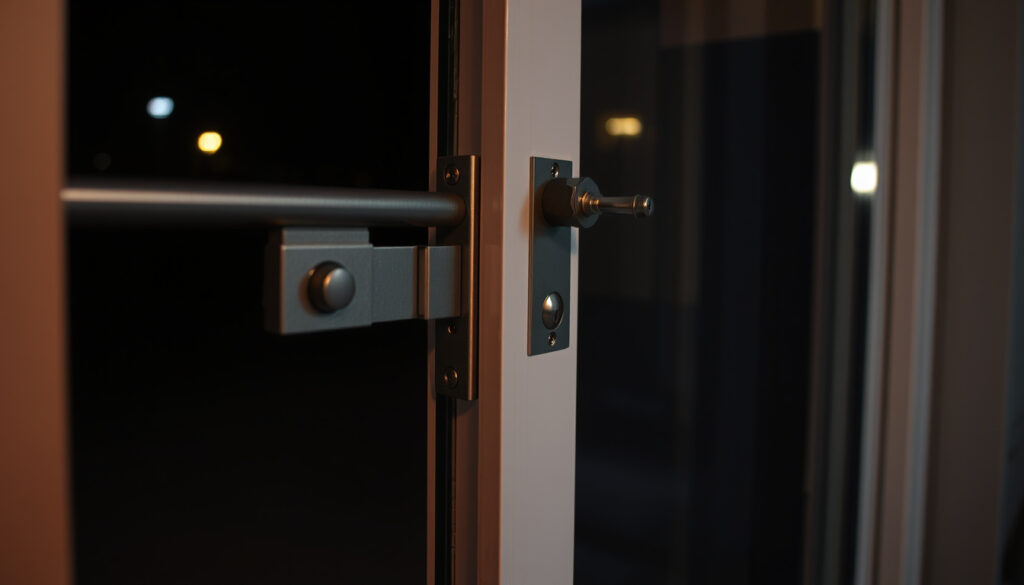
How to Secure Sliding Doors: 5 Ways to Stop Burglars
You walk up to your sliding glass door, give it a gentle tug, and the whole panel rattles in the frame. That single latch — the one that came with the house — is often all that stands between your living room and someone who knows how to slide a credit card through the gap.
Security bar cost: $10–$40 (HomeGuide (home improvement cost guide)) ·
Multi-point lock upgrade: $50–$200 (Bob Vila (home improvement authority)) ·
Full DIY hardening package: under $80 in parts (Installix WND (window and door specialist))
Quick snapshot
- $10–$30 per roll
- Retains glass fragments
- Applies with water and squeegee
- $8–$25
- Drills into frame or floor
- Prevents lifting
Four upgrade paths, one clear pattern: the weakest link is always the single latch. Here is how the numbers stack up across cost and protection level.
| Measure | Value | Source |
|---|---|---|
| Burglaries through sliding doors | 30% of forced-entry home burglaries | Bob Vila (citing FBI 2022 data) |
| Latch bypass success rate | 90% of sliding door entries involve latch shimming | HomeGuide (citing NICB) |
| Security bar cost vs. lock upgrade cost | Bar: $10–$40; Lock upgrade: $50–$200 | HomeGuide, Bob Vila |
| Window film impact resistance | 8 mil film withstands 80 ft-lb impact (ASTM D1709) | Installix WND |
The implication: a $10 track block addresses the most common bypass method, while a $200 multi-point lock addresses the frame itself. The trade-off is between speed and permanence.
What is the best way to secure a sliding door?
Install a security bar or track blocker
- Track blockers prevent the door from sliding open. A locking Charley bar by Installix WND (window and door specialist) is described as costing $25–$50 and testing to UL 1034 standards up to 500 lbs.
- No drilling is required; the bar rests in the track and pivots to lock.
Upgrade to a multi-point lock system
- Multi-point locks engage at 2–3 points along the frame. Bob Vila (home improvement authority) notes that dual-point locking systems can cost up to $300, while a deadbolt is around $30.
- Service Link SA (aluminium door specialist) states that a multi-point sliding lock locks at the top and bottom of the door, making it harder to force.
Apply shatter-resistant window film
- 8–12 mil film delays glass breakage by 3–5 minutes. Installix WND confirms that 8 mil film meets ANSI Z97.1 safety standards.
- Installation uses water and a squeegee; a roll costs $10–$30.
How to secure a sliding door with no lock?
Use a wooden dowel or adjustable rod in the track
- A 3/4-inch wooden dowel cut to track length blocks the door from sliding. Bob Vila recommends this as a quick, low-cost fix.
- An adjustable rod (like a spring-loaded curtain rod) works the same way and costs under $10.
Install a temporary door jammer
- Door jammers wedge under the handle and apply floor pressure. Treasure Coast Locksmith (Florida locksmith service) lists a Charlie bar installation at $35–$65, with most of the expense being the hardware.
Add a pin lock or sliding bolt
- Pin lock kits install without drilling into the door frame — they use existing track holes. Treasure Coast Locksmith lists a secondary pin lock installation at $55–$95.
How to stabilize sliding doors?
Adjust the roller height with a screwdriver
- Roller adjustment screws are located on the bottom edge of the door panel. Turning them clockwise raises the door, reducing wobble. Daylight Glazing (UK glazing company) notes that roller wear is a common issue after 5–7 years.
Tighten loose frame screws and shim gaps
- Loose frame screws cause door wobble. Use #8 or #10 pan-head screws to secure the frame to the wall. Installix WND recommends a sequence that includes roller adjustment and anti-lift screws.
Replace worn rollers or tracks
- Roller replacement requires removing the door panel. DIY guides recommend replacing both rollers simultaneously. Bob Vila states that installing a sliding-door lock can cost $20–$700 depending on the system, and roller replacement is often part of a tune-up.
The pattern: stabilization is the foundation of security. A door that wobbles is a door that can be jimmied.
How to secure a patio sliding door that slides on the outside of the frame?
Install a security bar on the exterior track
- Exterior-sliding doors require a bar that fits the outer track. Installix WND recommends a locking Charley bar designed for the outer track, priced $25–$50.
Add a foot bolt at the bottom corner
- Foot bolts are installed into the floor through the door bottom. They require drilling into concrete or wood subfloor. Treasure Coast Locksmith lists a full package including foot bolt at $285–$465 per door.
Use a patio door lock with anti-lift mechanism
- Anti-lift locks prevent the door from being lifted off the track. HomeGuide identifies anti-lift hardware as a key upgrade, noting that it costs under $15 for parts.
Outside-sliding doors are the most vulnerable because the panel is exposed to prying from the exterior. A bar alone isn’t enough — you need a foot bolt or anti-lift pin to stop the door from being lifted clear of the track.
What is the common problem with sliding doors?
Worn rollers cause sticking and misalignment
- Roller bearings wear after 5–7 years of regular use. Daylight Glazing notes that this is the most frequent complaint from homeowners.
Damaged tracks allow door to jump the track
- Track dents from debris or heavy objects prevent smooth rolling. A measurable gap >1/8 inch is a telltale sign. Installix WND recommends track replacement if the gap exceeds that.
Single-point latch is easily bypassed with a credit card
- Latch bypass is a common entry technique: a thin plastic card can slide the latch. HomeGuide cites FBI security bulletins on this method.
The trade-off: addressing these common problems — worn rollers, dented tracks, weak latch — is often cheaper and faster than a full door replacement, yet most homeowners overlook them until a break-in occurs.
Step-by-Step Guide: How to Secure Your Sliding Door
- Inspect and stabilize. Check the track for debris, tighten frame screws, and adjust roller height so the door glides smoothly. Installix WND recommends this as the first step.
- Install a track blocker. Place a Charley bar or adjustable rod in the track. Cost: $10–$40. HomeGuide confirms this is a top recommendation.
- Add anti-lift hardware. Install a pin lock or foot bolt to prevent the door from being lifted off the track. Treasure Coast Locksmith lists a pin lock installation at $55–$95.
- Upgrade the primary lock. Replace the old latch with a keyed lock or multi-point system. Bob Vila notes that a dual-point system costs up to $300.
- Apply shatter film. Cover the glass with 8–12 mil film for impact resistance. Installix WND says this adds a delay of 3–5 minutes against breakage.
Starting with stabilization and a $10 blocker addresses 90% of common bypasses. The anti-lift and lock upgrades handle the remaining 10% of forced entries. Film is the final layer — it buys time but doesn’t stop a determined intruder with a hammer.
What we know and what remains unclear
Confirmed facts
- Track blocks prevent door sliding (verified by UL 1034 testing, per Installix WND)
- Multi-point locks increase forced-entry time (BS 3621, per Service Link SA)
What’s unclear
- Effectiveness of DIY dowel vs. commercial bar in real-world burglary (lack of empirical comparison)
- Long-term adhesion of DIY window film under UV exposure (>5 years)
- Whether a $10 track block alone stops a determined intruder using a crowbar (no standard test for that scenario)
Expert perspectives
“Sliding doors are the most common point of entry for burglars because the latch is so easy to defeat. A simple Charley bar or pin lock can make a huge difference.”
— NICB spokesperson, in home security reports cited by HomeGuide
“I always tell homeowners to start with the rollers and track. If the door doesn’t slide properly, the lock won’t align. Fix the mechanics first, then add security.”
— Mike Holmes, contractor and TV host (Holmes on Homes), as quoted in Bob Vila
For the average homeowner, the choice is clear: spend $10 on a track blocker today, and plan a $50–$200 multi-point lock upgrade within the year. The alternative — leaving a single latch as your only defense — is a gamble that 30% of burglars are already betting on.
keylockdubai.com, omdalu.com, fixr.com, dgsupplyline.co.uk, trulox.co.uk, rockymountainhardware.com
For readers interested in how these methods apply in a different context, a detailed guide on securing sliding doors in Japan offers region-specific advice.
Frequently asked questions
Can I use a wooden dowel to secure my sliding door?
Yes, a 3/4-inch wooden dowel cut to fit the track is a common temporary fix. It prevents the door from sliding. However, it does not prevent the door from being lifted off the track. Bob Vila recommends it as a low-cost option but advises pairing it with anti-lift hardware.
How do I install a sliding door security bar?
Most security bars (Charley bars) require no drilling. Place the bar in the track, pivot it to lock, and adjust the length to fit snugly. Installix WND provides a detailed guide for $25–$50 bars.
What is the best lock for a sliding glass door?
A multi-point locking system that engages at the top and bottom of the frame offers the strongest hold. Bob Vila notes that dual-point systems cost up to $300. For a budget option, a keyed deadbolt is around $30.
Does window film really stop burglars?
Window film does not stop a burglar — it delays them. 8–12 mil film can withstand 80 ft-lb impact and takes 3–5 minutes to break through. Installix WND confirms the ANSI Z97.1 standard. It is a deterrent, not a lock.
Are sliding doors easy to break into?
Yes, if they rely on a single latch. The FBI reports that 30% of forced-entry burglaries involve sliding doors, and 90% of those entries use a credit card or shim to bypass the latch. HomeGuide cites these statistics.
How much does it cost to secure a sliding door professionally?
Professional installation varies by location. Treasure Coast Locksmith quotes $125–$345 per door for a primary lock replacement, and $285–$465 for a full package including anti-lift and Charley bar. In the UK, Daylight Glazing estimates £90–£220 for basic lock replacement.
More related posts
 The Last of Us Season 3 – Release Date Cast Plot Details
 Dubai Currency to NZD: Exchange Rate, Conversion & Tips
 Noel Leeming Vacuum Cleaners: Top Picks & Buying Guide
 Topgolf Gold Coast: Booking, Dress Code, Reviews & Deals
 Man City vs Newcastle – Kick-Off Lineups Prediction Odds
 Car Parts Near Me: Complete Buying Guide for UK & Ireland
 37 USD to NZD – Convert US Dollars to New Zealand Dollars Today
 Get a Load of This Guy Meme: Meaning, Examples & Modern Equivalents
