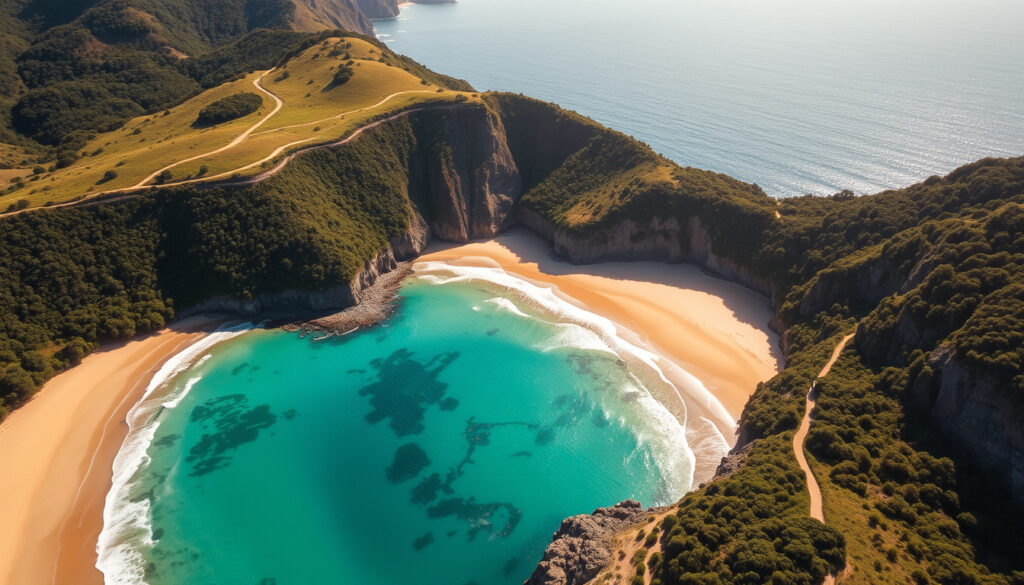
Abel Tasman National Park: Visitor Guide
You’ve seen the photos—golden sand meeting turquoise water, framed by lush coastal forest. But planning a trip to Abel Tasman National Park raises real questions: how long does the famous coast walk take, is it safe to swim, and what will it actually cost? This guide distills the practical trade-offs so you can decide if New Zealand’s smallest national park fits your next adventure.
Size: 22,500 hectares · Coast Track length: 60 km (37 mi) one way · Typical walk duration: 3–5 days · Golden beaches: Over 20 named beaches · Established: 1942
Quick snapshot
- New Zealand’s smallest national park at 22,500 hectares (AbelTasman.com (dedicated park guide))
- The Coast Track is 60 km long and takes 3–5 days (Britz Campervans (NZ campervan rental))
- Swimming is generally safe at calm beaches (Tourism New Zealand (national tourism board))
- Exact annual visitor numbers — estimates range from 250,000 to 350,000 (AbelTasman.com (park info hub))
- Water taxi pricing changes seasonally; current fares may differ from published rates (Never Ending Voyage (travel blog))
- Park established in 1942; Coast Track developed from the 1960s through 1990s (Department of Conservation (NZ government land manager))
- Marine reserve created in the early 2000s (DOC (conservation authority))
- Visitor numbers continue growing; book huts and water taxis well ahead in summer (Britz Campervans (travel operator))
- Climate patterns may affect water temperatures and fire risk during dry spells (DOC (environmental monitor))
Six key specs, one pattern: Abel Tasman packs extraordinary coastal variety into a compact area.
| Attribute | Detail |
|---|---|
| Established | 1942 (DOC (government conservation authority)) |
| Total area | 22,500 hectares (AbelTasman.com (park guide)) |
| Coast Track length | 60 km (one way) (Britz Campervans (NZ travel specialist)) |
| Number of beaches | Over 20 named beaches (Tourism New Zealand (national tourism office)) |
| Track walking time (full) | 3–5 days (Never Ending Voyage (travel experience blog)) |
| Best time to visit | December to March (summer) (Britz Campervans (holiday operator)) |
What is so special about Abel Tasman National Park?
Unique coastal landscape with golden beaches and granite cliffs
- Over 20 golden sand beaches line the coast, backed by sculptured granite cliffs and native forest (Tourism New Zealand (national tourism board)).
- The park is named after Dutch explorer Abel Janszoon Tasman, the first European to sight New Zealand in 1642 (AbelTasman.com (historical overview)).
New Zealand’s smallest national park with high accessibility
- At 22,500 hectares, it’s the country’s smallest national park, but that compact size makes it easier to explore in a short trip (AbelTasman.com (park facts)).
- From Nelson, it’s about 80 km or a 1-hour-30-minute drive to the main access point at Mārahau via State Highway 60 and Motueka (Britz Campervans (travel directions)).
Abel Tasman Coast Track as a world-famous hike
- The Abel Tasman Coast Track stretches 60 km one way and is typically completed in 3 to 5 days (AbelTasman.com (track guide)).
- Most of the park is accessible only on foot or by water taxi — there is no road through its length (Never Ending Voyage (travel report)).
For a first-time visitor, the park’s small footprint means you can hit the highlights — golden beaches, granite viewpoints, and native wildlife — without the multi-week commitment that larger parks like Fiordland demand.
The implication: the park’s design favours short, high-impact visits over extended wilderness treks.
Is Abel Tasman National Park worth visiting?
Reasons to visit: unique coastal hiking, swimming, kayaking
- The park is described as a “slice of paradise” with pristine sandy beaches and epic hiking trails that combine forest and coastline (Tourism New Zealand (visitor introduction)).
- Kayaking and water taxis allow visitors to reach remote beaches and coves that are otherwise inaccessible (Britz Campervans (activity guide)).
Comparison with other New Zealand national parks
- Unlike the dramatic fjords of Milford Sound or the alpine terrain of Aoraki Mount Cook, Abel Tasman offers a relaxed coastal environment suited to walkers of moderate fitness.
- Its compact size and proximity to Nelson make it one of the most accessible parks in the country — you can experience a half-day or stretch it over several days (Britz Campervans (flexible itinerary)).
What visitors commonly report about the experience
- Travel blogs and review sites consistently rate the Coast Track as a must-do activity in the Nelson Tasman region (Never Ending Voyage (first-hand account)).
- Many visitors say the combination of golden beaches, clear water, and easy walking makes it suitable for families and casual hikers.
If you have only 2–3 days on the South Island’s northern coast, Abel Tasman delivers a concentrated coastal experience that larger parks can’t match in the same time frame.
The pattern: the park’s design favours short, high-impact visits over extended wilderness treks.
How long does it take to walk the Abel Tasman?
Abel Tasman Coast Track: typical 3–5 day itinerary
- The full Coast Track is 60 km and most walkers take 3 to 5 days, staying in huts or campsites along the route (AbelTasman.com (track details)).
- Tides affect access to some sections — plan around low tide to cross certain estuaries (DOC (track advisory)).
Day hike options and shorter walks
- Day visitors can explore without walking the full track: popular day walks include the stretch from Marahau to Anchorage or from Totaranui to Separation Point (Never Ending Voyage (day trip tips)).
- Water taxis drop you at one point and pick you up later, allowing you to walk a 2–4 hour section without carrying a full pack (Britz Campervans (water taxi use)).
Factors affecting walking duration
- Fitness level, pack weight, tide timing, and how often you stop for swimming all influence your daily pace.
- Accommodation along the track is limited and must be booked in advance, especially during summer (DOC (booking advice)).
Can you do Abel Tasman in 2 days?
Two-day itinerary options
- Yes, it’s possible to hike a portion in 2 days using water taxis to skip longer sections. A common 2-day option walks the northern section from Totaranui to Separation Point and back, or the southern section from Marahau to Anchorage and return (Britz Campervans (short itinerary)).
- Combining hiking with kayaking allows you to cover more ground — paddle one day, walk the next (Never Ending Voyage (kayak-walk combo)).
Water taxi and kayak combinations for shortened trips
- The Kaiteriteri to Totaranui water taxi takes about two hours and costs approximately NZ$63 per adult and NZ$31.50 per child each way (prices may vary seasonally) (Never Ending Voyage (price report)).
- Water taxi timetables are reduced outside peak season, so check ahead (Never Ending Voyage (seasonal note)).
What you miss with a 2-day visit
- The full 60 km track passes through several distinct ecosystems and remote beaches that a short visit can’t cover.
- If you only have 2 days, you won’t experience the complete hut-to-hut rhythm that many hikers value.
The trade-off: a 2-day trip gives you a genuine taste of the park’s beauty without committing to a multi-day tramp. If you prioritize coastal highlights over the full through-hike, it’s a smart compromise.
Is it safe to swim in Abel Tasman National Park?
Typical swimming conditions
- Swimming is generally safe at the park’s calm golden beaches, which are sheltered from strong ocean swells (Tourism New Zealand (safety overview)).
- Water temperatures range from 15 °C in spring to 22 °C in summer (November–March) (DOC (climate data)).
Safety tips for swimming
- Be aware of tidal currents around estuary mouths — these can be stronger than they appear. Always check local conditions before entering the water (Britz Campervans (swim safety)).
- Jellyfish are occasionally present in summer; stings are usually mild but carry vinegar in your first-aid kit.
Marine life considerations
- The park includes marine reserve areas where fur seals and dolphins are common. While they are not aggressive, keep a respectful distance (Tourism New Zealand (wildlife etiquette)).
A calm beach can hide a tidal rip at the river mouth. If you’re swimming with children in the late afternoon, stick to the central bay areas where the flow is weakest.
The catch: safe swimming here depends on knowing where and when to enter the water, not on whether swimming is allowed.
Timeline
- : Abel Tasman first European to sight New Zealand, anchoring near the park area (AbelTasman.com (history)).
- : Abel Tasman National Park officially established (DOC (park establishment)).
- : Development of the Abel Tasman Coast Track and hut system (DOC (track history)).
- : Marine reserve designation in park waters (DOC (marine reserve)).
- : Park receives over 300,000 visitors annually (AbelTasman.com (visitor statistics)).
Confirmed facts
- Abel Tasman is New Zealand’s smallest national park at 22,500 hectares.
- The Abel Tasman Coast Track is 60 km long and takes 3–5 days.
- Swimming is generally safe in calm beach areas.
What’s unclear
- Exact annual visitor numbers (reported estimates vary between 250,000 and 350,000).
- Current water taxi pricing may change seasonally.
What visitors say
“Abel Tasman National Park is a coastal paradise. The golden sand beaches and clear turquoise water are unlike anywhere else in New Zealand.”
— Department of Conservation, New Zealand (DOC (official park description))
“This is the perfect place for a relaxing holiday, with easy walking tracks, beautiful beaches, and great wildlife. It’s accessible for all ages and fitness levels.”
— Tourism New Zealand (Tourism New Zealand (national tourism board))
The implication for you: Abel Tasman’s appeal isn’t just its postcard beauty — the park delivers a genuine coastal wilderness experience without requiring weeks of your time or expert-level fitness. For the traveller with 2–5 days on the South Island’s northern coast, the choice is clear: go and walk a section, swim at a quiet beach, and decide for yourself whether the hype holds up.
petrinadarrah.com, trip.com, awaywithmaja.com, tripadvisor.com, facebook.com
For a broader perspective on the region, check out this guide to Abel Tasman National Park and other top activities around Nelson.
Frequently asked questions
Do I need to book huts in advance for the Abel Tasman Coast Track?
Yes. Huts and campsites along the Coast Track require advance booking through the Department of Conservation, especially during summer (December–March) when they fill weeks ahead (DOC (booking portal)).
Can I bring my dog to Abel Tasman National Park?
No. Dogs are not permitted on the main tracks or beaches within the national park to protect native wildlife (DOC (dog policy)).
Are there guided tours available in Abel Tasman National Park?
Yes. Several operators offer guided walking tours, kayaking trips, and water taxi tours. Check with local providers in Marahau or Kaiteriteri (Tourism New Zealand (activities listing)).
What should I pack for a day walk in Abel Tasman?
Water, sun protection, swimwear, sturdy footwear, a windproof jacket, snacks, and a small first-aid kit. Tides can affect access, so take a tide chart (Britz Campervans (packing list)).
Is Abel Tasman National Park accessible for wheelchair users?
Some short sections near the main car parks are wheelchair-friendly, but most tracks are uneven and include steep sections. The best accessible beach is at Kaiteriteri (outside the park) (DOC (accessibility info)).
Are there kayaking options in Abel Tasman National Park?
Yes. Sea kayaking is a popular way to explore the coastline. Guided trips and rentals are available from Marahau and Kaiteriteri (Tourism New Zealand (kayaking guide)).
Can I see seals or dolphins in Abel Tasman National Park?
Yes. Fur seals are commonly seen basking on rocks, and dolphins (especially dusky dolphins) travel through the marine reserve (Tourism New Zealand (wildlife sightings)).
More related posts
 The Wonderfully Weird World of Gumball – All You Need to Know
 Free Healthy Homes Assessment – Safer Homes for Low-Income Families
 How to Get a Police Clearance in Ireland: Step by Step
 How Much Fibre Per Day? UK & US Guidelines
 Cat Age in Human Years: Calculator, Chart & Formula
 What Is the Salary? Definition, Frequency & Lookup Guide
 Cast of How to Get to Heaven from Belfast: Derry Girls Cameos
 Rainbow Six Siege X: Free Access & Rebranding Explained
