Cat Age in Human Years: Calculator, Chart & Formula
Most cat owners have heard the “multiply by seven” rule, but it’s wildly inaccurate. The American Veterinary Medical Association and major feline-health organizations endorse a precise formula: 15 human years for the first cat year, 9 more for the second, then 4 additional years for each year thereafter. Understanding where your cat falls on this scale directly shapes vet visit frequency, dietary choices, and preventive care timing.
1 cat year: 15 human years · 2 cat years: 24 human years · Each year after 2: +4 human years · 7 cat years: 44 human years · 15 cat years: 76 human years
Quick snapshot
- Owners can apply the formula with a simple calculator or chart
- Senior cats (10+) benefit from twice-yearly vet visits per AAFP guidelines
How to tell your cat’s age in human years
The standard formula endorsed by major veterinary associations treats the first two years of a cat’s life as a rapid growth phase, then slows the clock for each year thereafter.
Standard cat age conversion formula
- The first year of a cat’s life equals approximately 15 human years, according to the American Veterinary Medical Association.
- The second year adds roughly 9 more human years, bringing the total to 24 human years by the end of year two.
- After age 2, each additional cat year adds about 4 human years to the total.
Purina notes there’s no reliable scientific way to precisely calculate cat years to human years—the formula is an approximation based on physiological development, not DNA methylation or other biological clocks.
Factors affecting cat aging rate
Domestic cats age similarly across breeds, unlike dogs which vary significantly by size, according to Chewy’s education center. Some breeds like Maine Coons may age faster than average, but documented data on breed-specific variations remains limited.
The implication: most domestic cats follow the same aging curve, so the formula works reliably regardless of breed or background.
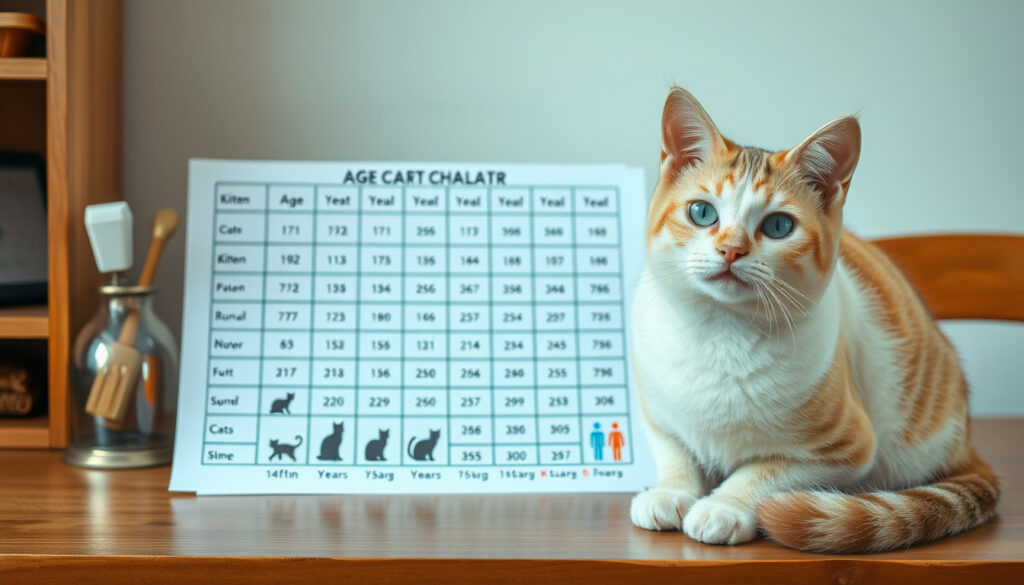
Cat age in human years chart
Nine age milestones show how cats progress through life stages—from kitten to super senior—with corresponding human equivalents based on veterinary guidelines.
| Cat age | Human equivalent | Source |
|---|---|---|
| 6 months | 10 years | AAHA |
| 1 year | 15 years | PetMD citing AVMA |
| 2 years | 24 years | Purina |
| 3 years | 28 years | IAMS |
| 6 years | 40–42 years | Chewy |
| 7 years | 44 years | Purina |
| 10 years | 56–60 years | Purina |
| 15 years | 76 years | Purina |
| 20 years | 96 years | Purina |
Kitten to senior cat stages
| Life stage | Cat age | Human years | Notes |
|---|---|---|---|
| Kitten | 0–2 years | 15–24 years | Rapid growth phase; kitten vaccines due |
| Adult | 3–6 years | 28–40 years | Prime health; regular checkups |
| Mature | 7–10 years | 44–56 years | Subtle aging signs may appear |
| Senior | 11–14 years | 60–72 years | Vet visits every 6 months recommended |
| Super Senior | 15+ years | 76+ years | Special care; exams every 4 months |
Chart for ages 1–20 years
The IAMS life stage chart places cats aged 3–6 cat years in the prime stage (28–40 human years), while the senior stage of 11–14 cat years corresponds to 60–72 human years. This aligns with AAFP definitions that classify cats over 10 years as senior.
The American Animal Hospital Association’s chart shows a 6-month-old cat equals approximately 10 human years, helping owners understand why kittens need early socialization and training before they reach the equivalent of elementary school age.
How old is a 7 year old cat in human years?
A 7-year-old cat is equivalent to 44 human years using the standard formula (15 + 9 + 4×5 = 44). This places the cat in what veterinarians describe as the mature or early senior stage.
Life stage at 7 years
The mature stage begins around age 7 with subtle aging signs: slightly reduced energy, potential changes in appetite, and the start of dental wear. This isn’t old age yet, but it’s when preventive care becomes more important.
Health considerations
- Schedule comprehensive blood work to establish baseline values
- Discuss dental health—adult teeth show wear by this age
- Adjust diet to senior-formulated food if weight management becomes an issue
- Monitor litter box habits for early signs of kidney or thyroid issues
How old is a 15 year old cat?
A 15-year-old cat is equivalent to approximately 76 human years, placing them in the super senior category. The PetMD citing AVMA confirms this calculation aligns with the standard 15+9+4×13 formula.
Senior cat health needs
The AAFP 2021 Feline Senior Care Guidelines recommend that healthy senior cats over 15 years need veterinary exams every 4 months. The 2025 FVMA Feline Oral Health Guidelines also emphasize earlier dental intervention for aging cats, as dental disease worsens with age.
Conversion calculation
Formula: 15 (year 1) + 9 (year 2) + 4 × (cat age − 2). For a 15-year-old cat: 15 + 9 + 4 × 13 = 76 human years. This can be expressed as Human age ≈ 16 + 4 × (cat’s age − 2) for cats over 2 years, as noted by Askavet.
How old is a 20 year old cat?
A 20-year-old cat equals approximately 96 human years using the formula (15 + 9 + 4 × 18 = 96). This is exceptionally rare—most indoor cats live 12–18 years—but it’s possible with excellent care and genetics.
Exceptional longevity factors
According to Naju Pets, a 15-year-old cat is equivalent to a mid-70s human, which means a 20-year-old cat would be pushing near 100 in human terms. Longevity factors include indoor-only lifestyle, regular veterinary care, healthy weight management, and breed genetics.
End-of-life care
At this advanced age, quality of life becomes the primary concern. Senior cats show signs like dental wear, reduced mobility, and potential cognitive changes at 10+ years, according to Askavet. Work with your veterinarian to assess pain management, hydration needs, and nutritional support for a 20-year-old cat.
Calculate cat age in human years
You can manually convert your cat’s age using the AVMA-endorsed formula or follow these steps to find the result quickly.
- Step 1: Identify your cat’s age in whole years.
- Step 2: If your cat is under 2 years, use the fixed values: 1 year = 15 human years; 2 years = 24 human years.
- Step 3: For cats over 2 years, subtract 2 from the cat’s age, multiply by 4, then add 24. Formula: 24 + 4 × (cat age − 2).
- Step 4: Compare the result to the life stage thresholds: kitten (0–2), adult (3–6), mature (7–10), senior (11–14), super senior (15+).
- Step 5: Schedule veterinary appointments based on life stage—every 6 months for seniors, every 4 months for super seniors.
The American Veterinary Medical Association classifies cats as senior after 10 years of age, which means most indoor cats spend a significant portion of their lives in the senior or super senior category. Understanding this helps owners anticipate health screenings, dietary changes, and comfort-focused care.
What we know and what we don’t
Confirmed facts
- The formula (15 + 9 + 4 per year after 2) is consistent across AVMA, iCatCare, and Purina sources
- Cats are considered senior at 10 years by AVMA and AAFP guidelines
- Senior cats over 15 need exams every 4 months per AAFP 2021 guidelines
- Domestic cats age uniformly across breeds, unlike dogs
What’s unclear
- Exact rate variations by breed or individual health conditions remain poorly documented
- Limited peer-reviewed studies directly validating the conversion formula
- Regional or environmental variations in cat aging rates not studied
What experts say
“The first year of your cat’s life is considered the equivalent of 15 human years.”
— Purina (pet nutrition brand)
“Cats are generally considered ‘senior’ after 10 years of age.”
— AVMA (American Veterinary Medical Association)
“The ‘7 cat years = 1 human year’ myth is misleading.”
— Askavet (veterinary blog)
The formula works because it reflects how cats develop rapidly in early life—reaching sexual maturity within their first year, much like humans in early teens—then age more gradually afterward. For cat owners, the practical takeaway is straightforward: a 7-year-old cat needs the same kind of preventive attention a 44-year-old human would prioritize—checkups, blood pressure monitoring, and dental care.
Related reading: Willowbank Wildlife Reserve Reviews · West Coast Wildlife Centre
Cat owners using age charts to gauge maturity levels often turn to specialized Applaws cat food review for tailoring diets to those equivalent human years.
Frequently asked questions
How old is a 7 year old cat in human years?
A 7-year-old cat is equivalent to 44 human years. This calculation: 15 (year 1) + 9 (year 2) + 4 × 5 = 44. Cats at this age are entering the mature stage and may show subtle aging signs.
How to tell your cat’s age in human years?
Use the AVMA formula: first year = 15 human years, second year = 24 total, then add 4 human years for each year after age 2. You can also use an online cat age calculator or refer to a conversion chart.
How old is a 15 year old cat?
A 15-year-old cat is equivalent to approximately 76 human years. This places the cat in the super senior category, requiring veterinary exams every 4 months and potential adjustments to diet, medication, and comfort care.
How old is a 20 year old cat?
A 20-year-old cat equals approximately 96 human years. While exceptionally rare, some indoor cats reach this age with excellent care. At this advanced age, quality of life assessments and palliative care become the priority.
How old is a cat in 3 years?
A 3-year-old cat is equivalent to 28 human years. Calculation: 15 + 9 + 4 × 1 = 28. Cats at this age are in their prime adult stage with peak energy and health.
Is 7 considered old for a cat?
At 7 years (44 human years), cats are in the mature stage—not yet senior, but approaching it. The AVMA classifies cats as senior after 10 years, so 7 is middle-aged. However, this is when preventive care starts becoming more important.
What is a cat age in human years chart?
A cat age chart lists cat years alongside their human equivalent based on the veterinary formula. Standard charts show: 1 year = 15 human years, 2 years = 24, 7 years = 44, 10 years = 56–60, 15 years = 76, and 20 years = 96. These align with life stage definitions from AVMA, AAFP, and AAHA.
More related posts
 Crossword Solver Missing Letter: Free Tools & Tips
 WWE Hall of Fame 2025: Inductees, Watch Guide & 2026 Predictions
 School Bags for Girls: Top Brands and Local Buying Tips
 What Is the Salary? Definition, Frequency & Lookup Guide
 NZX 50 Index Today: Live Price, Chart, News & Analysis
 Richest Country in the World: GDP vs Per Capita
 A Good Girl’s Guide to Murder: Age, LGBTQ, Season 2
 NZD to GBP Exchange Rate: Current Rate, Converter, and History
