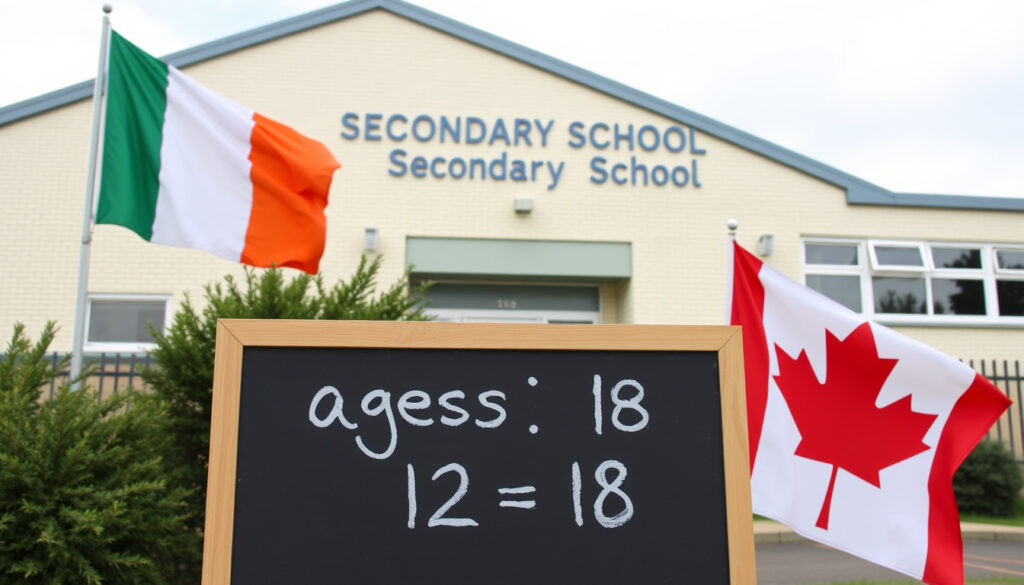
What Is Secondary School? Ireland, Canada, and Key Ages
The same phrase “secondary school” points to different institutions on opposite sides of the Atlantic: in Ireland it means post-primary school starting at age 12 or 13, while in Canada it usually means high school. This guide untangles the definitions, age ranges, and key differences between the two systems, and shows where post-secondary education fits in.
Ireland term: post-primary school, also called secondary school ·
Typical start age: 12 or 13 ·
Secondary school length: 5 or 6 years in Ireland ·
Post-secondary: education after secondary school
Quick snapshot
- Secondary school is an institution that provides secondary education after primary school (Wikipedia (encyclopedic reference)).
- In Ireland it is called post-primary school (Greenheart Travel (student travel guide)). (Wikipedia (encyclopedic reference))
- In some countries, including Canada, it is also called high school (Government of Canada (official immigration site)). (Wikipedia (encyclopedic reference))
- Children usually start at age 12 or 13 (Greenheart Travel (student travel guide)).
- Secondary school is free in Ireland (Citizens Information (Irish public service)).
- It typically lasts 5 or 6 years (Greenheart Travel). (Greenheart Travel (student travel guide))
- Secondary school generally means high school (Government of Canada (official immigration site)).
- Provincial education departments set grade ranges (Statistics Canada (national statistical agency)).
- It is not the same as post-secondary education (Government of Canada). (Government of Canada (official immigration site))
- A 12-year-old may be in primary or starting secondary (ISGI / Guardianship Ireland (education advisory)).
- A 13-year-old is usually in secondary (EducationUSA Canada (educational advising)).
- A 17-year-old in Ireland is usually in senior cycle (ISGI / Guardianship Ireland). (ISGI / Guardianship Ireland (education advisory))
The table below condenses the most important labels and dates.
| Label | Value |
|---|---|
| Secondary school in Ireland | Post-primary school |
| Usual starting age | 12 or 13 |
| Usual length | 5 or 6 years |
| Cost | Free in Ireland |
| Canada | Secondary school usually means high school |
| Post-secondary | College or university after secondary school |
What is a secondary school in Ireland?
In Ireland, secondary school is officially called post-primary school. It is the second level of education, after primary school, and it covers roughly ages 12 to 18, spanning first year through sixth year (Greenheart Travel (student travel guide)). Children are entitled to free secondary education at state-funded schools (Citizens Information (Irish public service)).
What level is secondary school in Ireland?
Post-primary education in Ireland is the second level, after primary school and before post-secondary education. It is split into two cycles: the junior cycle (first three years) and the senior cycle (two or three years, including optional Transition Year) (ISGI / Guardianship Ireland (education advisory)).
What is a secondary school qualification called?
The final state qualification in Irish secondary school is the Leaving Certificate, taken at the end of sixth year. This is the qualification that determines university entry (Citizens Information).
Ireland’s secondary school is a clear two-stage system: three years of junior cycle followed by a senior cycle that includes the optional Transition Year. For students, the path is predictable but flexible enough to allow a gap year within the school system.
The pattern: “post-primary” names a level, not a building; it always follows primary school, and it always comes before post-secondary education.
What is a secondary school in Canada?
In Canada, secondary school generally means high school, covering grades 7 to 12 (ages 12 to 18) in most provinces (Government of Canada (official immigration site)). Education is managed by the provinces, so grade ranges and compulsory attendance ages can vary. For example, in Quebec, high school ends after Grade 11, after which students typically attend CEGEP (Wikipedia (general reference)).
Is secondary school the same as high school in Canada?
Yes, in Canada the terms “secondary school” and “high school” are used interchangeably. There is no separate term like “post-primary” — the stage is simply called high school (Government of Canada).
Bottom line: Canada’s secondary school is a provincial system, not a national one. The implication: a student in Ontario may have a different end-of-school age than one in Quebec, and the grade structure is purely numeric (Grade 7, Grade 8, etc.) rather than named years.
Is a 12 year old in secondary school?
Age 12 sits right at the boundary between primary and secondary school in Ireland. Children usually start secondary school at age 12 or 13, so a 12-year-old could be either in the last year of primary or the first year of secondary (ISGI / Guardianship Ireland (education advisory)). In Canada, a 12-year-old is typically in Grade 7, which is the start of secondary school in most provinces (EducationUSA Canada (educational advising)).
What grade is a 13-year-old in?
In Ireland, a 13-year-old is usually in first or second year of secondary school. In Canada, a 13-year-old is typically in Grade 8 (EducationUSA Canada).
How old is a 6th grader?
A 6th grader in North America is typically 11 or 12 years old. In Canada, Grade 6 is still part of elementary school in most provinces (EducationUSA Canada).
The age boundary between primary and secondary school is not fixed by a single global rule. In Ireland, the cutoff is based on the child’s birthday and school enrollment date, not just the calendar year. That means two 12-year-olds in the same class could be in different stages.
The pattern: age alone does not tell you a student’s stage; you need the local cutoff and entry rules.
Can a child leave school at 16 in Ireland?
In Ireland, a child cannot normally leave school before age 16 or before completing three years of post-primary education, whichever is later (Citizens Information (Irish public service)). A 16-year-old may leave only if the later of those two conditions has been met. This rule applies even if the child is still enrolled in secondary school at age 16.
What is the school leaving age in Ireland?
The compulsory school leaving age in Ireland is 16, but with the condition that the student must have completed three years of post-primary education. If a 16-year-old has not yet completed three years, they must remain in school until the end of that school year (Citizens Information).
Bottom line: Ireland’s school leaving policy is a conditional rule, not a flat age floor. The trade-off: a student who starts secondary at age 13 may be required to stay until age 16, but a student who started at age 12 may be able to leave at 16 after completing three years.
What grade is a 17-year-old in Ireland?
In Ireland, a 17-year-old is usually in 5th or 6th year of secondary school, depending on whether they took Transition Year. If they skipped Transition Year, they are typically in 5th year; if they took it, they are in 6th year (ISGI / Guardianship Ireland (education advisory)). This places a 17-year-old firmly in the senior cycle of post-primary school.
What is post-secondary school?
Post-secondary school is any education after secondary school, including college, university, and vocational training. College is not secondary school; it is post-secondary education (Government of Canada (official immigration site)).
What is the difference between secondary and high school?
In many countries, including Canada, the terms are synonyms. But in Ireland, “secondary school” is the common term, while “high school” is rarely used. The key difference is regional usage: “secondary school” is the standard term in Ireland, the UK, and many Commonwealth countries, while “high school” is standard in North America (Wikipedia (encyclopedic reference)).
A 17-year-old in Ireland is still in secondary school, while a 17-year-old in Canada could be in Grade 12, about to graduate. The difference is not just a year number — it reflects the optional Transition Year that lengthens the Irish system without adding extra academic content.
Six key differences, one pattern: Ireland and Canada organize secondary education around different cycles and terminology, but both lead to post-secondary options.
| Feature | Ireland | Canada |
|---|---|---|
| Common name | Post-primary school / secondary school | High school |
| Typical start age | 12 or 13 | 12 or 13 (Grade 7) |
| Length | 5 or 6 years (incl. Transition Year) | 5 or 6 years (Grades 7–12, varies by province) |
| Compulsory end age | 16 or after 3 years of post-primary | 16–18 depending on province (Statistics Canada) |
| Final qualification | Leaving Certificate | Provincial diploma (e.g., OSSD in Ontario) |
| Distinctive feature | Transition Year (optional) | Provincial control, Quebec has CEGEP |
Confirmed facts and what’s unclear
Confirmed facts
- Secondary school is called post-primary school in Ireland (Greenheart Travel).
- Children in Ireland usually start secondary school at age 12 or 13 (ISGI / Guardianship Ireland).
- Secondary school in Ireland can last 5 or 6 years (Greenheart Travel).
- Children in Ireland are entitled to free secondary school (Citizens Information).
- Post-secondary school means education after secondary school, such as college or university (Government of Canada).
What’s unclear
- The exact age at which an individual 12-year-old starts secondary school depends on birthday and school enrollment.
- A 17-year-old’s year group in Ireland depends on whether they take Transition Year.
- The phrase “secondary school degree” is not a single global qualification; its meaning varies by country.
- The grade at which Canadian secondary school starts depends on province; some provinces begin in Grade 7, while others start later (Statistics Canada).
- Whether a 16-year-old can leave school in Ireland depends on the later of age 16 or three completed years of post-primary education (Citizens Information).
The pattern: the confirmed list captures system-level rules, while the unclear list captures individual exceptions.
Perspectives on secondary school
Post-primary school is also called secondary school. Children usually start post-primary school when they are aged 12 or 13.
– Citizens Information (Irish public service)
Secondary school in Ireland is 5 or 6 years, with three initial years before state examinations.
– Greenheart Travel (student travel guide)
Secondary school is an institution providing secondary education.
– Wikipedia (encyclopedic reference)
The pattern: official, travel, and reference sources agree on the basic structure, but stress different details — which is why local terminology still needs checking.
For a parent in Ireland trying to plan their child’s education, the choice is clear: secondary school is a structured, free system that runs from age 12 to 18, with a flexible Transition Year option. For a family moving to Canada, the same stage is called high school, and the rules vary by province. The implication for families: knowing the local terminology and age boundaries is essential, or you risk misreading the starting point and the leaving age.
educationusacanada.ca, en.wikipedia.org, en.wikipedia.org, ridleycollege.com, k12academics.com, www150.statcan.gc.ca, www150.statcan.gc.ca
Frequently asked questions
How long does secondary school last in Ireland?
Typically 5 or 6 years, depending on whether the student takes Transition Year (an optional one-year programme).
What is the Junior Cycle in Ireland?
The Junior Cycle is the first three years of secondary school, culminating in the Junior Cycle Profile of Achievement (formerly the Junior Certificate).
What is the Senior Cycle in Ireland?
The Senior Cycle spans the final two or three years, including Transition Year (optional), and ends with the Leaving Certificate examination.
What is the Leaving Certificate in Ireland?
The Leaving Certificate is the state final examination taken at the end of sixth year, used for university admissions.
Is secondary school free in Ireland?
Yes, state-funded secondary schools are free for all children in Ireland.
Is college secondary school?
No, college is post-secondary education. Secondary school is the stage before college.
What is a secondary school degree?
There is no single “secondary school degree.” The qualification earned varies by country (e.g., Leaving Certificate in Ireland, high school diploma in Canada).
More related posts
 The Athlete’s Foot NZ: Store Locations & Treatment Guide
 South Island New Zealand: Best Time, Itineraries & Tips
 Michael Kors Bags NZ: Deals, Outlets & Prices
 All I Want for Christmas Is You: Chart History & Record
 Ryman hare price NZX: I RYM undervalued at $2.15?
 Best Dog Training Collars 2025: Vets, Trainers, and Data
 Support Staff Collective Agreement: 2024-2026 Pay Details
