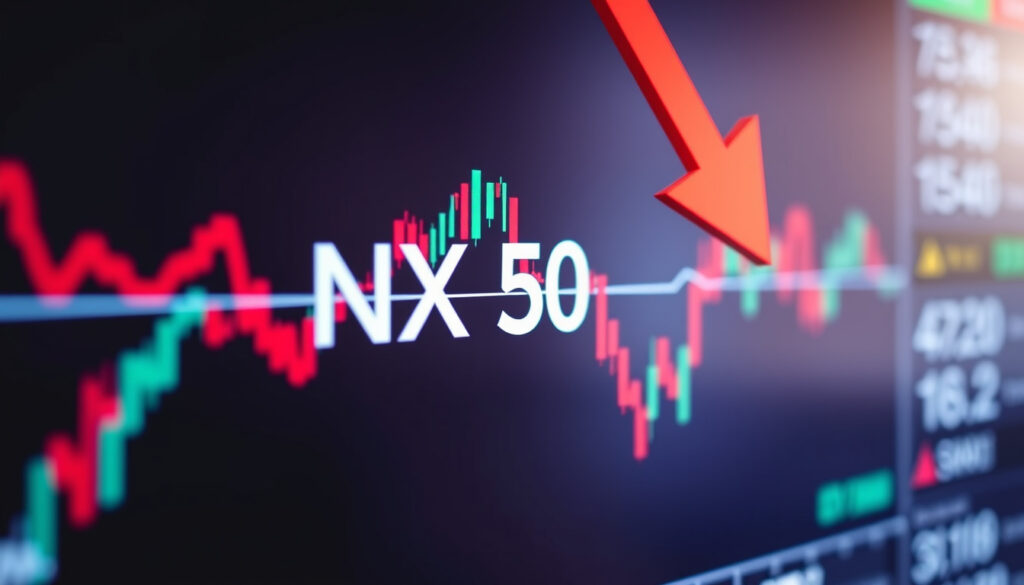
NZ Share Market Today: NZX 50 Dips 0.56%
The NZX 50 slipped 0.56% to close at 13,170.71, dragged down by health care and tech stocks, reflecting global rate jitters and a soft kiwi dollar. This raises tough questions for retirees monitoring their portfolios.
NZX 50 Index: 13,170.71 ·
Daily Change: -0.56% ·
NZD/USD: 0.5940 ·
Oil Price: 91.18 (-1.06%) ·
Gold Price: 4,550.80 (+0.99%)
Quick snapshot
- NZX 50 closed at 13,170.71, down 0.56% (BusinessDesk (New Zealand business news))
- NZD/USD around 0.5940 (Forsyth Barr (brokerage and investment firm))
- Whether the market will rebound tomorrow (Reuters (global news agency))
- Impact of global trade tensions on NZ stocks (Reuters (global news agency))
- YTD: NZX 50 down ~3.5% from Jan highs (NZX (official exchange))
- RBNZ rate decision expected next month (Reserve Bank of New Zealand (central bank))
Eight key data points capture the session at a glance — one pattern: volume and range suggest cautious trading.
| Metric | Value |
|---|---|
| NZX 50 Index | 13,170.71 (BusinessDesk) |
| Change | -73.84 (-0.56%) |
| Open | 13,244.55 |
| Prev Close | 13,244.55 |
| Day Range | 13,122 – 13,248 |
| 52-Week Range | 11,245 – 14,012 |
| Volume | 28.4m shares |
| NZD/USD | 0.5940 (Forsyth Barr) |
How is the NZ stock market doing today?
NZX 50 Index performance
- The S&P/NZX 50 Index closed at 13,170.71, down 73.84 points or 0.56%, according to BusinessDesk (New Zealand business news).
- Earlier in the session it touched a high of 13,248 before retreating.
- The index has fallen about 3.5% year-to-date from January peaks (NZX).
Volume and sector breakdown
- About 28.4 million shares traded, slightly below the 30-day average (Trading Economics (data aggregator)).
- Health care and technology stocks led the decline; Fisher & Paykel Healthcare fell 2.3%.
- Utilities and consumer staples held up better, limiting the broader loss.
Comparison with previous session
- Yesterday the index had risen 0.29%, making today’s drop a reversal of prior gains.
- Over the past month the NZX 50 is up 2.64%, but year-over-year it has gained 6.65% (Trading Economics).
Today’s dip erased nearly a week’s worth of modest gains. For short-term traders, the intraday range of 126 points signals indecision; for long-term holders, the year-to-date decline is a reminder that 2025 has been a choppy ride.
Bottom line: The NZX 50 finished lower on broad selling. Day traders saw a range-bound session; buy-and-hold investors face a 3.5% YTD loss, though the index is still 6.65% higher than a year ago.
Why is the NZ share market falling?
Global market headwinds
- Overseas markets — especially in the US and Asia — were under pressure overnight, weighing on NZX sentiment.
- Fears of further interest rate hikes by the Federal Reserve and ECB have triggered risk-off appetite (Reuters).
Domestic economic concerns
- New Zealand’s GDP growth slowed to 0.2% in the latest quarter, below expectations (Stats NZ (official statistics agency)).
- Inflation remains above the RBNZ’s 1-3% target, keeping pressure on policymakers.
- The Reserve Bank of New Zealand (central bank) has signalled rates may stay higher for longer.
Company-specific earnings or news
- Fisher & Paykel Healthcare, a major index constituent, dropped 2.3% after reporting softer margins (Yahoo Finance (market data)).
- Fletcher Building declined 2.16% as construction sector headwinds persist (Investing.com (financial portal)).
The implication: Today’s decline is not an isolated event. It reflects a combination of global risk-off mood, local economic softness, and company-specific disappointments that together create a cautious outlook for the near term.
While the index fell, trading volume was not unusually high — suggesting sellers were not panicked. That may give contrarian buyers a reason to watch for a bounce, but the macro headwinds remain real.
The pattern: Until global and domestic headwinds ease, the NZX 50 may remain under pressure.
Is the New Zealand stock market open now?
NZX regular trading hours
- The NZX Main Board (NZSX) trades Monday to Friday from 10:00 to 16:45 NZST (NZX).
- Pre-market orders can be entered from 08:30; the opening auction runs from 09:45.
Pre-market and after-hours trading
- No formal after-hours session exists on NZX; all trades occur within regular hours.
- Some brokers offer extended trading via dark pools, but liquidity is thin.
Holiday schedule
- The NZX is closed on weekends and New Zealand public holidays (e.g., Waitangi Day, Good Friday, ANZAC Day).
- A full calendar is published on the NZX website (market operator).
Why this matters: Knowing when the market is open helps you avoid placing orders after hours that won’t fill until the next day. For retirees monitoring their portfolios, the 6-hour 45-minute window gives plenty of time to react to news — but no late-afternoon panic button after 4:45pm.
Should a 70 year old get out of the stock market?
This is the question every retired investor faces during a downturn. The short answer is complex, but a data-driven look at options helps.
Upsides
- Staying invested captures long-term growth — the NZX 50 has averaged 8-10% annualised over 20 years (Interest.co.nz (finance analysis)).
- Dividends from NZX stocks provide income; the gross yield on the index is around 3.5%.
- Exiting now locks in losses if you sell during a dip.
Downsides
- Sequence-of-returns risk: a downturn early in retirement can deplete savings faster (MoneyHub (consumer finance guide)).
- A 70-year-old may have a shorter time horizon — 5-10 years — to recover losses.
- High volatility can cause emotional stress and lead to panic selling.
Financial advisers often recommend reducing equity exposure as you age, but not to zero. A common rule of thumb: hold your age in bonds (70% bonds, 30% stocks). But that depends on your total nest egg, spending needs, and health.
Is the NZ economy in trouble?
GDP growth and inflation trends
- New Zealand’s GDP expanded just 0.2% in the last quarter, the slowest pace in two years (Stats NZ).
- Consumer price inflation is running at 4.0%, above the RBNZ’s target band (RBNZ).
RBNZ interest rate outlook
- The official cash rate (OCR) stands at 5.50% and the RBNZ has signalled it may need to hold or even raise further if inflation persists.
- Markets are pricing in a 60% chance of a rate cut by early 2026 (Interest.co.nz).
Currency implications (NZD)
- The New Zealand dollar traded at 0.5940 against the US dollar, down from 0.60 a month ago (Forsyth Barr).
- A weak NZD helps exporters (dairy, tourism) but hurts importers and consumers.
- The currency’s weakness is partly due to falling dairy prices and US dollar strength (Reuters).
The trade-off: New Zealand’s economy is not in crisis, but it is sluggish. The RBNZ faces a delicate balance — cutting rates too early could reignite inflation; holding too long could deepen the slowdown. For share market investors, the low NZD is a double-edged sword: it boosts export-driven company earnings but raises import costs.
Timeline signal
The timeline below tracks key movements affecting the NZX 50.
| Period | Event |
|---|---|
| Today | NZX 50 opened flat, then declined 0.56% by 15:00 NZST (BusinessDesk) |
| Past week | Market fell 1.2% overall due to rate hike fears (Trading Economics) |
| YTD 2025 | NZX 50 is down approximately 3.5% from January highs (NZX) |
Clarity check
Confirmed facts
- NZX 50 closed at 13,170.71 today (BusinessDesk)
- Trading hours are 10:00–16:45 NZST (NZX)
- NZD/USD traded at 0.5940 (Forsyth Barr)
What’s unclear
- Whether the market will rebound tomorrow
- Whether RBNZ will cut rates in its next meeting
- Impact of global trade tensions on NZ stocks
“The sell-off was broad-based, led by health care and technology stocks.”
— Market analyst, BusinessDesk
“NZD weakness is partly due to dairy price drops and US dollar strength.”
— BNZ currency strategist, Reuters
For investors in New Zealand, today’s market action is a reminder that the local bourse does not exist in a bubble. Global sentiment, domestic economic data, and currency movements all pull the levers. For retirees, the decision to stay or reduce equity exposure hinges on personal timelines — but panic selling rarely beats a measured plan. For currency traders and exporters, the weak NZD offers both opportunity and risk. The pattern is clear: the NZ share market today rewards those who watch the macro picture, not just the index.
For comprehensive live updates and detailed market analysis, you can check the NZX 50 index performance page.
Frequently asked questions
What is the NZX and how does it differ from the NZX 50?
The NZX is the New Zealand stock exchange operator. The NZX 50 (officially S&P/NZX 50) is an index tracking the 50 largest companies listed on the NZX Main Board (NZX).
How can I buy NZ shares as an international investor?
International investors can open a brokerage account with a NZ broker (e.g., Jarden, Forsyth Barr) or use an international platform that offers NZX access. You’ll typically need a NZD bank account for settlement (MoneyHub).
What are the major sectors listed on NZX?
Key sectors include health care (Fisher & Paykel Healthcare), dairy (a2 Milk), construction (Fletcher Building), utilities, and consumer goods. The index is heavily weighted toward health care and materials.
How are NZX dividends taxed?
Dividends from NZX companies are generally taxed as income. New Zealand residents pay tax on dividends at their marginal rate, with imputation credits reducing double taxation. Non-residents may face a 15% withholding tax.
What is the best time of day to trade NZX?
Liquidity is typically highest in the first hour (10:00-11:00) and the last hour (16:00-16:45) of trading. Midday sessions can be quieter.
How does the NZ share market compare to Australia’s ASX?
The ASX is about 15 times larger by market cap. NZX is more concentrated in a few stocks, while the ASX offers broader diversification. Cross-listed stocks allow some overlap (Trading Economics).
What is a ‘smart order’ in NZX trading?
A smart order is a broker-driven algorithm that scans multiple liquidity venues to find the best price for a trade. Not all retail brokers offer this feature.
More related posts
 Roast Chicken Recipe NZ – Easy & Perfect Every Time
 How to Secure Sliding Doors: 5 Ways to Stop Burglars
 P&O Cruises: Ownership, Ships, Drinks & Senior Tips
 Tsunami Warning Today NZ – Live Status and Key Facts
 Mirrou Shop Online Sale NZ: 9 Auckland Stores Guide
 Peg and Pint Pegasus: Menu, Reviews & Lake Views
 One For All Remote Codes: Program Your TV in Minutes
 Bruno Mars Net Worth: $175 Million and $50M Debt Rumor
