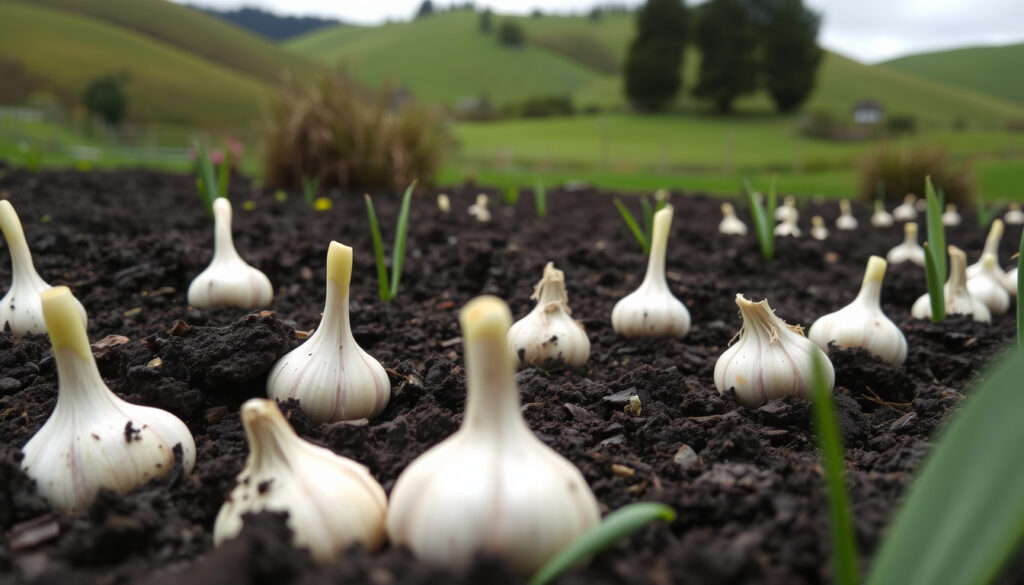
When to Plant Garlic in New Zealand: Complete Guide
There’s a moment in every Kiwi gardener’s year when the soil cools and the question arrives: when exactly should I get garlic in the ground? The answer isn’t a single date — it depends on where you live, what variety you’re growing, and whether you’re planting in pots or open ground, which is why this guide walks through the timing, technique, and tricks that New Zealand gardeners actually use.
Optimal planting window: April–July · Harvest period: November–December · Recommended depth: 3–5 cm · Spacing between cloves: 10–15 cm · Time to maturity: 6–8 months · Ideal soil pH: 6.0–7.0
Quick snapshot
- April–July: main planting window (Tui Garden)
- March–April: early varieties (Edible Backyard)
- November–December: harvest (Grow Yours)
- Pots vs ground? (Love the Garden NZ)
- Peel cloves? (Awapuni)
- Companion planting? (Kōanga)
- Traditional rule: shortest day to longest day (Palmers)
- Early planting reduces rust risk (Gourmet Garlic)
The table below summarises the key planting parameters for garlic in New Zealand.
| Factor | Value |
|---|---|
| Planting depth | 3–5 cm |
| Spacing | 10–15 cm between cloves |
| Days to maturity | 180–240 days |
| Optimal soil pH | 6.0–7.0 |
| Harvest window | November–December |
When to plant garlic in New Zealand?
New Zealand runs a broad planting window from April through July, but the exact month depends on your region and the variety you choose. The old Kiwi rule — plant on the shortest day, harvest on the longest — still holds as a rough guide, but modern growers have more nuance.
Early planters get bigger bulbs and less rust, but risk rotting if autumn soils stay too wet. Late planters wait for drier ground but confront a shorter growing season. There’s no perfect date — only the best for your patch.
When to plant garlic in Auckland
Auckland’s mild, frost-free winters change the timing. Warmer areas can benefit from starting earlier — Yates NZ recommends April planting for Auckland and other warm northern regions (Yates NZ gardening guide). The risk of rust increases if you delay into June, so early planting gives the cloves a head start before fungal pressure builds.
When to plant garlic in pots
Container planting opens a wider window because you control the soil temperature and drainage. But pots also mean less insulation from cold snaps. Gourmet Garlic notes that milder winters call for earlier planting and colder areas for later planting (Gourmet Garlic planting guide). In pots, aim for April to June — the same window as ground planting, but with the advantage of moving pots to sheltered spots if frost threatens.
Is it too late to plant garlic?
If you missed April–May, don’t panic. Awapuni suggests an ideal planting time of mid-June to August (Awapuni garlic guide). Daltons says late autumn to mid-winter is the best time for the South Island and across New Zealand (Daltons planting guide). What you sacrifice in bulb size with late planting, you may gain in cleaner soil conditions and less disease pressure.
The implication: timing flexibility is real, but every week past May costs you some yield. Early planting delivers the heaviest bulbs; late planting still works for good crops, especially with short-season varieties.
Bottom line for NZ gardeners: Plant garlic from April to July; early planting reduces rust risk and boosts bulb size, but late planting is still viable if soil conditions are right.
How deep to plant garlic?
Getting depth wrong is the most common beginner mistake. Too shallow and the cloves heave out in frost; too deep and they struggle to break the surface.
Spacing and depth for NZ gardens
- Plant cloves 3–5 cm deep — measure from the tip of the clove to the soil surface (Love the Garden NZ)
- Space cloves 10–15 cm apart in rows 30 cm apart (Palmers NZ)
- Pointy end up, root plate down — it matters for straight growth (Grow Yours)
Step-by-step planting guide
- Separate cloves from the bulb 24–48 hours before planting, keeping the root plate intact (Kōanga).
- Plant cloves 3–5 cm deep with the pointy tip facing up (Love the Garden NZ).
- Space cloves 10–15 cm apart in rows 30 cm apart (Palmers NZ).
- Water deeply after planting and keep soil moist but not waterlogged (Grow Yours).
- Mulch with straw or compost to retain moisture and suppress weeds (Yates NZ).
Heavy clay soils need shallower planting — go no deeper than 3 cm — because the clove needs air as well as moisture. Sandy soils allow the full 5 cm without risk.
Why this matters: depth controls how well the clove roots before winter. Too shallow = frost lift. Too deep = delayed emergence. The 3–5 cm rule is a tested middle ground for New Zealand’s variable conditions.
Is garlic better in pots or ground?
The answer splits roughly along climate lines. Pots give you control and mobility; ground gives you volume and bulb size. But for many New Zealand growers, the choice comes down to whether your garden drains well enough.
Benefits of growing garlic in pots
- Mobility: shift containers to sunnier or drier spots as weather changes (Love the Garden NZ)
- Soil control: fill with premium compost and avoid soil-borne diseases (Yates NZ)
- Cool climate advantage: South Island growers can start pots in a greenhouse and move them out after frost risk passes (Gourmet Garlic)
Benefits of growing garlic in ground
- Larger bulbs: unrestricted root growth produces bigger, heavier garlic (Edible Backyard)
- Lower cost: no pots, no potting mix purchases each season (Daltons)
- Better moisture buffer: ground holds water more evenly through dry spells (Tui Garden)
How to grow garlic in pots in NZ
Container depth is critical. Use pots at least 20 cm deep with drainage holes. Fill with a mix of quality potting mix and compost. Space cloves 10 cm apart even in pots — crowding reduces bulb size. Water less than you think: garlic hates wet feet (Grow Yours).
The table below compares the key differences between pots and ground.
| Factor | Pots | Ground |
|---|---|---|
| Bulb size potential | Smaller (10–20% smaller on average) | Larger (full potential) |
| Drainage control | Full control | Depends on soil type |
| Climate adaptation | Movable to shelter | Fixed exposure |
The pattern: pots win for renters, cold-climate growers, and anyone with heavy clay. Ground wins for volume and quality. Neither is wrong — they’re tools for different situations.
Decision guide for NZ growers: If you have well-drained soil and space, ground planting gives larger bulbs. If you face heavy clay, cold winters, or limited space, pots offer control and flexibility.
Do you peel garlic cloves before planting?
It’s one of those questions every first-time garlic grower asks. The short answer is straightforward, but the reasoning matters.
Should you peel the papery skin?
Do not peel. The papery skin protects the clove from soil pathogens and rot. Plant the clove with its skin intact (Awapuni garlic planting guide).
How to prepare cloves for planting
- Separate cloves from the bulb 24–48 hours before planting (Kōanga growing guide)
- Keep the root plate (the hard base) intact — damage here means no roots (Tui Garden)
- Soak in a seaweed solution for 2–4 hours before planting to reduce disease risk, but this is optional (Yates NZ)
What this means: the skin is armour, not packaging. Leave it on and your clove stands a much better chance against soil-borne fungi.
What should you not plant garlic next to?
Companion planting with garlic isn’t nostalgia — it’s pest management. But some plants actively hate having garlic as a neighbour.
Companion plants for garlic
- Roses: garlic deters aphids that attack rose buds (Kōanga companion planting notes)
- Tomatoes: garlic repels red spider mites and improves tomato flavour (Edible Backyard)
- Carrots: garlic masks the scent that attracts carrot rust fly (Gourmet Garlic)
- Brassicas (cabbage, broccoli, kale): garlic discourages cabbage white butterfly (Love the Garden NZ)
Plants to avoid near garlic
- Peas and beans: garlic stunts legume growth by blocking beneficial bacteria (Daltons)
- Asparagus: competition for nutrients and space reduces both crops (Grow Yours)
- Sage and parsley: allelopathic effects — garlic chemicals suppress their growth (Palmers NZ)
Animals that garlic repels
The same sulfur compounds that give garlic its pungency also work as a deterrent. Garlic planted near garden borders repels aphids, slugs, and snails — plus deer and rabbits in rural gardens (Gourmet Garlic).
The trade-off: garlic is a powerful ally and an equally powerful antagonist. Plan your garden layout with these interactions in mind and you’ll save yourself pest control work later.
Can you leave garlic in the ground too long?
Yes — and the consequences are visible. Over-mature garlic splits open in the soil, stores poorly, and risks rot.
Signs it’s time to harvest
- Lower leaves turn yellow and dry — usually 3–5 brown leaves out of 8–10 total (Tui Garden)
- Leaf tips die back from the bottom upwards (Edible Backyard)
- Bulb wrappers feel paper-thin and tight (Grow Yours)
What happens if you plant a single clove
One clove grows into a full bulb containing 5–12 new cloves (Awapuni). That’s the multiplication rate — from one clove, a whole bulb. Save your biggest cloves for next season’s planting stock and eat the rest.
Storing harvested garlic
Cure garlic in a dry, airy place for 2–3 weeks before storage — hang in bundles or spread on a wire rack (Yates NZ). Once cured, store in a cool, dark cupboard (not the fridge). Softneck varieties store 6–8 months; hardnecks last 3–5 months (Gourmet Garlic).
Why this matters: harvesting a week late costs you months of storage life. Watch the leaf colour — it’s your best calendar.
Timeline: Garlic planting in New Zealand
New Zealand’s growing conditions span from subtropical to cool temperate. The timeline below covers the full cycle from early planting through harvest.
Plant early garlic varieties (e.g., Early Purple) (Edible Backyard)
Main crop planting (most common) (Grow Yours)
Late planting possible; risk of rust increases (Gourmet Garlic)
Active growth; apply fertiliser (Yates NZ)
Harvest when lower leaves yellow (Tui Garden)
The pattern: early planting reduces disease risk, while late planting may work but with smaller bulbs.
Confirmed facts and what’s unclear
Confirmed facts
- Plant garlic in autumn/winter (April–July) in NZ (Tui Garden)
- Do not peel cloves before planting (Awapuni)
- Harvest when lower leaves turn yellow and dry (Edible Backyard)
- Spacing 10–15 cm gives best bulb size (Palmers)
What’s unclear
- Exact harvest date varies by variety and microclimate (Kōanga)
- Effectiveness of companion planting is anecdotal but widely practiced (Gourmet Garlic)
- Pots vs ground preference depends on specific garden conditions (Love the Garden NZ)
The key is to use the confirmed facts as a foundation and adapt to your local conditions.
Expert perspectives
“In New Zealand garlic planting time is April–July.”
— Tui Garden (NZ garden retailer and growing guide publisher)
“Have a go with early varieties in March and April, and main crop varieties in May.”
— Edible Backyard (NZ edible gardening educator)
“By planting early the garlic plants have a great start… before rust season.”
— KoruKai Blog (NZ gardening and food blog)
The pattern across these sources is consistent: early planting reduces disease pressure and increases yield. The risk is wet soil, not cold soil.
Frequently asked questions
How often should I water garlic?
Water deeply every 7–10 days during dry spells. Stop watering completely 2–3 weeks before harvest to allow bulbs to dry and cure underground. Overwatering causes rot and splits.
What fertiliser is best for garlic in NZ?
Use a balanced slow-release fertiliser at planting time, then top-dress with a high-potassium feed every 4 weeks through active growth. Blood and bone works well for organic growers.
Can I grow garlic from supermarket cloves?
You can, but it’s risky. Supermarket garlic is often sprayed with growth inhibitors and may carry diseases not present in NZ seed garlic. Always buy from a reputable NZ supplier.
How to prevent rust disease on garlic?
Plant early, space cloves well for airflow, rotate crops every 2–3 years, and avoid overhead watering. No chemical control is fully effective — prevention is the only reliable defence.
When should I fertilise garlic?
Apply fertiliser at planting time, then again in early spring (August–September) when active growth resumes. A third feed in mid-spring can boost bulb size but stop by October.
How to store garlic after harvesting?
Cure for 2–3 weeks in a dry, airy place, then store in a cool, dark cupboard. Softneck varieties keep 6–8 months; hardnecks last 3–5 months. Never refrigerate.
What are the best garlic varieties for New Zealand?
Early Purple for early harvest, Glenlarge for main crop, and Elephant garlic for mild flavour in salads. Hardneck varieties like Chesnok Red suit cooler southern regions.
These answers cover the most common concerns for NZ garlic growers.
For New Zealand gardeners, the best garlic planting window is April to July, with early planting reducing rust risk. Whether in pots or ground, proper depth and spacing ensure a successful harvest.
Related reading
More related posts
 Cast of Sleepy Hollow (1999): Full List, Facts & Harry Potter Overlap
 2026 School Holidays NZ: Full Calendar and Term Dates
 Translate Portuguese to English: Best Free Tools
 NZD to GBP Exchange Rate: Current Rate, Converter, and History
 Rhythm and Vines Lineup 2026: Full Artist List
 Harper Vivienne Ann Lockwood: Biography, Custody & Facts
 Life Insurance Comparison NZ 2026: Best Policies, Quotes & Costs
 Ninja Swirl Creami NZ: Price, Differences & Verdict
