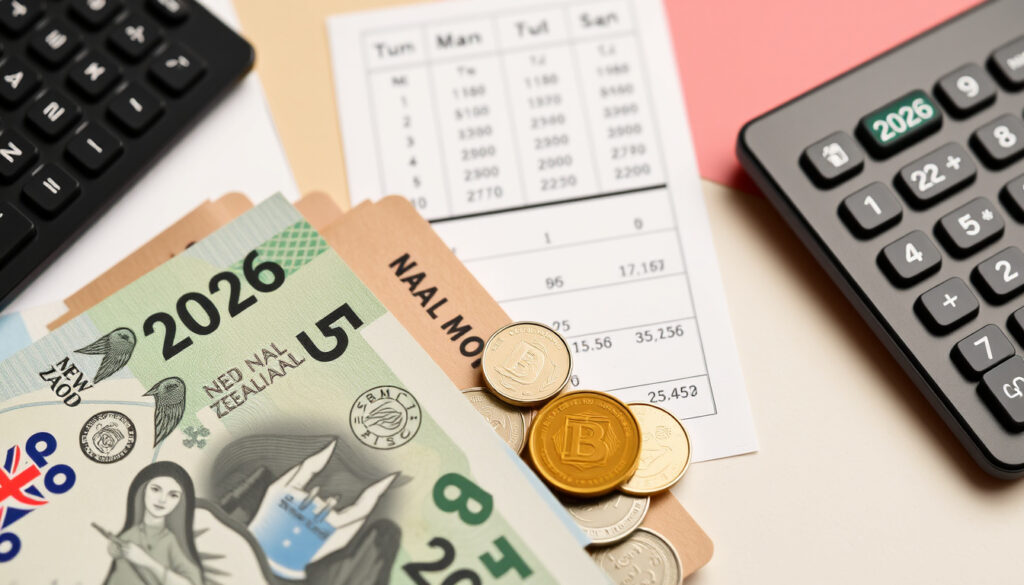
New Zealand Minimum Wage 2026: Hourly, Weekly & Annual Rates
If you’ve ever tried to stretch a weekly pay packet across rent, groceries, and a bit of fun in New Zealand, you already know the math doesn’t always add up. The minimum wage is set to rise to NZD 23.95 per hour from 1 April 2026 New Zealand Legislation – Minimum Wage Order 2026 — a 45-cent bump that sounds good on paper, and this guide breaks down what that actually means for your weekly take-home pay, how it stacks up against the cost of living, and where New Zealand stands next to Australia and the UK.
“From 1 April 2026, the adult minimum wage increases to $23.95 per hour.”
“The starting-out and training rates remain at 80% of the adult minimum wage.”
Current adult minimum wage: NZD 23.95/hour · Starting-out wage: NZD 19.16/hour · 40-hour gross (adult): NZD 958/week · Annual gross (adult): NZD 49,816 · Effective date: 1 April 2026
Quick snapshot
- Adult minimum wage: NZD 23.95/hour (NZ Legislation – Minimum Wage Order 2026)
- Starting-out/training wage: NZD 19.16/hour (Employment New Zealand)
- No minimum wage for workers under 16 (NZ Legislation – Minimum Wage Order 2026)
- Exact after-tax take-home depends on individual tax credits and deductions (Deloitte NZ Tax Highlights 2026)
- Living costs vary significantly by city and household size (Stats NZ)
- Future rates beyond 2026 are unannounced (MBIE)
- Annual review cycle: rates announced Jan/Feb, effective 1 April
- 2026 increase: 1.9% rise from NZD 23.50 to NZD 23.95
- Starting-out wage remains at 80% of adult rate
Key facts: New Zealand minimum wage rates
The rates are straightforward, but the impact varies depending on exemptions and hours worked.
| Category | Hourly rate | Weekly (40 hrs) | Annual (52 weeks) |
|---|---|---|---|
| Adult minimum wage | NZD 23.95 | NZD 958.00 | NZD 49,816 |
| Starting-out / training wage | NZD 19.16 | NZD 766.40 | NZD 39,852 |
| Workers under 16 | No minimum wage | — | — |
| After-tax take-home (adult, approx.) | — | ~NZD 779 | ~NZD 40,500 |
| Monthly gross (adult, 4.333 weeks) | — | — | ~NZD 4,149 |
| Starting-out weekly gross | NZD 19.16 | NZD 766.40 | — |
| Starting-out annual gross | — | — | NZD 39,852 |
Six rows, one standout: the 40-hour week at adult rate barely crosses NZD 958 gross — before tax, before rent.
What is 40 hours minimum wage in NZ?
How is the 40-hour minimum wage calculated?
- Adult minimum wage × 40 hours = NZD 23.95 × 40 = NZD 958.00 gross per week (New Zealand Legislation – Minimum Wage Order 2026)
- Monthly: NZD 958.00 × 4.333 = ~NZD 4,149 gross
- Starting-out wage at 40 hours: NZD 19.16 × 40 = NZD 766.40 gross per week (Employment New Zealand)
- Annual gross (adult, 40 hrs): NZD 958.00 × 52 = NZD 49,816
What are the gross weekly and annual amounts?
At 40 hours per week on the adult minimum wage, you earn NZD 958.00 before any deductions. Over a full year, that comes to NZD 49,816. For someone on the starting-out wage of NZD 19.16, the annual figure drops to NZD 39,852.
A minimum-wage worker pulling 40 hours weekly grosses NZD 49,816 annually — but after PAYE tax, the take-home shrinks to roughly NZD 40,500, or about NZD 779 per week.
Does the minimum wage apply to all workers?
- Workers aged 16 and over who are not starting-out workers or trainees must receive at least the adult minimum wage of NZD 23.95/hour (MBIE – Minimum Wage Order 2026 Proactive Release)
- Starting-out workers (those new to the workforce or under 20) and trainees can be paid NZD 19.16/hour
- Workers under 16 have no legal minimum wage requirement
- The minimum wage applies nationally and does not vary by region
The pattern: New Zealand uses a simple three-tier system — adult, training, and under-16 exemption — with no regional adjustments, meaning Auckland renters and Invercargill renters get the same base rate despite wildly different housing costs.
How much salary is enough to live in New Zealand?
What is the cost of living breakdown for a single person?
Regional budgeting guidance suggests a single person renting in Auckland or Wellington may face core living costs of about NZD 2,400 to NZD 3,500+ per month (Owdyn – NZ Cost of Living 2026 analysis). That includes rent, groceries, transport, utilities, and basic essentials. The cost of living for the average New Zealand household increased 2.1 percent in the 12 months to the March 2026 quarter, according to Stats NZ.
A worker on NZD 49,816 annual gross taking home ~NZD 40,500 after tax faces monthly rent in Auckland (NZD 2,000–2,500 for a one-bedroom) eating 60–74% of take-home pay — before a single grocery is bought.
How does the minimum wage compare to the living wage?
- The living wage campaign in New Zealand targets approximately NZD 26.00 per hour
- At NZD 23.95, the adult minimum wage sits about NZD 2.05 below that target
- A worker earning the living wage at 40 hours would gross NZD 1,040 weekly or NZD 54,080 annually
What are the rental costs in major cities?
- Auckland: average one-bedroom rent NZD 2,000–2,500 per month
- Wellington: comparable to Auckland, slightly lower in outer suburbs
- Christchurch, Hamilton, Tauranga: generally cheaper, around NZD 1,500–2,000 for one-bedroom
The catch: even in lower-cost cities, minimum-wage take-home of ~NZD 3,375 per month means rent consumes 45–60% of income — well above the recommended 30% threshold.
Is $70,000 a good salary in New Zealand?
How does $70,000 compare to the median salary?
New Zealand’s median salary sits at approximately NZD 70,000 per year. That’s roughly 40% higher than the minimum wage annual gross of NZD 49,816. A $70,000 salary places you squarely in the middle of the income distribution.
Can you live comfortably on $70,000 in different cities?
- In Auckland: after-tax take-home of ~NZD 56,500 leaves about NZD 4,708 per month; rent for a one-bedroom at NZD 2,250 leaves NZD 2,458 for all other costs
- In Christchurch: lower rent means more breathing room — potentially NZD 600–800 more per month after housing
- $70,000 is comfortable for a single person outside Auckland/Wellington, but tight for a family with children
$70,000 is a good salary — it’s median, after all — but it buys far more in Christchurch than Auckland. Location, not just income, determines comfort in 2026.
What is the after-tax income for $70,000?
Using the 2026 tax brackets from Deloitte New Zealand Tax Highlights 2026 — 10.5% up to NZD 15,600, 17.5% from NZD 15,601 to NZD 53,500, and 30% above that — a $70,000 salary yields roughly NZD 56,500 after tax, or NZD 4,708 per month.
The implication: a $70,000 salary’s after-tax value is solid, but its real-world purchasing power depends heavily on whether you rent in Auckland or Christchurch.
To further understand how salary benchmarks work, see our guide on What Is the Salary?.
Is it cheaper to live in NZ or UK?
How do housing costs compare?
- Auckland rent is comparable to London suburbs but higher than regional UK cities like Manchester or Birmingham
- UK’s National Minimum Wage (for workers 21+) is GBP 11.44/hour (~NZD 23.00) as of 2026 — similar to NZ’s adult rate
- Deposit requirements and stamp duty in the UK create different barriers to home ownership
What about groceries, transport and utilities?
- Groceries are generally more expensive in NZ — up to 10–15% higher than UK equivalents
- Petrol and public transport costs are comparable, though UK has more extensive subsidised rail networks
- Utilities (electricity, internet) are more expensive in NZ due to lower population density and infrastructure costs
Which country offers better value for a minimum wage worker?
New Zealand’s cost of living is generally higher than the UK in 2026, according to comparison data from Owdyn’s cost analysis. A minimum wage worker in the UK may find cheaper groceries and utilities, while NZ offers better climate and outdoor lifestyle — but the wallet feels tighter in NZ.
New Zealand offers a higher headline minimum wage than the UK in nominal terms, but higher living costs — especially housing and food — partially cancel that advantage. The trade-off is lifestyle versus buying power.
The choice between NZ and UK for minimum wage workers comes down to whether lifestyle or buying power is the priority.
Which country pays the highest minimum wage?
Where does New Zealand rank globally?
New Zealand’s adult minimum wage of NZD 23.95 (~USD 14.40) ranks approximately 8th highest among OECD nations — ahead of the UK and Canada, but behind Australia, Luxembourg, Switzerland, and several other European countries.
What are the top five highest minimum wage countries?
The following table compares the top five minimum wage countries, showing how NZ stacks up.
| Country | Minimum wage (local currency) | Approximate NZD equivalent |
|---|---|---|
| Australia | AUD 24.10/hour | ~NZD 25.80 |
| Luxembourg | EUR 14.86/hour (skilled workers) | ~NZD 26.50 |
| Switzerland | Varies by canton; CHF 23–24/hour in Geneva | ~NZD 40–42 |
| Germany | EUR 12.82/hour (2026) | ~NZD 22.80 |
| New Zealand | NZD 23.95/hour | NZD 23.95 |
Five countries, one clear pattern: Australia pays about NZD 1.85 more per hour than New Zealand. Over a 40-hour week, that’s an extra NZD 74 — or about NZD 3,848 more per year.
How does purchasing power adjust these comparisons?
Purchasing power parity can alter the real value of minimum wages. While Switzerland’s rate looks massive, its cost of living is also among the world’s highest. Australia tends to come out ahead in purchasing power comparisons due to relatively lower housing costs outside Sydney and Melbourne.
The implication: New Zealand’s minimum wage ranks well globally, but the gap widens when adjusted for purchasing power — especially against Australia.
Timeline: Minimum wage increases in New Zealand
- March 2024: Adult minimum wage at NZD 22.70; training wage at NZD 18.16 (MBIE)
- 1 April 2025: Adult rate increased to NZD 23.50 per hour (Employment New Zealand)
- 1 April 2026: Adult minimum wage rises 45 cents to NZD 23.95; starting-out/training wage rises to NZD 19.16
- Ongoing: Annual review each year, typically announced in late January or February, effective 1 April (MBIE)
The pattern: increases have been modest — 45 cents in 2026, roughly 1.9% — barely keeping pace with household living-cost inflation of 2.1% reported by Stats NZ for the same period.
payroll.org, mbie.govt.nz, xero.com, beehive.govt.nz, tradingeconomics.com
Frequently asked questions
What is the minimum wage in New Zealand for foreigners?
The same minimum wage applies to all workers legally employed in New Zealand, regardless of citizenship or visa status. Foreigners on work visas must receive at least NZD 23.95 per hour from 1 April 2026.
Do students get the minimum wage in New Zealand?
Yes — students aged 16 and over who are not starting-out workers or trainees must be paid the adult minimum wage of NZD 23.95 per hour. Students under 16 have no minimum wage entitlement.
Is the minimum wage in New Zealand enough to live on?
For a single person renting in Auckland or Wellington, the minimum wage is tight. After-tax take-home of roughly NZD 779 per week leaves little after rent (NZD 500–625/week for a one-bedroom), groceries, and transport. In lower-cost cities, it’s more manageable.
How often does the minimum wage change in NZ?
The government reviews the minimum wage annually, with new rates typically announced in late January or February and taking effect on 1 April each year.
What is the minimum wage for a work visa holder in New Zealand?
Work visa holders must be paid at least the adult minimum wage of NZD 23.95 per hour. Accredited employer work visas may require higher wage thresholds depending on the role.
Does New Zealand have the highest minimum wage in the world?
No. New Zealand ranks approximately 8th globally. Australia, Luxembourg, and Switzerland all have higher minimum wages in nominal terms, and Australia’s purchasing power advantage is larger.
What is the minimum wage in New Zealand in USD?
At current exchange rates (~0.60 USD/NZD), NZD 23.95 is approximately USD 14.37 per hour. This places NZ above the US federal minimum wage of USD 7.25 but below several US states.
For minimum wage workers in New Zealand, the choice in 2026 is clear: the rate is among the world’s highest, but the cost of living — especially housing — erodes much of that advantage, making it hardest for those in Auckland and Wellington.
More related posts
 Car Parts Near Me: Complete Buying Guide for UK & Ireland
 Fo Guang Shan Temple Auckland: Photos, Dress Code & Cafe Guide
 Chelsea F.C. vs Arsenal F.C.: Head-to-Head, Stats, and Pride
 Royal Canin Dog Food: Reviews, Prices, Vet Advice
 Learning Spanish Free: Tips for Seniors & Dyslexia
 Love Island UK Season 12 – Dates, Host, Cast, Episodes
 100 Men vs 1 Gorilla: Who Would Win? Strength & Genetics Compared
 Translate Portuguese to English: Best Free Tools
