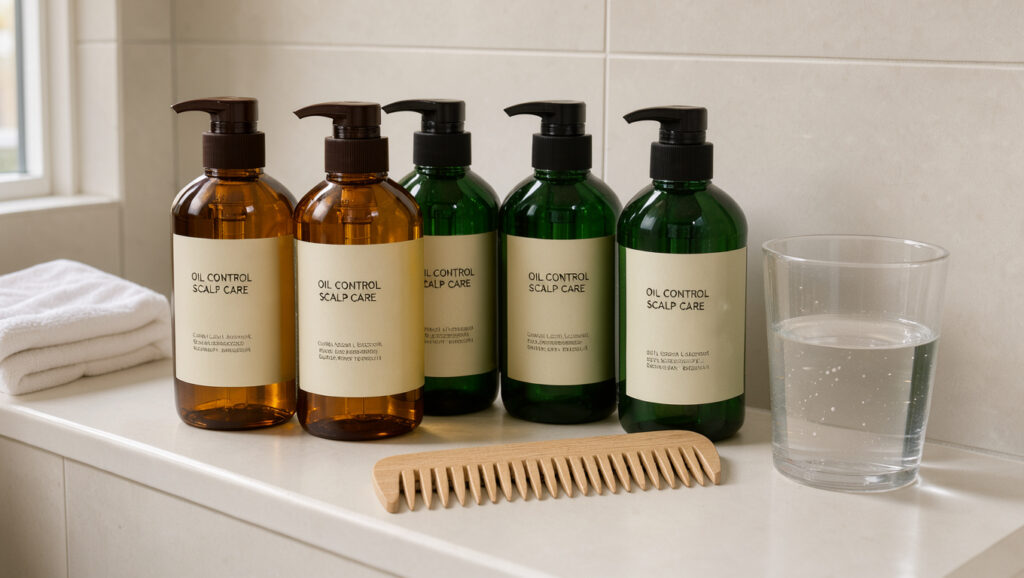
Shampoo for Oily Hair: Best Types and How to Stop Greasy Roots
If your hair looks greasy by lunchtime, you have probably tried a few bottles already and wondered why nothing lasts. Shampoo can clear surface oil but cannot switch off the glands that make it, and dermatologists quoted by GQ (men’s style magazine) point to salicylic acid as a practical starting ingredient.
Oil-producing glands: Sebaceous glands attached to hair follicles (GoodRx (health information site)) · Cortisol evidence level: Indirect only · Starting wash schedule: Every other day, adjusted to scalp response (CNN Underscored (lifestyle shopping guide))
Quick snapshot
- Salicylic acid appears in many oil-control shampoos (GQ, men’s style magazine) (NBC News Select (news and shopping guide))
- Sulfate shampoos can strip scalp oils and cause dryness and irritation (NBC News Select (news and shopping guide))
- Clarifying shampoo is recommended about once per week (L’Oréal Paris (cosmetics brand guide))
- Stress and nutrition are cited as possible scalp-health factors, according to NBC News Select (news and shopping guide), but no direct evidence links high cortisol alone to greasy hair
- Whether any shampoo changes long-term sebum output, which the sources reviewed do not address
- Which shampoo suits an individual scalp, since results vary by scalp type
- Vogue published its oily-hair shampoo guide on (Vogue (fashion magazine))
- CNN Underscored’s oily-hair guide is dated (CNN Underscored, lifestyle shopping guide) (Vogue (fashion magazine))
- Start with washing every other day and adjust to how the scalp responds (CNN Underscored, lifestyle shopping guide)
- Book a clinician visit if itching, redness, or flaking appears alongside oily hair (NBC News Select, news and shopping guide)
Seven facts, one pattern: the practical levers are ingredients, wash timing, and product placement, while the hormone link has the thinnest evidence.
| Fact | Detail |
|---|---|
| Sebum source | Sebaceous glands attached to hair follicles (GoodRx, health information site) |
| Common oil-control active | Salicylic acid in many oily-scalp shampoos (GQ, men’s style magazine) |
| Common anti-dandruff active | Zinc pyrithione, helpful for scalp conditions that contribute to oiliness (Allure (beauty magazine)) |
| Clarifying shampoo frequency | About once per week (L’Oréal Paris, cosmetics brand guide) |
| Dry shampoo role | Absorbs surface oil between washes but does not cleanse the scalp (L’Oréal Paris, cosmetics brand guide) |
| Conditioner placement | Mid-lengths and ends, not the scalp or roots (L’Oréal Professionnel (salon hair brand)) |
| Cortisol and greasy hair | No direct evidence that high cortisol alone causes greasy hair; the research reviewed includes no clinical trial on the link |
Which type of shampoo is best for oily hair?
No single bottle wins for every oily scalp. The useful question is which active ingredient fits your scalp, and how strong a cleanser you can use before oil creeps back. Clear shampoos are stronger cleansers designed to remove excess oil, while milky shampoos carry more conditioning ingredients for drier hair (Good Housekeeping (home product testing magazine)).
Gentler surfactants versus sulfates
- Sodium lauryl sulfate can be very stripping, while cocamidopropyl betaine is a less harsh surfactant alternative, according to dermatologists quoted by Vogue (fashion magazine).
- Sulfate-containing shampoos can strip scalp oils and cause dryness and irritation, so experts suggest using them in moderation (NBC News Select, news and shopping guide).
- Shampoos containing sulfates and parabens may irritate the scalp and increase oil production, according to Dr. Marisa Garshick (GQ, men’s style magazine).
Salicylic acid and clarifying formulas
- Clarifying shampoos use heavier surfactants that remove scalp oil normal shampoos can leave behind (NBC News Select, news and shopping guide).
- Dr. Marisa Garshick recommends searching for salicylic acid, which can help reduce oil and buildup (GQ, men’s style magazine).
- Dr. Sobel says salicylic acid helps exfoliate skin, decrease inflammation, and decrease oil production (Vogue, fashion magazine).
Marketing words that mislead
- Shampoos marketed as hydrating, moisturizing, or smoothing often contain ingredients that weigh hair down, according to Dr. Kristin M. Baird (CNN Underscored, lifestyle shopping guide).
- An oil-control label describes a goal, so the ingredient list on the back of the bottle is the more useful check.
A front-of-bottle promise is a weak signal for oily roots. The ingredient list tells you whether a formula is built to degrease, and a hydrating claim points the other way (CNN Underscored, lifestyle shopping guide).
Four shampoo types, one pattern: the strongest oil removal comes with the highest risk of over-stripping.
| Shampoo type | Where it fits | Trade-off |
|---|---|---|
| Clarifying shampoo | Deeper cleanse for buildup, suited to occasional use (L’Oréal Paris (cosmetics brand guide)) | Overuse can dry the scalp and trigger more oil (CNN Underscored, lifestyle shopping guide) |
| Salicylic acid shampoo | Oil and buildup control, per Dr. Marisa Garshick (GQ, men’s style magazine) | Rotate in a gentler formula one or two times per week (GQ, men’s style magazine) |
| Sodium lauryl sulfate shampoo | Strong surfactant that is very stripping (Vogue, fashion magazine) | Can strip scalp oils and cause dryness; use in moderation (NBC News Select, news and shopping guide) |
| Cocamidopropyl betaine shampoo | Gentler surfactant derived from coconuts (Vogue, fashion magazine) | Less harsh than sodium lauryl sulfate (Vogue, fashion magazine) |
The implication: pick a cleanser for the job it does, not the label it carries. Clarifiers belong on a weekly calendar, and gentler surfactants cover the washes in between.
Upsides
- Clarifying shampoos offer a deeper cleanse than regular shampoos, which suits oily scalps (GQ, men’s style magazine)
- Salicylic acid helps reduce oil production, according to Dr. Sobel (Vogue, fashion magazine)
Downsides
- Overusing a clarifier can dry the scalp and trigger more oil (CNN Underscored, lifestyle shopping guide)
- Sulfate shampoos can cause dryness and irritation (NBC News Select, news and shopping guide)
What this means: a clarifier that runs every day stops cleaning buildup and starts working against the scalp it was meant to clear.
How do I stop my hair from getting so oily?
Washing controls how oily hair looks, but it does not stop sebum production. Water temperature matters too, since hot water can strip natural oils and prompt sebaceous glands to make more (GoodRx, health information site).
How often to wash oily hair
- Start with washing every other day, then adjust based on how the scalp responds (CNN Underscored, lifestyle shopping guide).
- The American Academy of Dermatology notes that oily scalps may need more frequent washing, not less (L’Oréal Paris, cosmetics brand guide).
- Dove’s guide suggests trichologists may recommend daily or every-other-day washing when hair gets oily quickly, and a doctor visit if oiliness persists after daily washing (Dove (personal care brand)).
Conditioner placement and oil buildup
- Conditioner belongs on mid-lengths and ends rather than the scalp or roots (L’Oréal Professionnel, salon hair brand).
- Conditioner left on roots can leave a residue that makes hair look flat and oily (L’Oréal Paris, cosmetics brand guide).
- Dr. Jenna Queller advises a light amount of lightweight, non-comedogenic conditioner, rinsed thoroughly (Allure, beauty magazine).
Brushing, touching, and styling products
- Over-brushing can spread oil from the scalp through the lengths more quickly (Dove (personal care brand)).
- Frequent touching transfers oil from hands to hair, which makes it look greasy faster (GoodRx, health information site).
- Dry shampoo absorbs surface oil between washes but does not cleanse the scalp, so it should not replace shampooing (L’Oréal Paris, cosmetics brand guide).
Oily roots respond more to wash timing and product placement than to any single miracle bottle. Dr. Kristin M. Baird’s point is that washing too often strips oil and signals the scalp to make more, so a schedule that matches scalp feel beats a rigid rule (CNN Underscored, lifestyle shopping guide).
Put those habits into one routine, in this order.
- Wash on a schedule your scalp tolerates, starting about every other day (CNN Underscored, lifestyle shopping guide).
- Use warm water rather than hot water (GoodRx, health information site).
- Use a clarifying shampoo about once per week (L’Oréal Paris, cosmetics brand guide).
- Apply conditioner to mid-lengths and ends only (L’Oréal Professionnel, salon hair brand).
- Between washes, spray dry shampoo onto dry roots from about 6-8 inches away, then massage it in (L’Oréal Paris, cosmetics brand guide).
Two dry shampoo formats, one pattern: aerosol covers broad ground fast, while powder earns its place at the part and hairline, and neither one cleans the scalp.
| Feature | Aerosol | Powder |
|---|---|---|
| Coverage | Broad areas such as the crown (Ulta Beauty (beauty retailer)) | Targeted spots (Ulta Beauty, beauty retailer) |
| Best placement | Crown (Ulta Beauty, beauty retailer) | Part and hairline (Ulta Beauty, beauty retailer) |
| Spray distance | About 6-8 inches away (L’Oréal Paris, cosmetics brand guide) | Not stated in the sources reviewed |
| Where to apply | Dry roots (L’Oréal Paris, cosmetics brand guide) | Dry roots (L’Oréal Paris, cosmetics brand guide) |
| Finish | Massaged in after a few seconds of drying (L’Oréal Paris, cosmetics brand guide) | Not stated in the sources reviewed |
| Cleans the scalp? | No (L’Oréal Paris, cosmetics brand guide) | No (L’Oréal Paris, cosmetics brand guide) |
Why is my hair getting greasier all of a sudden?
A sudden change often traces back to something you can see, such as a new routine or a different water temperature. The guidance on routine is the clearest, while the hormone side is the thinnest.
Changes in products, water, or washing routine
- Washing too often strips natural oils and signals the scalp to produce more oil, according to Dr. Kristin M. Baird (CNN Underscored, lifestyle shopping guide).
- Hot water strips natural oils, which can prompt sebaceous glands to increase sebum production (GoodRx, health information site).
Hormonal and stress-related shifts
- Stress and nutrition are cited as possible factors affecting scalp health and oil regulation, according to Hallajian in NBC News Select (news and shopping guide).
- The sources reviewed contain no hormone-specific data on sebum output, so any hormone link stays general.
When a sudden change needs a doctor
- Itching, redness, flaking, scalp odor, inflammation, or hair shedding alongside oily hair can point to an underlying condition such as seborrheic dermatitis, and professional scalp evaluation is advised (NBC News Select, news and shopping guide).
- Dove’s guidance treats oiliness that persists after daily washing as a reason to see a doctor (Dove, personal care brand).
Sudden oiliness is a scalp signal worth tracking, not a verdict on your hair. Pair it with itching or flaking, and a clinician visit becomes a better first step than another bottle.
The pattern: a sudden change usually points to routine or symptoms first, and that order matters for what you do next.
Does high cortisol cause greasy hair?
The question sounds like a simple cause-and-effect check, and the evidence reviewed here does not support one.
What cortisol does in the body
- Stress and nutrition are cited as scalp-health factors, according to Hallajian (NBC News Select, news and shopping guide).
- The sources reviewed for this article do not name cortisol as a cause of oily hair.
What the evidence shows about sebum
- Sebum comes from sebaceous glands attached to hair follicles (GoodRx, health information site).
- The research reviewed includes no clinical trial comparing cortisol levels with scalp oil.
Other causes to rule out first
- Washing too often can signal more oil, per Dr. Kristin M. Baird (CNN Underscored, lifestyle shopping guide).
- Scalp symptoms such as inflammation or flaking warrant evaluation (NBC News Select, news and shopping guide).
The hormone angle draws the most attention, but the washing routine is the lever with the clearest guidance, so the routine comes first.
The implication: treat cortisol as an open question rather than a diagnosis.
Is there a shampoo for oily thin hair?
Fine oily hair is a combination problem, with oily roots on top and drier lengths below. The fix is usually a lighter formula at the scalp and a different approach at the ends.
Lightweight formulas that do not weigh hair down
- Fine hair gets oily faster and may need daily washing, while thicker hair can go longer (Vogue, fashion magazine).
- Shampoos marketed as hydrating or smoothing often weigh hair down, per Dr. Kristin M. Baird (CNN Underscored, lifestyle shopping guide).
Dry ends and oily roots in one routine
- Shampoo the roots, and apply conditioner only to mid-lengths and ends (L’Oréal Professionnel, salon hair brand).
- Conditioner on roots can leave a residue that makes them look flat and oily (L’Oréal Paris, cosmetics brand guide).
Clarifying use and its limits
- Clarifying shampoo is recommended about once per week (L’Oréal Paris, cosmetics brand guide).
- Overusing it can dry the scalp and trigger more oil production (CNN Underscored, lifestyle shopping guide).
Oily thin hair tempts people to reach for the strongest cleanser every day. The sources point the other way, so the strongest bottle belongs on a weekly calendar rather than in the shower.
Related reading: Neutrogena T/Gel shampoo alternatives covers other scalp-care options if your usual bottle is gone.
The trade-off: fine hair needs scalp control without added weight, so lighter formulas and wash timing matter more than raw strength.
Confirmed facts
- Sebum comes from sebaceous glands attached to hair follicles (GoodRx, health information site)
- Salicylic acid is an active in many oil-control shampoos (GQ, men’s style magazine)
- Sulfate shampoos can strip scalp oils and cause irritation (NBC News Select, news and shopping guide)
What’s unclear
- Whether high cortisol directly increases scalp oil in people; no direct evidence is established
- Whether any shampoo changes long-term sebum output; the sources reviewed do not address it
- Which shampoo suits an individual scalp, since results vary by scalp type
- Whether the every-other-day starting point fits every scalp; the sources say to adjust it (CNN Underscored, lifestyle shopping guide)
Three experts, three cautions, each drawn from the sources reviewed.
“Salicylic acid helps exfoliate the skin, decrease inflammation, and decrease oil production.”
Dr. Sobel, dermatologist, as cited by Vogue (fashion magazine)
“Overdoing it can dry your scalp and trigger even more oil production.”
Stephens, expert, as cited by CNN Underscored (lifestyle shopping guide)
“The goal is to not over-cleanse and instead use products that gently remove buildup.”
Tompkins, trichologist, as cited by NBC News Select (news and shopping guide)
Shampoo changes how oily hair looks between washes, but it cannot switch off sebum, and the sources here offer no direct proof that cortisol drives it. Anyone with greasy roots and dry ends should wash on a schedule the scalp tolerates, keep conditioner on the lengths, and reserve the strongest clarifier for about once a week. Anyone with itching or flaking should book a clinician visit first (NBC News Select, news and shopping guide).
Related reading: Neutrogena T/Gel shampoo alternatives · blue black hair dye guide
Frequently asked questions
How often should oily hair be washed?
Start with washing every other day and adjust to how the scalp responds (CNN Underscored, lifestyle shopping guide). The American Academy of Dermatology says oily scalps may need more frequent washing, not less (L’Oréal Paris, cosmetics brand guide).
Does conditioner make oily hair greasier?
It can, when it lands on the roots. Conditioner applied there can leave a residue that looks flat and oily, so mid-lengths and ends are the target (L’Oréal Paris, cosmetics brand guide).
Are clarifying shampoos safe for oily hair?
They are safe in moderation. Clarifying shampoo is recommended about once a week, because overusing it can dry the scalp and trigger more oil (CNN Underscored, lifestyle shopping guide).
Do dry shampoos make oily hair worse?
The sources reviewed do not say dry shampoo makes oil worse. They say it absorbs surface oil between washes but does not cleanse the scalp, so it should not replace shampooing (L’Oréal Paris, cosmetics brand guide).
Can an oily scalp cause dandruff?
Flaking with oily hair can signal seborrheic dermatitis, which dermatologists say may sit behind the oiliness (NBC News Select, news and shopping guide). Anti-dandruff shampoos with ketoconazole may help in that case (Vogue, fashion magazine).
More related posts
 Canterbury Power Outage Properties: Check Status & Act Fast
 100 Yen to NZD: Live Rate, Conversion & Expert Guide
 Cake Shop Near Me: Dublin Prices & Best Bakeries
 Epson EcoTank ET-2810: Pros, Cons, and Comparison to ET-2850
 Do Not Disturb on iPhone: What It Does & How to Turn Off
 How Much Protein Per Day? Calculator, Guidelines & Needs
 Brentford vs Man United 2026: Head-to-Head Record, Stats & Preview
 Bonnie Blue 1000 People Video: Documentary & Controversy
