How to Get Rid of Fruit Flies in Kitchen: Causes, Traps, Fixes
Few things ruin a quiet evening in the kitchen faster than a cloud of tiny flies over the fruit bowl, but the cause is usually something you can find and clear. Fruit flies can lay over 500 eggs in bio-buildup inside a kitchen drain, according to State Farm (insurer’s home pest guidance), so the breeding site matters more than the flies you can see.
Egg to adult: approximately 7 to 10 days (PestsGuide (home pest guide)) · Larval stage: 5 to 6 days (PestFact (pest-control site)) · Eggs in one bio-buildup site: over 500 (State Farm (insurer’s home pest guidance))
Quick snapshot
- Eliminating the breeding source works better than fighting adults already present (York Region (Ontario news, entomologist quoted))
- Vinegar traps only remove adults and do nothing to eggs and larvae (SaniIQ (home pest-control site))
- Dish soap breaks the surface tension of the trap liquid, so landing flies sink (Terminix (pest-control company))
- Adult lifespan in home kitchens: the sources reviewed give no verified figure.
- Whether any spray ends an infestation on its own: the evidence points to no, but no controlled trial was retrieved.
- Whether secondary guides match the original extension publications: none were retrieved for this piece.
- Typical clearance runs about 1 to 2 weeks once breeding sites are removed and traps are in place (HB Magazine (home pest guide))
- Populations rebound within days after a spray, according to The Faunalist (wildlife blog)
- Keep traps running until several days pass with no sightings, and for at least two to three weeks (PestsGuide (home pest guide)) (Pest Me Off (pest library citing Texas A&M AgriLife))
- Scrub drain pipes with a stiff brush and flush them with hot water (Pest Me Off (pest library citing Texas A&M AgriLife))
Six figures set the timing. The life-cycle numbers are the most consistent, while clearance estimates still vary from one guide to the next.
| Fact | Value |
|---|---|
| Egg to adult development | approximately 7 to 10 days (PestsGuide (home pest guide)) |
| Larval stage in fermenting matter | 5 to 6 days (PestFact (pest-control site)) |
| Egg hatching threshold | less likely to hatch below 75 degrees Fahrenheit (24 degrees Celsius) (Cleveland Clinic (medical center)) |
| Apple cider vinegar trap, vinegar depth | about 1/2 inch (approx. 1.3 cm) (Cleveland Clinic (medical center)) |
| Apple cider vinegar trap, replacement interval | every 3 to 4 days (PestFact (pest-control site)) |
| Typical clearance after source removal | about 1 to 2 weeks (HB Magazine (home pest guide)) |
Why is my kitchen suddenly full of fruit flies?
What draws them in
- Fruit flies are drawn to fermented drinks, including beer, liquor and wine, and they breed in sink drains, garbage disposals, trash cans and mop buckets (House Beautiful (home lifestyle magazine)).
Where they breed
- They breed in moist, fermenting or decaying organic matter, including garbage containers, unwashed recycling bins, sink and disposal residue, damp mops and cloths, and spills under appliances (York Region (Ontario news, entomologist quoted)).
- The larvae feed in fermenting film of yeast and organic matter, in drains and in the bottom of recycling bins, not in whole fruit itself, according to HB Magazine (home pest guide).
What this means: the fruit bowl shows you the problem, but the drain and the bin usually hold it. Start the search below the sink before you start on the counter.
Where do fruit flies lay eggs?
Produce and fermenting liquids
- Refrigerating produce for 24 hours can help kill eggs, and eggs are less likely to hatch below 75 degrees Fahrenheit (24 degrees Celsius) (Cleveland Clinic (medical center)).
Drains, garbage and recycling bins
- Fruit flies lay their eggs in the film of sink drains and garbage disposals, trash cans and mop buckets (House Beautiful (home lifestyle magazine)).
- Fruit flies can lay over 500 eggs in bio-buildup inside kitchen drains (State Farm (insurer’s home pest guidance)).
What this means: the egg count lives in the drain film and the bin lining, not on the fruit you can see. The fix starts where the eggs are, which is why fruit-bowl cleanups alone tend to disappoint.
What spray kills fruit flies instantly?
What sprays actually reach
- Insecticide sprays kill visible adults but leave eggs and larvae untouched, and populations rebound within days, according to The Faunalist (wildlife blog).
Why sprays do not remove breeding sites
- Insecticides alone are rarely successful indoors, and sanitation and traps are preferred where food is prepared, according to Pest Control For Home (pest control guide).
A spray can make the counter look clear within the hour while the drain keeps producing adults.
What this means: no spray in the evidence reviewed ends a kitchen infestation instantly. A spray clears the flies you can see and leaves the source you cannot, so it belongs at the end of the routine, not the start.
Can I use regular vinegar to get rid of fruit flies?
Vinegar and dish soap traps
- Apple cider vinegar works better than plain white vinegar, which Terminix (pest-control company) describes as less effective because it does not mimic fermenting fruit closely enough.
- Dish soap breaks the surface tension of the vinegar, so flies that land sink rather than skate away (Terminix (pest-control company)).
A trap that still catches flies a week in is telling you the breeding site is still open.
Vinegar and the drain question
- Vinegar traps only remove adults; they do nothing to eggs and larvae in the breeding site (SaniIQ (home pest-control site)).
- Scrub drain pipes with a stiff brush and flush with hot water as part of breeding-site removal (Pest Me Off (pest library citing Texas A&M AgriLife)).
What this means: the vinegar trap works as a gauge. It shows how many adults remain, and the drain decides whether that number keeps falling.
Why won’t fruit flies go away?
Hidden larvae and the life cycle
- The egg-to-adult cycle runs roughly 8 to 10 days in a warm kitchen, according to LeafyPixels (home pest guide).
- Eggs and larvae hide in the breeding site, which explains why adults keep appearing after the surface looks clean (SaniIQ (home pest-control site)).
Breeding sites left untreated
- Terminix recommends removing food sources and cleaning drains and bins alongside traps (Terminix (pest-control company)).
- Numbers drop within days once the breeding site is removed, and the infestation finishes over about two weeks, according to HouseBugGuide (citing Colorado State).
Step-by-step removal routine
- Find the breeding site on the same day you set traps: check drains, bins, produce and damp cloths. A same-day approach that combines vacuuming, source removal and a trap is described by Fruit-flies.com (fruit fly guide).
- Scrub drains with a stiff brush and hot water, then flush them.
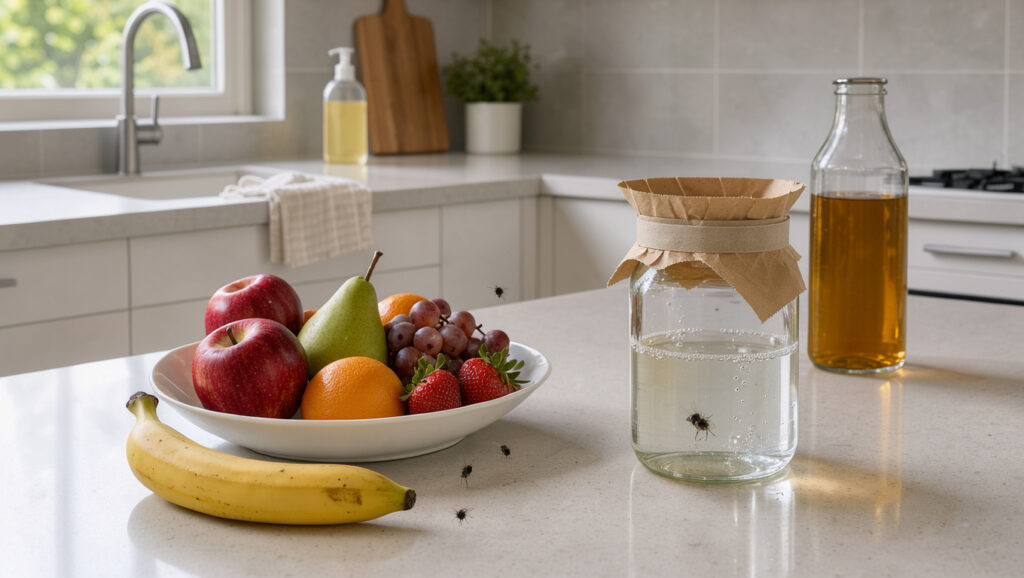
- Set a vinegar trap with about 1/2 inch of apple cider vinegar and one to two drops of dish soap. Cover it with plastic wrap and poke small holes in the wrap.
- Refresh the bait every 3 to 4 days, and keep trapping for at least two to three weeks after the last sighting.
A falling trap count is good news, but it is not the finish line. Keep the routine running until the traps stay empty.
The implication: the routine, not any single product, decides when the count reaches zero.
Confirmed facts and what’s unclear
Confirmed facts
- Terminix recommends sticky traps alongside removing food sources and cleaning drains and bins (Terminix (pest-control company)).
- Scrubbing drain pipes with a stiff brush and hot water is part of breeding-site removal (Pest Me Off (pest library citing Texas A&M AgriLife)).
- Insecticide sprays kill visible adults but leave eggs and larvae untouched (The Faunalist (wildlife blog)).
What’s unclear
- Adult lifespan in home kitchens: the sources reviewed give no verified figure.
- Whether fine-mesh screens keep out every new fly: one syndicated pest guide says they prevent entry (Columbia Climate School (syndicated pest guide)).
- Whether a fly over a plughole proves breeding in the pipe: a syndicated lifestyle piece says it does not (Yahoo Lifestyle (syndicated lifestyle piece)).
- Whether secondary guides match the original extension publications: none were retrieved for this piece.
The implication: the open questions outnumber the settled ones, so treat the timing figures as estimates rather than promises.
What the experts say
“Eliminating breeding sources is often more effective than trying to control the adult flies that are already present.”
Sinia, Ontario entomologist, quoted by York Region (Ontario news, entomologist quoted)
“Fruit flies are attracted to ripe and rotting fruits and vegetables, so it’s important to keep your kitchen clean and free of any food debris.”
Ludwiczak, cleaning expert, House Beautiful (home lifestyle magazine)
Most of this comes down to where the eggs are, not where the flies are. Clear the drain, the bin and the damp cloths on the same day you set a trap, because traps and sprays only reach adults. For a homeowner staring at a fruit bowl at 11 p.m., the choice is clear: clean the breeding site tonight, or keep buying sprays that only reach the flies you can already see.
Related reading: Best Meal Prep Containers: Glass vs Plastic Safety Guide · Can You Freeze Cooked Chicken? Tips & Safety Guide
Frequently asked questions
How long do fruit flies typically live?
The sources reviewed give no verified adult lifespan for home kitchens. The egg-to-adult cycle is the timing that matters most when you plan a cleanup.
How long will a fruit fly infestation last?
Estimates vary. According to HouseBugGuide (citing Colorado State), numbers drop within days after the breeding site is removed, and the infestation finishes over about two weeks.
What do fruit flies absolutely hate?
No deterrent in the sources reviewed works reliably on its own. Terminix says essential oils such as peppermint, lemon and lavender may help deter them, but the evidence is limited and they do not replace source removal (Terminix (pest-control company)).
How can I tell the difference between fruit flies and gnats?
The sources reviewed compare fruit flies with drain flies rather than gnats. A fly hovering over a plughole is not proof of breeding inside the pipe (Yahoo Lifestyle (syndicated lifestyle piece)).
What is the fastest way to get rid of fruit flies?
Work the breeding site and the trap on the same day. A three-step same-day approach combines vacuuming, source removal and a trap (Fruit-flies.com (fruit fly guide)).
More related posts
 Cheap Houses for Sale in Christchurch Dublin: Prices Guide
 Rotorua to New Plymouth: Travel Guide & Stops
 Register for GST NZ – Step-by-Step myIR Guide
 100 Yen to NZD: Live Rate, Conversion & Expert Guide
 Lorna Jane Discount Code – Verified Savings and Deals
 Burnham Fish and Chips: Menu, Prices, Photos & Opening Hours
 Who Invented the Telephone? Bell, Meucci and the True Story
 New Balance Men’s 530s: Style, Comfort & Buying Guide (2025)
