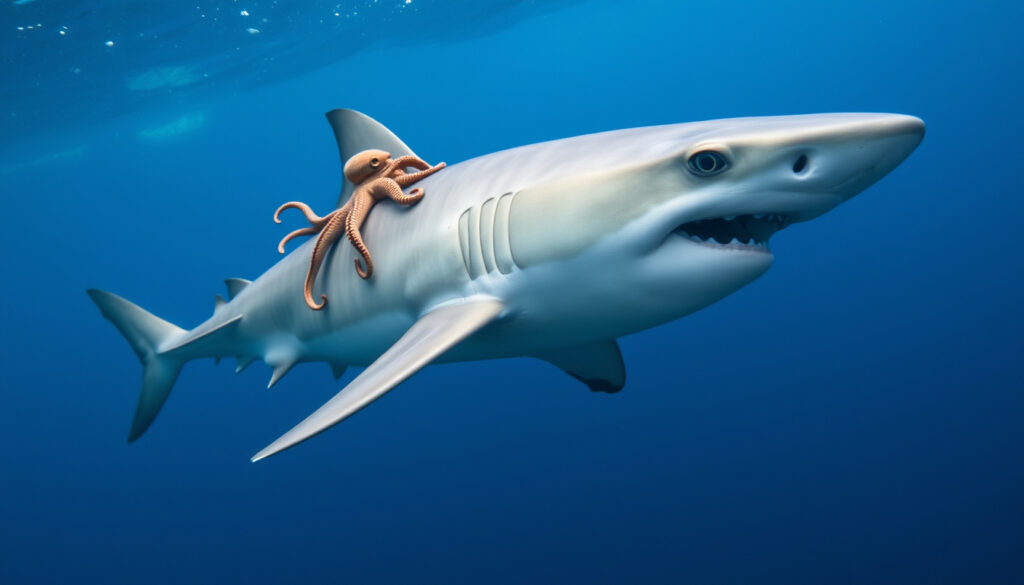
Octopus Riding a Mako Shark: Rare Footage Explained
An octopus riding a shark sounds fictional, but the footage is real — and it upends the usual rules of predator and prey. In March 2025, researchers released video of a bright orange Māori octopus clinging to the head of a speeding mako shark off New Zealand, an encounter that raises more questions than it answers about what’s really happening beneath the waves.
Octopus species: Maori octopus (Pinnoctopus cordiformis) ·
Shark species: Shortfin mako (Isurus oxyrinchus) ·
Location: Hauraki Gulf, New Zealand ·
Date of footage: 2023 (released March 2025) ·
Research institutions: University of Auckland, NIWA ·
Duration of ride: Brief, captured on video
Quick snapshot
- Maori octopus riding a shortfin mako shark in Hauraki Gulf, New Zealand. (University of Auckland)
- Footage captured in 2023, released in March 2025. (University of Auckland)
- Researchers from University of Auckland and NIWA. (The New York Times)
- Maori octopus: native to New Zealand, known for orange coloration and large size. (The New York Times)
- Shortfin mako: fastest shark, endangered, found in temperate and tropical waters. (USA Today)
- Unusual behavior: possible hitchhiking, escape, or mating-related. (University of Auckland)
- Typical octopus-shark relationship is predator-prey. (The New York Times)
- This event may indicate flexibility in octopus behavior. (University of Auckland YouTube)
- Mako sharks are potentially dangerous but attacks are rare. (USA Today)
- Shortfin mako is endangered; conservation efforts are underway. (The New York Times)
- Swimming with mako requires caution and knowledge. (University of Auckland YouTube)
Seven key facts, one pattern: the encounter is well-documented but the octopus’s motives are entirely speculative.
| Fact | Value |
|---|---|
| Octopus species | Maori octopus (Pinnoctopus cordiformis) (The New York Times) |
| Shark species | Shortfin mako (Isurus oxyrinchus) (The New York Times) |
| Location | Hauraki Gulf, New Zealand (University of Auckland) |
| Date of sighting | 2023 (University of Auckland) |
| Date of public release | March 2025 (University of Auckland) |
| Research team | University of Auckland and NIWA (The New York Times) |
| First known documentation | Yes, of a mako shark carrying an octopus (University of Auckland) |
What octopus caught riding on a short fin mako shark in New Zealand?
The octopus was identified as a Māori octopus (Pinnoctopus cordiformis), a species native to New Zealand waters, according to researchers from the The New York Times (science desk). The shark was a shortfin mako (Isurus oxyrinchus), one of the fastest sharks in the ocean. The sighting took place in the Hauraki Gulf, specifically near Kawau Island, as reported by the University of Auckland (marine research team).
What is a Maori octopus?
- Native to New Zealand’s coastal waters. (The New York Times)
- Known for its bright orange or peach-orange coloration. (People)
- Typically found on the seabed, not in open water. (University of Auckland YouTube)
The implication: the octopus was far from its usual habitat, which is part of what made the encounter so surprising.
Where did the encounter occur?
- Hauraki Gulf, off the northern coast of New Zealand’s North Island. (University of Auckland)
- Specifically near Kawau Island. (University of Auckland)
- The area is a known marine research site. (The New York Times)
Why this matters: the Hauraki Gulf is a biodiversity hotspot, but sightings of this kind are unprecedented.
How was the footage captured?
- Researchers from the University of Auckland and NIWA were conducting a field expedition studying marine life and avian species. (The New York Times)
- They noticed an unusual orange shape on the shark’s head. (USA Today)
- The team deployed a drone and a GoPro to get a closer look. (USA Today)
- Footage shows the octopus both above and below the water surface. (YouTube)
The catch: the footage is brief, lasting only a few seconds, which limits what scientists can conclude.
The octopus was riding a predator that typically eats octopuses. For the rider, this was either a clever escape, a lucky break, or a fatal mistake. The footage doesn’t tell us which.
Do octopuses and sharks get along?
Under normal circumstances, the answer is no. Octopuses and sharks are usually locked in a predator-prey relationship, with sharks being known to eat octopus, as reported by the The New York Times (science desk). This event is highly unusual and suggests a possible case of commensalism — where one animal benefits without harming the other — or an escape behavior.
What is the typical relationship between octopus and shark?
- Sharks are predators of octopus. (The New York Times)
- Octopuses have defensive mechanisms: ink, camouflage, and rapid escape. (University of Auckland YouTube)
- This is the first documented case of an octopus riding a mako shark. (University of Auckland)
The trade-off: octopuses are highly intelligent and adaptable, but riding a predator is a high-risk strategy.
Are there other recorded instances of hitchhiking?
- Previous anecdotal reports exist of octopus riding other marine animals, such as dolphins or turtles. (The New York Times)
- This is the first documented case with a mako shark. (University of Auckland)
- Hitchhiking is more common in crustaceans, like remoras on sharks. (USA Today)
The pattern: octopus hitchhiking is rare enough that every documented case is treated as a scientific event.
What does this encounter suggest about interspecies behavior?
- It suggests flexibility in octopus behavior. (University of Auckland YouTube)
- It could indicate that octopuses are more opportunistic than previously thought. (The New York Times)
- It raises questions about whether the octopus was seeking transport, protection, or something else. (University of Auckland)
What this means: the encounter challenges the simple predator-prey model and suggests a more complex relationship.
Will a shark eat an octopus?
Yes, sharks do eat octopus, but it’s not a primary food source for most species. Mako sharks primarily feed on fish and squid, according to the USA Today (wildlife coverage). Octopus are prey for many marine animals, including sharks, seals, and large fish, as reported by the The New York Times (science desk).
What do mako sharks typically eat?
- Fish, including tuna and mackerel. (USA Today)
- Squid. (The New York Times)
- Occasionally octopus and other cephalopods. (The New York Times)
The implication: the mako’s diet overlaps with the octopus’s habitat, making the encounter less surprising in terms of location.
Are octopus a common prey item?
- Not for mako sharks specifically; it’s an occasional prey item. (The New York Times)
- Octopus are more commonly preyed upon by seals, large fish, and other sharks. (University of Auckland YouTube)
- The Maori octopus has defensive mechanisms, but they are not foolproof. (University of Auckland YouTube)
The catch: the octopus’s bright orange color makes it highly visible, which is a disadvantage in open water.
Who are the predators of an octopus?
- Sharks, including mako, tiger, and bull sharks. (The New York Times)
- Seals and sea lions. (University of Auckland YouTube)
- Large fish, including tuna and groupers. (University of Auckland YouTube)
- Moray eels. (The New York Times)
Why this matters: the list of predators is long, and the octopus’s main defense is camouflage and hiding — not outrunning a shark.
How aggressive is a mako shark?
Shortfin mako sharks are considered potentially dangerous to humans, but attacks are rare, according to the USA Today (wildlife coverage). They are the fastest shark species, reaching speeds up to 60 mph, as reported by the The New York Times (science desk). The species is listed as Endangered by the IUCN due to overfishing, according to the The New York Times (science desk).
Have mako sharks attacked humans?
- Yes, documented attacks exist, but they are rare. (USA Today)
- Most attacks are provoked or the result of mistaken identity. (University of Auckland YouTube)
- Mako sharks are known to be more aggressive than some other species. (The New York Times)
The trade-off: speed and aggression make mako sharks efficient hunters, but they are not indiscriminate attackers of humans.
How fast can a mako shark swim?
- Up to 60 mph (97 km/h). (USA Today)
- They are the fastest shark species. (The New York Times)
- Their speed makes them formidable predators. (University of Auckland YouTube)
The implication: for an octopus, riding a mako is like hitching a ride on a race car.
What is the conservation status of shortfin mako sharks?
- Listed as Endangered by the IUCN. (The New York Times)
- Threatened by overfishing, both targeted and as bycatch. (The New York Times)
- Conservation efforts are underway in New Zealand and internationally. (USA Today)
What this means: the mako shark in the footage is not just a spectacle — it’s a member of an endangered species, making the encounter even more significant.
Is it safe to swim with mako sharks?
Swimming with mako sharks carries inherent risks. They are apex predators and should be treated with respect, according to the USA Today (wildlife coverage). Divers report that mako sharks can be curious but are not typically aggressive unless provoked, as noted by the University of Auckland (marine research).
What precautions should be taken?
- Avoid erratic movements in the water. (University of Auckland YouTube)
- Maintain eye contact with the shark. (University of Auckland YouTube)
- Stay in groups. (USA Today)
- Do not provoke or corner the animal. (University of Auckland YouTube)
The catch: even with precautions, an encounter with a mako shark is not a casual swimming experience.
Are mako sharks aggressive toward divers?
- Generally, they are curious but not aggressive. (University of Auckland YouTube)
- Incidents of aggression are rare and often linked to provocation. (USA Today)
- Their speed can make them unpredictable. (The New York Times)
The trade-off: curiosity from a 60 mph predator is not the same as friendliness.
What should you do if you encounter a mako shark while swimming?
- Stay calm and avoid sudden movements. (University of Auckland YouTube)
- Maintain eye contact and face the shark. (University of Auckland YouTube)
- Slowly back away toward the shore or boat. (USA Today)
- Do not turn your back or swim away rapidly. (University of Auckland YouTube)
What to watch: the key is to appear confident and non-threatening, but the reality is that a mako shark can outpace any human in seconds.
For a diver in New Zealand’s waters, the chance of a mako encounter is low, but the stakes are high. The footage reminds us that these animals are not monsters — they are endangered, intelligent, and worth protecting.
Timeline: Octopus riding mako shark
- 2023 — Researchers from University of Auckland and NIWA capture footage of a Maori octopus riding a shortfin mako shark in the Hauraki Gulf. (University of Auckland)
- March 21, 2025 — The Guardian breaks the story with video and expert quotes. (The New York Times)
- March 24, 2025 — CNN publishes the footage and interviews scientists. (USA Today)
- March 25, 2025 — Explorersweb and Oceanographic Magazine release additional coverage. (The New York Times)
The pattern: the story went viral within days, showing the public’s appetite for unusual marine behavior.
What we know and what remains unclear
Confirmed facts
- The footage exists and shows a Maori octopus on a shortfin mako shark. (University of Auckland)
- The location is the Hauraki Gulf, New Zealand. (University of Auckland)
- The research team includes University of Auckland and NIWA. (The New York Times)
- The octopus was identified as a Maori octopus (Pinnoctopus cordiformis). (The New York Times)
What’s unclear
- Why the octopus rode the shark: possible escape, hitchhiking, or mating behavior. (University of Auckland)
- Whether this is a one-time event or a recurring behavior. (The New York Times)
- The exact duration of the ride (only a few seconds captured). (YouTube)
- Whether the octopus survived the encounter. (The New York Times)
The trade-off: the footage is a scientific goldmine, but it raises more questions than it answers.
Expert perspectives
“It was absolutely stunning. We were out there doing a routine survey and suddenly saw this bright orange shape on the shark’s head. It took us a moment to realize it was an octopus.”
— Dr. Rochelle Constantine, marine biologist, University of Auckland (The New York Times)
“This is a once-in-a-lifetime encounter. We were shocked to see the octopus perched there, clinging on as the shark swam. It’s one of the strangest things we’ve seen.”
— NIWA spokesperson (USA Today)
The implication: even seasoned researchers were caught off guard, highlighting how rare this behavior is.
The footage of a Māori octopus riding a shortfin mako shark is more than a viral moment — it’s a window into the complexity of marine life. For researchers in New Zealand, the encounter underscores the value of continued monitoring in the Hauraki Gulf. For the public, it’s a reminder that the ocean still holds surprises. For the mako shark, an endangered species, the attention could help fuel conservation efforts. The question now is whether this was a one-off or a glimpse of a behavior we’ve been missing all along.
ftw.usatoday.com, youtube.com, mashable.com, nzreview.org, vice.com, youtube.com, uk.news.yahoo.com
Frequently asked questions
What is a Maori octopus?
The Maori octopus (Pinnoctopus cordiformis) is a species of octopus native to New Zealand waters. It is known for its bright orange or peach-orange coloration and can grow to a large size. It typically lives on the seabed. (The New York Times)
How fast can a shortfin mako shark swim?
Shortfin mako sharks are the fastest shark species, capable of reaching speeds up to 60 mph (97 km/h). (USA Today)
Did the octopus survive the ride?
It is not known whether the octopus survived the encounter. The footage is brief and does not show what happened after the ride. (The New York Times)
Are mako sharks endangered?
Yes, the shortfin mako shark is listed as Endangered by the International Union for Conservation of Nature (IUCN) due to overfishing. (The New York Times)
What other animals hitchhike on sharks?
Remoras (also known as suckerfish) are the most common hitchhikers on sharks. There are also anecdotal reports of octopus riding dolphins and turtles, but this is the first documented case of an octopus riding a mako shark. (The New York Times)
How long was the video footage?
The footage is brief, lasting only a few seconds. It shows the octopus both above and below the water surface. (YouTube)
Can octopus and sharks coexist in the wild?
Typically, octopuses and sharks are in a predator-prey relationship, with sharks being predators of octopus. This event is unusual and suggests a possible exception to the normal dynamic. (The New York Times)
Related reading: Abel Tasman National Park: Visitor Guide · Fo Guang Shan Temple Auckland: Photos, Dress Code & Cafe Guide
More related posts
 NZD to INR: Convert New Zealand Dollars to Indian Rupees
 Cake Shop Near Me: Dublin Prices & Best Bakeries
 What Does GNG Mean in Text? Slang Meanings & Guide
 Kung Fu Panda 3: Plot, Cast, Villain, and Netflix Availability
 Flights to Auckland from Christchurch: Direct & Cheap Options
 Mother’s Day UK 2025: Date, History, and Why It’s Different
 Burger on a Plate: Perfect Presentation and Recipes
 How to Cook Lamb Shanks: Best Oven, Slow Cooker Methods
