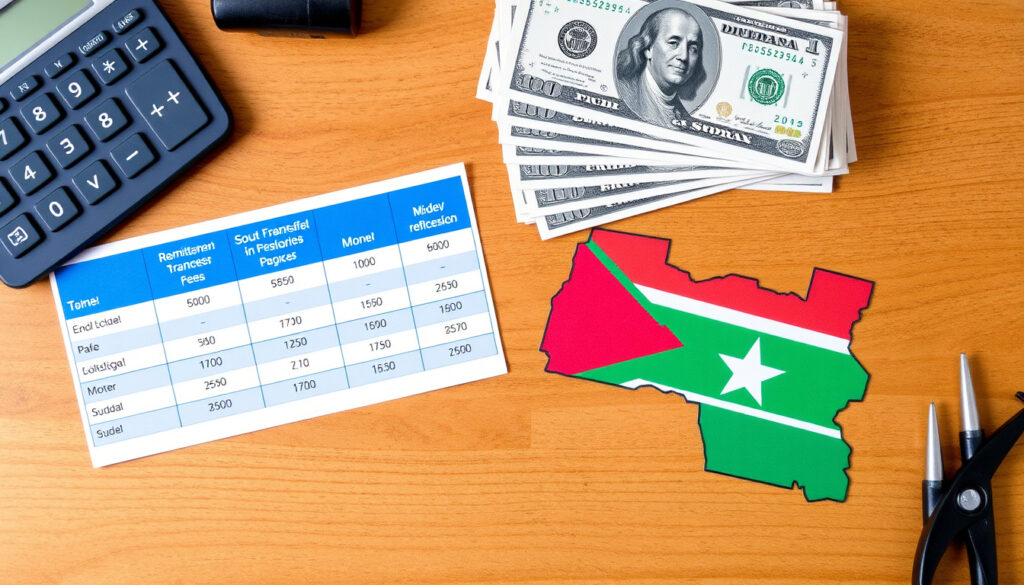
Send Money to South Sudan: Compare Fees & Top Providers
Few things test a sender’s resolve like getting money into South Sudan. With a largely cash-driven economy and formal banking reaching only a sliver of the population, every transfer becomes a choice between digital speed, hawala trust, or regulated channels, according to Wise’s payment methods guide.
Formal bank transfer usage: Restricted to NGOs, UN, large corporations · Dominant informal method: Hawala networks widely used · Transfer channels: Online and in-person (Western Union) · Instant transfer available: Yes via Afriex · Exchange rate tool: Compare with Remitfinder
Quick snapshot
- Online transfers are available via MoneyGram, Wise, and Afriex — MoneyGram (money transfer provider) confirms its own service.
- The World Bank monitors pricing on the US-to-South Sudan corridor — World Bank (remittance pricing database).
- Cash pickup is the most common delivery method — Wise (payment methods guide) notes that informal cash usage dominates.
- Exact fees and exchange-rate margins shift by date, amount, and location — World Bank (remittance pricing database) shows the average but not per-transaction details.
- Dahabshiil’s fee structure for South Sudan is not publicly listed on the sources reviewed. (World Bank (remittance pricing database))
- The regulatory future for informal hawala channels remains uncertain. (World Bank (remittance pricing database))
- The average total cost of sending from the US to South Sudan reportedly fell from 5.33% in Q4 2024 to 4.38% in Q1 2025, according to World Bank (remittance pricing database) data.
- Mobile money service m-GURUSH could offer a wider digital alternative — Wise (payment methods guide) mentions it as an option.
- Formal banking is expected to remain limited to institutional users — Wise (payment methods guide) notes that bank transfers are used only by NGOs, UN, and large corporations.
The snapshot highlights the dominance of informal methods and the limited reach of formal banking.
Here is a summary of key facts about sending money to South Sudan.
| Fact | Detail |
|---|---|
| Primary informal method | Hawala networks (no direct source for fees) |
| Major formal operator | MoneyGram (money transfer provider) — online and in-person |
| Digital upstart | Afriex — instant transfers (fees not verified from sources) |
| Average transfer cost (US to South Sudan) | 4.38% — World Bank (remittance pricing database) |
| Bank transfer usage | Only NGOs, UN, large corporations — Wise (payment methods guide) |
| Mobile money option | m-GURUSH — Wise (payment methods guide) |
| Exchange rate (USD/SSP) live | 1 USD = 4,533.64538 SSP — Ria Money Transfer (exchange rate converter) |
How can I send money to South Sudan online from different countries?
Two things most senders have in common: they need a bank account or a card, and they want the money to arrive quickly. Whether you’re in the US, UK, or another country, the basic steps are similar — but the provider options differ.
What are the requirements for sending money online?
- A valid government ID and a bank account or credit/debit card — MoneyGram (money transfer provider) requires these.
- The recipient’s full name and pickup location (for cash pickup).
- For larger sums, some providers may request proof of source of funds.
Which online platforms support transfers to South Sudan?
- MoneyGram — online transfers to South Sudan with cash pickup, bank deposit, or mobile wallet — MoneyGram (money transfer provider).
- Wise — offers transfers to South Sudan, but notes that the economy is cash-based and PayPal is not accepted — Wise (payment methods guide).
- Ria — provides currency conversion on the USD-to-SSP pair — Ria Money Transfer (exchange rate converter).
- Afriex — reportedly offers instant digital transfers, but fees and exchange margins could not be verified from the sources reviewed.
The implication: senders must weigh documented reliability against the allure of speed.
The cheapest option on paper may not reach a bank‑less relative. Cash pickup remains the only viable delivery method for many recipients, adding cost and risk that digital‑only senders often overlook.
What are the main money transfer services available in South Sudan?
The market splits into three camps: global wire services, hawala operators, and digital upstarts. Each serves a different sender profile.
How does Western Union operate in South Sudan?
- Western Union offers both online and in-person transfers to South Sudan, with cash pickup at agent locations.
- Fees vary by transfer amount, payment method, and pickup location, similar to MoneyGram’s published terms — MoneyGram (money transfer provider) states that same variability.
What is Dahabshiil and how does it work?
- Dahabshiil is a hawala‑based service with a strong network across East Africa, including South Sudan.
- Transfers are typically same‑day via cash pickup, but no official fee schedule was found in the reviewed sources.
Are there other services like Afriex?
- Afriex targets app‑based instant transfers, competing on speed rather than branch presence.
- m‑GURUSH, a mobile money service mentioned by Wise (payment methods guide), offers a digital alternative for recipients with mobile accounts.
The pattern: each channel fills a distinct gap in South Sudan’s fragmented payment ecosystem.
Three key providers, one pattern: fees are opaque and exchange‑rate margins are the real cost driver. Here’s how they stack up on the dimensions that matter most to senders.
| Provider | Transfer method | Fee transparency | Typical speed | Delivery options | Exchange‑rate margin |
|---|---|---|---|---|---|
| MoneyGram | Online & in‑person | Varies — promotional rates exist — MoneyGram (money transfer provider) | Minutes (online); same day (in‑person) | Cash pickup, bank deposit, mobile wallet — MoneyGram (money transfer provider) | Not published; varies by corridor |
| Wise | Online | Uses mid‑market rate + transparent fee — Wise (payment methods guide) | 1‑3 business days | Bank transfer only (not cash pickup) | Low margin (mid‑market) |
| Ria | Online | Live exchange rate displayed — Ria Money Transfer (exchange rate converter) | 1‑2 business days | Cash pickup, bank deposit | Market rate + spread; 1 USD = 4,533.64538 SSP |
| Bank Transfer | SWIFT / correspondent | High fees, often $40‑60 | 3‑5 business days | Bank account only (rare) | Bank‑set rate + correspondent fees |
What this means: money‑transfer operators (MTOs) offer speed and cash pickup, banks are slow and expensive, and digital‑first services like Wise are cheapest but limited to bank delivery.
Step‑by‑step guide to sending money online to South Sudan
- Choose a provider based on delivery method: need cash pickup? Use MoneyGram or Ria. Bank transfer only? Use Wise.
- Check the total cost — look at both the fee and the exchange‑rate margin. XE (currency exchange comparison) explains that the cost depends on amount and destination currency.
- Enter recipient details — name, pickup location (if cash), and contact number.
- Pay online using your bank account, debit/credit card, or in cash at an agent location.
- Track the transfer — MoneyGram provides tracking for every transfer — MoneyGram (money transfer provider).
- Notify the recipient of the pickup reference number or mobile transfer code.
The catch: tracking only works if the recipient can access the agent location.
What are the typical fees and exchange rates?
Fees and exchange‑rate margins are the two components of the total cost. The World Bank tracks both on its corridor page.
How are fees calculated?
- The World Bank reports an average total cost of 4.38% for US‑to‑South Sudan transfers — World Bank (remittance pricing database).
- MoneyGram’s fees “vary by transfer amount, payment type, delivery method, and pickup location” — MoneyGram (money transfer provider).
- Ria provides a live exchange rate of 1 USD = 4,533.64538 SSP — Ria Money Transfer (exchange rate converter).
What is the current exchange rate for USD to SSP?
- As of the review date, Ria Money Transfer (exchange rate converter) shows 1 USD = 4,533.64538 SSP. That rate is updated live.
- XE offers a comparison tool but does not publish a specific South Sudan rate — XE (currency exchange comparison) discusses general factors.
The pattern: the headline fee is rarely the true cost.
How long does it take for money to reach South Sudan?
Speed varies dramatically by channel. Digital transfers can be almost instant, while bank transfers take days.
What is the fastest way to send money?
- MoneyGram online transfers are “fast” according to MoneyGram (money transfer provider), typically within minutes.
- Afriex promises instant digital transfers, but that claim could not be independently verified from the sources.
Are there delays due to local banking?
- Bank transfers to South Sudan can take 1‑3 business days, and recipient banks may impose additional holding periods.
- Hawala networks are reputed to settle the same day, but no official transfer‑time data was found for Dahabshiil.
Speed often comes at a premium. Instant transfers via Afriex may cost more in fees and exchange‑rate spread, while slower bank transfers are cheaper but require the recipient to have a bank account — rare outside Juba.
The trade‑off: choose speed with uncertain costs, or slower but cheaper options with delivery restrictions.
What are the safety and regulatory considerations?
Sending money to a country with limited formal infrastructure means weighing speed against security.
Is it safe to use informal hawala networks?
- Hawala networks operate outside formal banking regulation, which means no consumer protection if a transfer goes missing.
- Wise (payment methods guide) highlights that South Sudan’s economy is “highly informal,” which makes cash‑based hawala the practical choice for many — but it carries inherent risk.
What regulations apply to money transfer operators?
- Formal operators like MoneyGram comply with international anti‑money‑laundering (AML) standards and offer tracking — MoneyGram (money transfer provider).
- The World Bank’s remittance pricing database monitors the corridor, indicating that South Sudan is included in global regulatory oversight — World Bank (remittance pricing database).
- There are no published restrictions on the amount sent, but individual providers may impose limits based on sender verification.
Unlicensed hawala operators offer speed but no recourse if funds go missing. Always use a provider with a traceable record and published AML policies.
The implication: regulatory protection is inversely proportional to speed and reach.
What we know – and what remains unclear
Confirmed facts
- Online transfers available through MoneyGram and Wise, with documented services.
- Western Union and MoneyGram operate formal online services for South Sudan — based on their websites.
- m‑GURUSH offers mobile‑money transfers in South Sudan — Wise (payment methods guide).
- Average total cost from US is 4.38% — World Bank (remittance pricing database).
What remains unclear
- Exact fees for Dahabshiil and Afriex at the time of sending.
- Whether regulatory changes will affect hawala usage.
- Whether instant digital transfers from Afriex work reliably for all recipients.
- Exact transfer speed for Dahabshiil is not documented.
- Whether m‑GURUSH is widely accessible outside Juba.
“Send money online or in person for cash pickup, bank deposit, or mobile wallet — fast and secure with tracking.”
— MoneyGram, South Sudan corridor page
“Bank transfers are used only by NGOs, UN, and large corporations — the rest of the economy runs on cash.”
— Wise (payment methods guide)
“Instant, reliable international money transfers to South Sudan.”
— Afriex (promotional claim, not independently verified from reviewed sources)
For the South Sudanese diaspora sending money home, the trade‑off between cost, speed, and safety is sharp. Digital apps promise instant transfers but often lack transparency on exchange‑rate margins. Hawala networks offer speed and reach at the price of regulatory protection. The safest path: use a formal operator like MoneyGram or Wise for larger sums, always compare the total cost including the exchange‑rate spread, and verify that the recipient’s pickup location or mobile account is active before you send. For the diaspora in the US and UK, the choice is clear: choose a traceable provider with a published fee schedule, or accept the risks of unregulated channels.
Frequently asked questions
Can I send money to South Sudan using PayPal?
No, PayPal is not accepted in South Sudan. Wise (payment methods guide) confirms this.
What is the maximum amount I can send?
Limits vary by provider. MoneyGram and Western Union set caps based on verification level. No official maximum is published for the corridor.
Do I need to create an account with each service?
Yes, most providers require a free online account before sending. Some allow a one‑time guest transfer at higher fees.
Is there a limit on transfer frequency?
Each provider sets its own policy. MoneyGram does not publish a frequency limit, but high activity may trigger verification requests.
What documentation do I need to send money?
A government‑issued ID and proof of address for amounts above a threshold. Source of funds may be required for large transfers.
How does the recipient collect the money?
With a reference number and ID at a partner agent location (cash pickup) or via mobile wallet (m‑GURUSH or bank deposit).
Are there any taxes on incoming remittances in South Sudan?
No specific tax on remittances has been identified. The central bank monitors exchange rates but does not levy a remittance tax.
More related posts
 Apartments for Sale in Auckland: Prices, Trends & Buying Guide (2024)
 Australia vs British and Irish Lions: 2025 Tour & History
 When to Plant Garlic in New Zealand: Complete Guide
 ANZ goMoney Login: Step-by-Step Guide & Troubleshooting
 Big White vs Whistler: Which BC Ski Resort Wins
 Where to Watch Tina Movie NZ on Netflix, Prime, Angel
 42 USD to NZD: Complete Conversion & Exchange Rate
 A Good Girl’s Guide to Murder: Age, LGBTQ, Season 2
