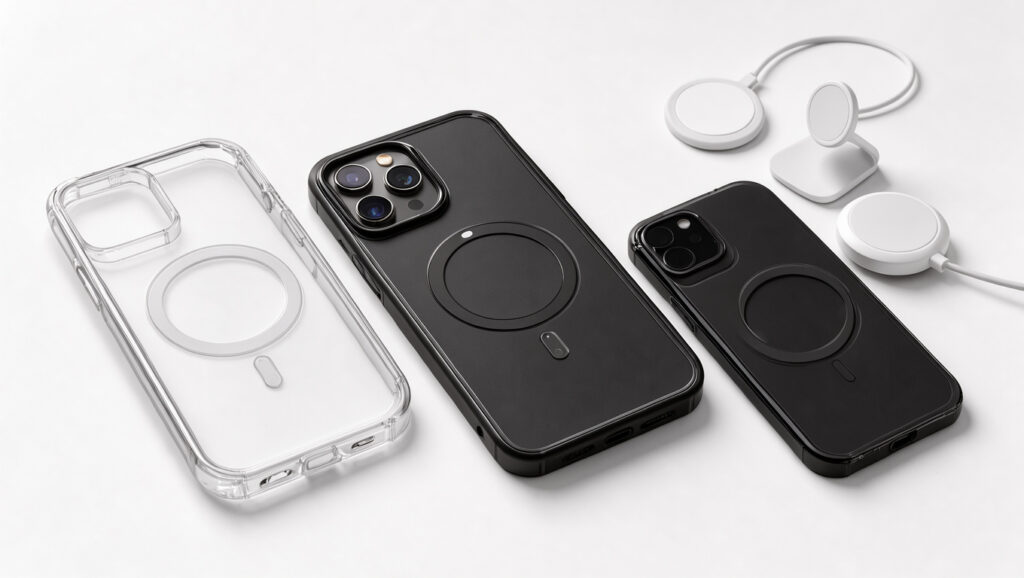
iPhone 13 Pro Case: Fit, Size, MagSafe and Compatibility
You’d expect two iPhones with the same 6.1-inch screen to take the same case, and that assumption is exactly what trips up buyers. Wired (product reviewer) found that cases fitting the iPhone 13 will not fit the iPhone 13 Pro, because the Pro’s camera system is significantly larger, and this guide sorts out which cases fit which model, how MagSafe magnets work, and how to check a listing before you pay.
Display size (iPhone 13 Pro): 6.1 inches, per Wired (product reviewer) · Length (iPhone 13 Pro): 148.1 mm (Mous (case brand listing)) · Length (iPhone 13): 148.7 mm, per Mous (case brand listing) · Magnetic force (ESR iPhone 13 Pro case): up to 1,500 g (ESR (case maker)) · MagSafe support (iPhone 13 Pro): built-in magnet ring (Best Buy Canada (retailer listing))
Quick snapshot
- Spigen lists its Mag Armor MagFit case for the iPhone 13 Pro Max, 13 Pro, 13 and 13 mini (Spigen (case maker))
- The iPhone 13 Pro camera module is larger and differently positioned than the iPhone 13’s (Gear Patrol (tech review site))
- iPhone 13 and iPhone 13 Pro lengths are 148.7 mm and 148.1 mm, per Mous (case brand listing) (Spigen (case maker))
- Whether third-party cases share the same camera cutout tolerance; no independent measurement was found
- Whether every MagSafe-labeled case contains magnets, since cases described only as wireless charging do not necessarily have them, per Best Buy Canada (retailer listing)
- Which direction fits: Gear Patrol says a 13 Pro case should fit the 13, while Wired says a 13 case will not fit the 13 Pro
- : iDownloadBlog (Apple news blog) reported that the iPhone 13 Pro camera cutout runs into the MagSafe Duo charger (iDownloadBlog (Apple news blog))
- Wired (product reviewer) published guidance that iPhone 13 cases do not fit the iPhone 13 Pro (iDownloadBlog (Apple news blog))
- Check that the listing names the iPhone 13 Pro, because cases for the standard 13 should not be assumed to fit the Pro, per Best Buy Canada (retailer listing)
- Remove attached wallets or grips before placing a MagSafe case on a charger, per Best Buy Canada (retailer listing)
Six facts settle most fit questions, and one pattern runs through them: the camera bump, not the screen, drives case design.
| Fact | Value |
|---|---|
| Display size (iPhone 13 Pro) | 6.1 inches, per Wired (product reviewer) |
| Length (iPhone 13 Pro) | 148.1 mm, per Mous (case brand listing) |
| Length (iPhone 13) | 148.7 mm, per Mous (case brand listing) |
| Camera module (iPhone 13 Pro vs iPhone 13) | Larger and differently positioned on the Pro, per Wired (product reviewer) |
| MagSafe support (iPhone 13 Pro) | Built-in magnet ring in MagSafe cases, per Best Buy Canada (retailer listing) |
| Magnetic force (ESR iPhone 13 Pro case) | Up to 1,500 g, per ESR (case maker) |
Apple’s official body-dimension figures were not among the sources we could check, so every measurement here comes from a retailer, brand or review listing. We left out iPhone 14 Pro and 15 Pro dimensions because none of our sources measured those bodies.
Can an iPhone 13 and an iPhone 13 Pro share the same case?
Which iPhone models use the same case dimensions?
- iPhone 13 and iPhone 13 Pro have close footprints, with lengths of 148.7 mm and 148.1 mm, per Mous (case brand listing)
- A case built for the 6.1-inch iPhone 13 will not fit the 6.1-inch iPhone 13 Pro, per Wired (product reviewer)
- The difference that breaks interchangeability is camera module size, not body length, per Gear Patrol (tech review site)
Close footprints make the two phones look interchangeable, and that is the trap. Wired (product reviewer) traced the problem to the Pro’s larger camera system rather than to the overall body.
“Cases that fit the 6.1-inch iPhone 13 will not fit the 6.1-inch iPhone 13 Pro. That’s because the camera system on the standard Pro is significantly larger.”
Wired editorial (product review publication)
Two phones, one small measurable gap: the Pro is 0.6 mm shorter, yet the camera bump is where the fit breaks.
| Feature | iPhone 13 | iPhone 13 Pro |
|---|---|---|
| Length (listing) | 148.7 mm, per Mous (case brand listing) | 148.1 mm, per Mous (case brand listing) |
| Width (listing) | 72.9 mm, per Mous (case brand listing) | 73.5 mm, per Mous (case brand listing) |
| Camera module | Smaller, per Gear Patrol (tech review site) | Larger and differently positioned, per Wired (product reviewer) |
| Case direction | Cases built for the 13 do not fit the 13 Pro, per Wired (product reviewer) | Gear Patrol says a 13 Pro case should fit the 13, per Gear Patrol (tech review site) |
The implication: a Pro-specific listing is the safer buy, because the length and width gap is small while the camera bump is what changes the fit.
Is the iPhone 13 Pro the same size as the iPhone 13?
How do iPhone 13 Pro and 12 Pro dimensions compare?
- iPhone 12 and iPhone 12 Pro were the same size, so their cases were interchangeable, per Gear Patrol (tech review site)
- iPhone 13 Pro measures 148.1 mm long and 73.5 mm wide, against 148.7 mm and 72.9 mm for the iPhone 13, per Mous (case brand listing)
- Both models have a 6.1-inch display, per Wired (product reviewer)
The 13 pair breaks the 12-series pattern, and Gear Patrol spells out the shift in plain terms.
“Unlike last year’s iPhone 12 and iPhone 12 Pro, which were the same exact size and could use cases interchangeably, the iPhone 13 and the iPhone 13 Pro don’t have the same size camera modules.”
Gear Patrol editorial (tech review site)
Eight listed specs, one pattern: body measurements sit within 0.6 mm of each other, while the camera module is where the two models split.
| Specification | Value | Named source |
|---|---|---|
| Display size, iPhone 13 Pro | 6.1 inches | Wired (product reviewer) |
| Length, iPhone 13 Pro | 148.1 mm | Mous (case brand listing) |
| Length, iPhone 13 | 148.7 mm | Mous (case brand listing) |
| Width, iPhone 13 Pro | 73.5 mm | Mous (case brand listing) |
| Width, iPhone 13 | 72.9 mm | Mous (case brand listing) |
| Camera module, iPhone 13 Pro | Larger and differently positioned than the iPhone 13’s | Wired (product reviewer) |
| Magnetic force, ESR iPhone 13 Pro case | Up to 1,500 g | ESR (case maker) |
| Magnet count, Torras iPhone 13 Pro case | 38 N52 magnets, reportedly | Walmart (third-party listing) |
The catch: a 0.6 mm gap in length is easy to dismiss, but the camera bump is where a case actually fails, so length alone is a poor fit test.
Which cases can fit the iPhone 13 Pro?
What is the size of the iPhone 13 Pro case?
- Case size follows the phone body, so there is no single case size to quote for the Pro. SUPCASE (case brand) says models that look alike are not interchangeable because of camera placement and overall dimensions (SUPCASE (case brand))
- Torras reportedly sells its magnetic case only for the 6.1-inch iPhone 13 Pro and advises buyers to check the phone model first, per Walmart (third-party listing)
- Apple’s iPhone 13 Pro Clear Case with MagSafe is listed by Target as designed for the Pro (Target (retailer listing))
Clear covers, back covers and leather cases all appear in retail listings for the 13 Pro, per Target (retailer listing). Moment’s leather case is built for the Pro with a proprietary magnet array, but Adorama (retailer listing) lists it as no longer available.
“No, the kate spade new york Protective Phone Case for iPhone 13/14/15/16e is not designed to fit the iPhone 13 Pro properly.”
Related reading: iPhone 13 case options and where to buy in NZ covers the iPhone 13 case range in more depth.
The implication: a case that names several iPhone models is the riskiest buy for the Pro, since Target’s own support says a multi-model kate spade case was not designed for it.
Does the iPhone 13 Pro work with MagSafe?
Which iPhone 13 Pro case types use magnets?
- Best Buy Canada says a MagSafe iPhone 13 Pro case has a built-in ring of magnets that lines up with the phone, per Best Buy Canada (retailer listing)
- Target lists Apple’s iPhone 13 Pro Clear Case with MagSafe as having built-in magnets aligned to MagSafe chargers, per Target (retailer listing)
- Moment’s leather case uses a proprietary (M)Force magnet array, per Adorama (retailer listing)
Magnets separate true MagSafe cases from look-alikes. Not every third-party case has them, and some claim MagSafe compatibility without them, where the connection is almost always weak, per Wired (product reviewer).
Magnet specs are the strongest buying signal here. ESR (case maker) puts its iPhone 13 Pro ring at up to 1,500 g of magnetic force, so a case that cannot name its magnet strength deserves a second look.
The charger is where fit problems surface. iDownloadBlog (Apple news blog) reported on that the iPhone 13 Pro camera cutout runs into Apple’s MagSafe Duo charger when a Pro case is fitted, leaving contact imperfect while wireless charging still works. Best Buy Canada (retailer listing) also advises removing attached wallets or grips before charging.
The implication: a MagSafe label is only as good as the magnet ring behind it, so check for magnets before assuming accessories will attach.
Are iPhone 13 and 14 Pro cases the same?
How do 13 Pro and 15 Pro dimensions differ?
- The sources checked did not measure iPhone 14 Pro or iPhone 15 Pro bodies, so this piece does not publish their dimensions.
- ESR (case maker) builds its iPhone 13 Pro cases around that model’s camera layout, because the 13 and 13 Pro camera modules differ in size and position, per ESR (case maker)
- Gear Patrol (tech review site) notes that the 13 series ended the case match that the 12 and 12 Pro enjoyed
Cases built for the 13 Pro should not be assumed to fit the 14 Pro or 15 Pro. A shared product line does not guarantee a shared cutout, as the 13 and 13 Pro already show.
Spigen (case maker) lists one Mag Armor case for four 13-series phones, which says nothing about the 14 Pro or 15 Pro, and a multi-model label is exactly where a fit gap hides.
What this means: the only reliable match is the exact model string printed on the listing, and any gap in model naming is a reason to skip the case.
Confirmed facts
- iPhone 13 Pro has a 6.1-inch display, per Wired (product reviewer)
- iPhone 13 Pro’s camera module is larger and differently positioned than the iPhone 13’s, per Gear Patrol (tech review site)
- Spigen’s Mag Armor case covers the iPhone 13 Pro Max, 13 Pro, 13 and 13 mini, per Spigen (case maker)
What’s unclear
- Whether third-party cases share the same camera cutout tolerance; no independent measurement was found
- Whether every iPhone 13 Pro case has magnets, since cases labeled only for wireless charging may lack them, per Best Buy Canada (retailer listing)
- Which direction fits: Gear Patrol says a 13 Pro case should fit the 13, while Wired says a 13 case will not fit the 13 Pro
- Fit for iPhone 14 Pro and 15 Pro cases, since none of the sources checked measured those bodies
For buyers holding an iPhone 13 Pro, the choice is clear: buy a case whose listing names the 13 Pro, states its magnet setup and shows the camera cutout, or accept that a generic case leaves camera and charger fit to chance.
Related reading: iPhone 13 case options and where to buy in NZ
Frequently asked questions
Is there a clear iPhone 13 Pro case with MagSafe?
Yes. Target lists Apple’s iPhone 13 Pro Clear Case with MagSafe as designed for the Pro, with built-in magnets aligned to MagSafe chargers, per Target (retailer listing).
Are leather cases still sold for the iPhone 13 Pro?
Moment’s leather case with MagSafe is built for the 13 Pro, but Adorama (retailer listing) lists it as no longer available.
Does an iPhone 13 Pro case work with the MagSafe Duo charger?
Wireless charging still works, but iDownloadBlog (Apple news blog) reported on that the camera cutout runs into the charger and contact is imperfect.
How can I confirm a case fits the iPhone 13 Pro before buying?
Match the exact model name in the listing. SUPCASE (case brand) says models that look alike are not interchangeable because of camera placement and overall dimensions.
Do cases without magnets attach to MagSafe accessories?
Not reliably. Wired (product reviewer) says some cases claim MagSafe compatibility without magnets, where the connection is almost always weak.
More related posts
 Stainless Steel Drink Bottle NZ: Health & Safety Guide
 Rest Home Near Me: Costs, Options & How to Choose in Ireland
 All I Want for Christmas Is You: Chart History & Record
 Fix Windows Update Error: Step-by-Step Guide
 Free Healthy Homes Assessment – Safer Homes for Low-Income Families
 The Wonderfully Weird World of Gumball – All You Need to Know
 When to Plant Garlic in New Zealand: Complete Guide
 House for Sale Whitford: 3 Bed Listings & Waterford Properties
