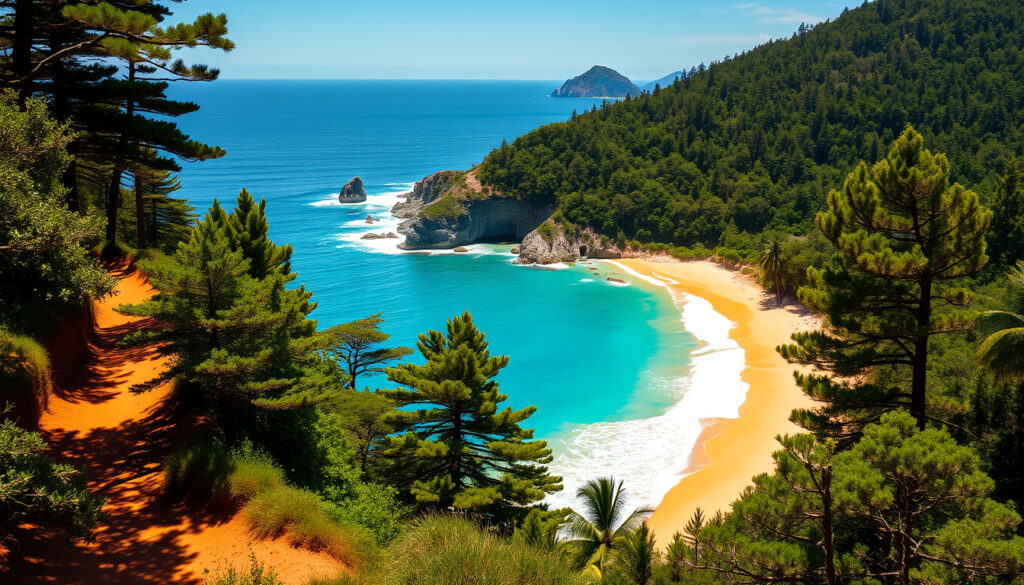
Abel Tasman Coast Track: Complete Guide (Distance, Cost, Tips)
Few multi-day hikes reward you as generously as the Abel Tasman Coast Track. Golden beaches and turquoise water await at the end of each day’s walk, and the trail itself is only 60 km with gentle gradients. But between booking huts, timing the tides, and arranging water taxis, the logistics can be a puzzle. Here is how to plan it all without the stress.
Distance: 60 km (37 mi) · Average duration: 3–5 days · Difficulty: Easy to moderate · Start point: Mārahau · End point: Wainui Bay · Great Walk status: Yes
Quick snapshot
- 60 km coastal trail (Department of Conservation)
- 3–5 days point‑to‑point (DOC track guide)
- Easy to moderate difficulty (DOC)
- Managed by Department of Conservation (DOC)
- Book huts or campsites in advance (Kiwi Reporter)
- Arrange water taxi if needed (Marahau Water Taxis)
- Check tide times for estuary crossings (Marahau Water Taxis)
- Pack sun protection and rain gear (Kiwi Reporter)
- Golden sandy beaches and turquoise waters (DOC)
- Native coastal forest and birdlife (DOC)
- Well‑marked trail with some steep climbs (DOC)
- Opportunities for swimming and kayaking (DOC)
- Hut fees $32–$45 per night
- Campsite fees $15 per night
- Water taxi $35–$50 per leg
- Great Walk booking opens 1 July for following season
Seven key facts, one takeaway: the Abel Tasman Coast Track is a well-managed, accessible trail with clear costs and logistics that reward early planning.
| Fact | Value |
|---|---|
| Track length | 60 km (37 mi) |
| Typical duration | 3–5 days |
| Difficulty | Easy to moderate (DOC) |
| Start point | Mārahau |
| End point | Wainui Bay |
| Managed by | Department of Conservation (DOC) |
| Great Walk status | Yes |
The table above distills the track’s core specifications for quick reference.
How long does it take to walk Abel Tasman track?
Average walking time for the full track
- The track is 60 km one way, and most hikers complete it in 3 to 5 days, according to the Department of Conservation track guide.
- AllTrails estimates a moving time of 19–21 hours, though actual time depends on pace, tide crossings, and how many beach stops you make.
- A commonly used itinerary is approximately 4 days, as noted by Abel Tasman tourism operators.
The pattern: most people finish comfortably in 4 days, but 3 days is doable for fit hikers who pack light. The 5-day option is ideal if you want to swim, kayak, or linger on the beaches.
Day trip possibilities
- Day walks are possible using water taxis to access specific sections of the track. Marahau Water Taxis operates scheduled services throughout the day from six main coastal access points: Anchorage, Torrent Bay, Bark Bay, Onetahuti, Awaroa, and Totaranui.
- A popular one-day option is taking a water taxi to Anchorage and walking back to Mārahau (12.4 km, about 3.5 hours), or the shorter Torrent Bay to Bark Bay section (7.8 km, about 2.5 hours).
The trade-off: day trips let you experience the coastline without carrying a pack, but you skip the sunrise and sunset moments that make the multi-day walk special.
Is Abel Tasman easy?
Terrain and gradient
- The Department of Conservation rates the track as easy to moderate. The trail is well-formed and mostly follows the coastline, with some steep sections between beaches.
- One notable feature: the Anchorage to Torrent Bay section has two routes depending on the tide. The high-tide route is 4.0 km and takes about 1.25 hours; the low-tide route across the sand is 0.9 km and takes about 20 minutes, according to Marahau Water Taxis.
- The Awaroa-Totaranui tidal estuary can only be crossed 1.5 to 2 hours either side of low tide, so checking tide times is essential.
The implication: the track itself is gentle by Great Walk standards, but the tide adds a layer of complexity that catches unprepared hikers off guard.
Fitness recommendations
- Suitable for most fitness levels with basic preparation. Abel Tasman local guides note that the track can be walked in either direction, and the graded surface makes it accessible for casual hikers.
- No technical climbing or scrambling is required. The main physical demand is carrying a pack for multiple days with some elevation changes between coves.
The catch: “easy” on paper still means 60 km over 3–5 days with a pack. Beginners should aim for the 4- or 5-day itinerary to keep daily distances manageable.
How much does it cost to walk the Abel Tasman?
Hut and campsite fees
- Great Walk hut fees apply: approximately $32–$45 per adult per night, depending on the season. Campsite fees are lower, around $15 per night, as confirmed by DOC.
- There is no entrance fee to Abel Tasman National Park itself — you only pay for accommodation and transport.
Water taxi costs
- Water taxi fares vary by distance. A typical one-way fare ranges from $35 to $50 per leg, depending on how far up the coast you go, according to Marahau Water Taxis.
- If you are doing a day walk, you will likely need one water taxi ride each way, so budget $70–$100 for transport.
The pattern: a 4-day hut trip costs roughly $128–$180 in accommodation plus $70–$100 for water taxis. A campsite trip is cheaper at around $60 for sites plus transport. Compare that with other New Zealand Great Walks, and the Abel Tasman is mid-range in cost.
Where to sleep Abel Tasman?
Huts and campsites
- DOC huts along the track — including Heaphy Hut, Awaroa Hut, and others — require advance booking, and they fill up quickly during peak season (October to April). Kiwi Reporter notes that huts and campsites must be booked in advance year-round.
- Campsites are also available at various locations along the track and need to be reserved through the DOC booking system.
- Great Walk season bookings open on 1 July for the following season, so mark your calendar if you want a spot in summer.
Private accommodation
- Private lodges and holiday parks are available near the track ends in Mārahau and Kaiteriteri, as well as in the nearby town of Motueka.
- Freedom camping is not permitted within the national park boundaries, so all overnight stays must be at designated DOC sites or commercial accommodation.
The implication: if you prefer a bed and a hot shower, book a private lodge before or after the walk. If you want to sleep on the track, reserve your hut or campsite as early as possible — especially for December through February.
Are there toilets on the Abel Tasman track?
Facilities along the track
- Toilets are provided at all DOC huts and campsites along the track. DOC’s track guide confirms that backcountry sites have composting toilets.
- There are no toilets on the beaches themselves or at most day-use areas, so plan accordingly when you stop for lunch or a swim.
Where to find them
- Key toilet locations: Anchorage Hut, Torrent Bay, Bark Bay, Onetahuti, Awaroa Hut, and Totaranui. These correspond to the main hut and campsite locations.
- If you are doing a day walk, use the facilities at the start point (Mārahau or Wainui) before you head out, and again at any hut you pass.
The trade-off: the track is well-served for a remote coastal trail, but you will never be more than a few hours from a toilet. Carry a small trowel and toilet paper just in case you need an emergency stop between huts.
How to plan your Abel Tasman Coast Track hike: a step-by-step guide
- Choose your itinerary. Decide how many days you want to walk (3, 4, or 5) and whether you will go point-to-point from Mārahau to Wainui or the reverse. Check the DOC track guide for section distances and times.
- Book your accommodation. Reserve huts or campsites through the DOC booking system. Bookings for the Great Walk season open on 1 July each year. Kiwi Reporter advises booking in advance year-round to avoid disappointment.
- Arrange water taxi transport. If you are not walking the full track point-to-point, book a water taxi. Marahau Water Taxis offers scheduled services to six coastal access points. Prices range from $35 to $50 per leg.
- Check tide times. Download the DOC tide charts or use the local tide tables. The Awaroa-Totaranui estuary is only crossable 1.5–2 hours either side of low tide. Marahau Water Taxis recommends planning your crossing times before you set out.
- Pack your gear. Sun protection, rain gear, insect repellent, and a headlamp are essential. Carry enough food for the duration, plus a first-aid kit and a map. The track is well-marked, but a GPS or offline map app is a good backup.
- Get to the start. Drive to Mārahau (the main southern trailhead) or arrange a shuttle from Nelson or Motueka. If you are starting from Wainui Bay, you will need transport from Takaka or Collingwood. Check the Abel Tasman local guide for shuttle options.
What we know and what is still unclear
Confirmed facts
- The track is 60 km long and managed by DOC as a Great Walk.
- Booking is required for huts and campsites year-round.
- Water taxis operate daily from Mārahau to six coastal access points.
- The Awaroa-Totaranui estuary can only be crossed near low tide.
- Toilets are available at all huts and campsites.
What’s unclear
- Exact walking time varies by pace, fitness, and how many stops you make for swimming or photography.
- Difficulty perception differs among hikers — what feels easy to an experienced tramper may feel moderate to a beginner.
- Tide crossing conditions change daily, so the same section can take 20 minutes or 1.25 hours depending on the tide.
What the experts say
“Enjoy the mild climate, golden beaches and lush coastal native bush on the Abel Tasman Coast Track.”
— Department of Conservation
“The track provides a fantastic mix of pristine beaches, native bush, and wildlife. Each day offers something different, from tidal crossings to lookout points with panoramic views.”
— Abel Tasman tourism operators
The Abel Tasman Coast Track delivers a genuine coastal wilderness experience within reach of casual hikers — but only if you respect the tide. A walker who ignores the crossing window at Awaroa may face a 4 km detour or a long wait.
Booking early guarantees your spot but locks you into a schedule. Flexible hikers who book campsites instead of huts gain more spontaneity, but risk missing out during peak season when everything sells out.
Summary
The Abel Tasman Coast Track is one of New Zealand’s most accessible Great Walks, combining golden beaches, native bush, and gentle terrain in a 60 km package that takes 3–5 days. The planning — booking huts, timing tides, arranging water taxis — is the real work. For anyone based in Nelson or Tasman, the choice is clear: book early, check the tide tables, and pack for sun and rain. The beaches will do the rest.
sarafondo.com, abeltasman.com, newzealand-spirit.com, youtube.com, abeltasman.com, adventureplan.co.uk
Frequently asked questions
Are dogs allowed on the Abel Tasman Coast Track?
No, dogs are not permitted on the Abel Tasman Coast Track or anywhere within Abel Tasman National Park, as it is a protected conservation area.
Do I need to book water taxis in advance?
Yes, it is recommended to book water taxis in advance, especially during peak season (October to April). Marahau Water Taxis and other operators allow online booking.
What is the best time of year to walk the track?
The best time is from October to April (spring and summer), when the weather is mild and days are longer. January and February are the warmest months but also the busiest. May to September is cooler and wetter, with fewer crowds.
Is there cell phone reception on the track?
Cell phone reception is limited and patchy along most of the track. You may get a signal at higher points or near beaches, but do not rely on it for navigation or communication.
Can I swim on the Abel Tasman Coast Track?
Yes, swimming is one of the highlights of the track. The beaches have clear, calm water, especially in the summer months. Popular swimming spots include Anchorage, Torrent Bay, and Bark Bay.
Are guided walks available?
Yes, several operators offer guided walks on the Abel Tasman Coast Track, including multi-day guided trips with accommodation and meals included. These can be booked through local tourism operators.
What should I do if I need to cancel my hut booking?
You can cancel your DOC hut or campsite booking through the online booking system. Cancellation fees may apply depending on how far in advance you cancel. Check the DOC website for the current cancellation policy.
Related reading: Abel Tasman National Park: Visitor Guide · Picton to Wellington Ferry 2025: Prices, Timetable & Comparison
More related posts
 The Rookie Season 8: Release Date, Episodes & Where to Watch
 Blue Black Hair Dye: Best Permanent & Semi-Permanent UK Picks
 When to Plant Garlic in New Zealand: Complete Guide
 New Zealand CVD Risk Calculator: How to Use PREDICT-1 & Understand Your Score
 iPhone 14 Screen Protector: Should You Use One? Guide & Types
 How Many Fridays Until Christmas: 2026 Countdown
 Chiefs vs Moana Pasifika: Time, Stream & Prediction Guide
 A Good Girl’s Guide to Murder: Age, LGBTQ, Season 2
