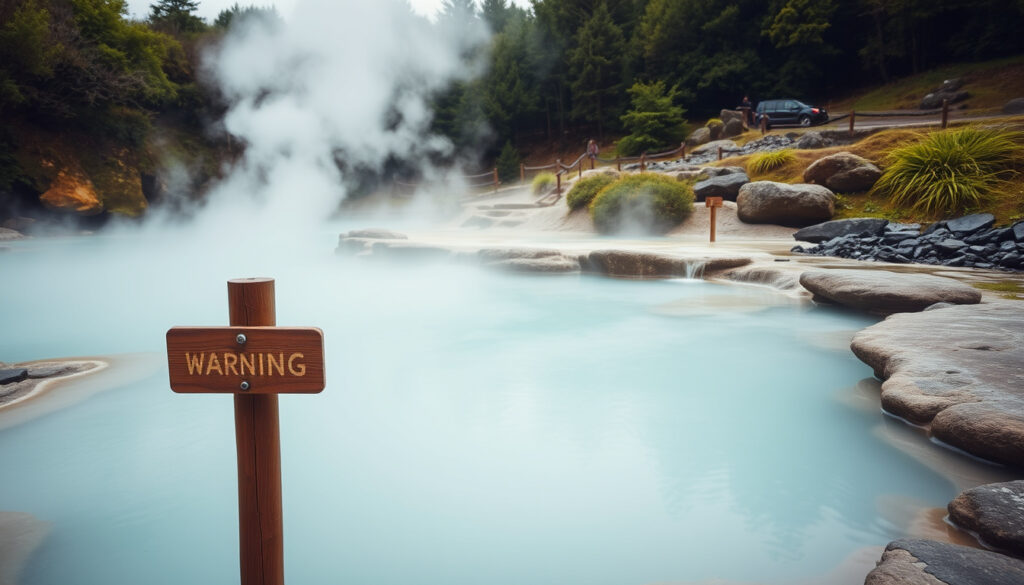
Free Hot Springs in Rotorua: Safety Tips & Best Natural Pools
There’s a moment every Rotorua visitor hits: you’ve smelled the sulfur, seen the steam, and then you check the price of a thermal soak and wince. The good news is that some of the region’s best geothermal experiences cost nothing at all.
Known free spots: Kerosene Creek, Kuirau Park foot bath, Hot & Cold Bridge ·
Popular free pool: Kerosene Creek (New Zealand Motorhome, an RV travel guide), about 30 min south of Rotorua ·
Free geothermal park: Kuirau Park (Viator, the booking platform’s travel blog), described as the city’s only free one ·
Best free soak for feet: Kuirau Park foot bath (foot soaking only)
Quick snapshot
- Kerosene Creek is a free, unmanaged natural hot stream south of Rotorua, without lifeguards or formal facilities (RotoruaNZ, the city’s official tourism site).
- Kuirau Park is a free geothermal park in central Rotorua, with steaming ponds, mud pools and walkways (AA New Zealand’s free-attractions guide).
- The Hot and Cold Pools form free where hot and cool water meet near a bridge on the Wai-O-Tapu Loop Road (Waimangu Volcanic Valley, a neighbouring geothermal attraction).
- Whether Waterfall Spout Bath is reliably accessible — it’s named in round-ups, but details are thin.
- Exact water temperature range at Butcher’s Pool — visitor documentation is sparse.
- Testing frequency for water quality at free natural pools — no official schedule is published.
- Whether late-1800s Māori use of geothermal springs is precisely documented by surviving records.
- Whether the 1990s is the exact decade Kuirau Park became a public geothermal park.
- Whether social media in the 2020s definitively caused increased visitation at Kerosene Creek.
- Check water temperature before entering any natural pool (Albom Adventures, a New Zealand travel blog).
- Go early: free pools get busy from mid-morning in summer. (Albom Adventures, a New Zealand travel blog)
- Leave valuables at home — break-ins have been reported at Kerosene Creek parking. (Albom Adventures, a New Zealand travel blog)
- Rotorua’s free geothermal pools continue to gain attention from budget travellers globally.
- Local tourism boards are expected to release more detailed safety resources for natural pools.
- The infrastructure at wild streams like Kerosene Creek is unlikely to change, reinforcing the self-reliant nature of the experience.
Key facts at a glance
Six details, one pattern: the free options split into managed parks and wild streams, and the wild streams hand all the safety duties to you.
| Kuirau Park entry | Free — steaming ponds, mud pools, walkways and thermal foot baths included. |
| Hot and Cold Pools | Free natural pools about 30 km south near Wai-O-Tapu, on the Wai-O-Tapu Loop Road (AA New Zealand’s free-attractions guide). |
| Kerosene Creek access | Unsealed gravel road, basic parking, no lifeguards or formal facilities (RotoruaNZ, the city’s official tourism site). |
| Managed free alternative | Rotorua Thermal Holiday Park gives guests three complimentary warm pools using fresh chlorinated water (Rotorua Thermal Holiday Park, an accommodation operator). |
| Head-submersion warning | Keep your head above water in Rotorua’s geothermal pools — amoebic meningitis risk (NZ Pocket Guide, a budget travel publisher). |
| Paid option in town | Te Puia, Rotorua’s flagship geothermal attraction, is ticketed — the free spots above are the no-entry-fee contrast. |
Are there any free natural hot springs in Rotorua?
Yes — on two different scales. You can soak in a wild stream with no infrastructure at all, or you can sit on a bench in the middle of town and warm your feet in a free public bath. Most visitors only hear about one of the two.
What makes a hot spring natural?
- A natural hot spring reaches the surface on its own — no pipes, pumps, chlorination or ticket gate.
- Kerosene Creek is the classic example: a naturally heated stream that stays free because nothing has been built around it.
- The Hot and Cold Pools are the other natural showcase: geothermal water and cool stream water meeting beneath a bridge on the Wai-O-Tapu Loop Road (Waimangu Volcanic Valley, a neighbouring geothermal attraction).
The difference matters because “natural” and “managed” lead to very different expectations. A managed pool has lifeguards, regulated temperatures and someone whose job is safety. A natural pool has none of that — and, as the rest of this guide shows, the free ones are natural by definition.
The pattern: when a listicle says “free hot spring,” check whether it means a wild stream or a public park before you pack a swimsuit.
Overview of free geothermal spots in Rotorua
- Kerosene Creek — the wild stream: free, unmanaged, about 30 minutes south of town, swimming expected.
- Kuirau Park — the central park: free entry, steaming ponds, mud pools and thermal foot baths.
- Hot and Cold Pools — the detour: free natural pools near Wai-O-Tapu, about 30 km south.
- Rotorua Thermal Holiday Park — the managed freebie: three free guest pools if you’re staying there.
That’s the full shape of Rotorua’s free geothermal scene: one wild stream, one public park with foot baths, and one pair of natural roadside pools. Everything else on the free lists is either a variation of these or a lesser-documented spot.
Where are the best free hot pools near Rotorua?
Three places deserve your time: a wild stream, a central-city park, and a pair of natural pools that most visitors drive past on the way to Wai-O-Tapu. They work best for different kinds of visits.
Kerosene Creek: directions and tips
Kerosene Creek is the most loved free pool in the Rotorua area — and the least managed. No lifeguards, no lighting, no facilities: that’s the trade-off for a free soak in the bush.
- The drive from Rotorua takes about 30 minutes on a gravel access road with basic parking (New Zealand Motorhome, an RV travel guide).
- The parking area has seen break-in reports, so leave valuables at home.
- Bring water shoes and arrive early; the pools get busy from mid-morning in summer.
The reward is a genuinely wild soak: warm water, bush on all sides, a small waterfall doing the soundtrack. It’s the kind of place that makes paid pools feel like a resort in comparison — until you remember nobody is on duty.
If you’re planning a longer budget trip, Kerosene Creek fits naturally into a Rotorua stop on a wider itinerary — see our cheap holidays from NZ guide for the broader picture.
Kuirau Park foot bath
- Walkable from the city centre, so you can skip parking entirely (New Zealand Motorhome, an RV travel guide).
- Free entry; the foot baths are for foot soaking, not full-body swimming (AA New Zealand’s free-attractions guide).
- Steaming ponds, mud pools and walkways make it a geothermal sightseeing stop as much as a soak.
Kuirau Park is the zero-planning option. You wander in after breakfast, find a foot bath, and sit with steam rising around you while the city goes about its day. The foot baths are warm, free and shared, so treat them as a community amenity rather than a private spa.
The trade-off for this one: it’s the easiest free geothermal experience in Rotorua, and also the least immersive — you only get your feet wet.
Waterfall Spout Bath and other hidden gems
Hidden gems are hidden for a reason. Waterfall Spout Bath and Butcher’s Pool appear in visitor round-ups, but their access and conditions are far less documented than Kerosene Creek’s.
Waterfall Spout Bath reportedly sits along the track near Waikite Valley Thermal Pools; Butcher’s Pool is described in round-ups as a more secluded alternative. Neither has the documentation of the main three, so treat them as bonus stops: worth a look if you’re already nearby, not worth planning a trip around sketchy information.
Can you swim in hot springs Rotorua?
At some of them, yes — but “can you swim” and “should you swim” are different questions. The free spots split into swim-ready streams and foot-soak-only parks.
Swimming regulations at free pools
- Kerosene Creek: swimming is the norm. It’s an unmanaged stream, so there’s no lifeguard and no formal rulebook.
- Kuirau Park: the foot baths are for feet, not bodies — as AA New Zealand’s guide spells out.
- Hot and Cold Pools: free and natural, but check the water temperature before you get in (Albom Adventures, a New Zealand travel blog).
In practice, the only truly swim-ready free spot on most lists is Kerosene Creek. Everywhere else you’re soaking body parts or admiring geothermal features — not swimming laps.
The pattern: the more “natural” the pool, the more likely swimming is allowed; the more “park” it is, the more likely the water is hands-only.
Safety considerations for natural hot springs
Untreated geothermal water is not a swimming pool. Keep your head above the surface — NZ Pocket Guide, a budget travel publisher, warns of amoebic meningitis in Rotorua’s geothermal pools.
- Temperature varies within a single pool — what’s comfortable at the edge can be much hotter a few steps in, so test before you commit.
- Stay on marked tracks and respect barriers: Rotorua’s safety guidance is blunt that steam vents can open unexpectedly and geothermal ground can be unstable.
- Fenced areas exist for a reason — at Kuirau Park they mark geothermal ground that is genuinely unsafe to cross.
None of this is meant to scare you off. It’s the difference between a managed pool and a natural one: the managed pool has already done the risk assessment, and the natural pool hands it to you.
What are the potential downsides of hot springs?
The free pools have a real cost — it’s just not measured in dollars. The downsides fall into three buckets: health, environment and crowds.
Health risks
- Scalding: natural pools have no temperature control, so water that’s perfect at the edge can be dangerous further in.
- Infection risk: untreated water can carry organisms; the head-submersion warning exists for a reason.
- No lifeguards: at unmanaged sites, nobody is monitoring the water or the swimmers.
The most serious risk is the one you can’t see. Amoebic meningitis is rare but severe, and the standard local advice removes it entirely: keep your head above the water. Everything else — burns, slips on wet rocks, cold shock — is more common but more manageable.
Environmental impact
- Geothermal ground is fragile; stepping off tracks can damage thin crust that takes years to recover.
- The free spots are day-use destinations, not campsites — nothing about them is set up for overnight stays.
- Litter and sunscreen run-off do real damage in unmanaged pools; pack out everything you bring.
The environmental catch is that popularity is the threat. The more people discover a free pool, the more pressure it takes — which is why the “leave no trace” rules matter more here than at a chlorinated complex.
Crowds and accessibility
- Summer weekends are the busiest window at Kerosene Creek; the gravel car park fills early.
- The access road can get muddy after rain, and none of the wild pools have changing rooms, toilets or wheelchair-friendly paths.
- Weekday mornings are the quietest, most pleasant time to visit.
The crowd situation is self-reinforcing: social media turned free pools into destinations, and destinations attract more visitors, which slowly erodes the very thing people came for. That’s the case for going early, going midweek and keeping the hidden gems off your Instagram.
The pattern across these downsides is that free geothermal soaking transfers every risk — health, environmental, social — directly to the visitor, demanding a level of awareness that paid pools simply automate.
Which town in New Zealand has hot springs?
Many towns do — but almost none of them hand out free geothermal access the way Rotorua does. That’s the geographic context that makes this city unusual.
Rotorua: the geothermal capital
- Rotorua sits on one of New Zealand’s most active geothermal fields; steam rising from parks is a normal sight.
- It’s the rare town where geothermal soaking exists free in the city centre, not just in the backcountry.
- Booking platform Viator describes Kuirau Park as Rotorua’s only free-entry geothermal park.
That combination — visible geothermal activity plus free public access — is what makes Rotorua unusual. If Rotorua is one stop on a longer budget trip, our guide to cheap holidays from NZ puts it in context with the rest of the country.
The pattern: in Rotorua, geothermal water is part of daily life; in most other towns, it’s a packaged product.
Other towns with hot springs: Taupo, Hanmer Springs
Rotorua’s free pools are the exception, not the rule. Hanmer Springs sells tickets to its famous baths; Taupo’s free options are natural riverside pools rather than developed facilities.
- Taupo: the Otumuheke Stream is the free natural soak that shows up most often in guides, where geothermal water meets the Waikato River.
- Hanmer Springs: a classic thermal resort town, but the main pools are ticketed — there’s no real free equivalent.
If you’re choosing a town specifically for free geothermal water, Rotorua wins on convenience: the free stuff is minutes from a coffee, not a long drive from the nearest shop. Taupo is the closest competitor, but its free options sit further out of town.
Free vs paid: the upsides and downsides
Both approaches make sense, depending on what you want from a soak. The free pools win on price and atmosphere; the paid pools win on safety, facilities and predictability.
Upsides
- Free entry at Kuirau Park, Kerosene Creek and the Hot and Cold Pools.
- A genuinely natural setting: bush, waterfalls and steam rather than tiled spa pools.
- Rotorua Thermal Holiday Park even gives guests three complimentary warm pools if you’re staying there.
- No booking needed — most free sites work on a simple show-up basis.
Downsides
- No lifeguards, lighting or formal facilities at the wild sites.
- Safety responsibilities — temperature, ground stability, water quality — sit entirely with you.
- Break-ins have been reported at Kerosene Creek’s parking area.
- Crowds on summer weekends make popular pools feel less secret.
The honest read: the free pools aren’t a “budget version” of a paid spa — they’re a different experience. Pick the free spots when you want atmosphere and independence; pick a paid pool when you want someone else to handle the risk.
What’s confirmed and what’s still unclear
The facts are solid on what exists and what it costs. The grey areas are about conditions, testing and the less-documented spots.
Confirmed facts
- Kuirau Park is free and open to the public (Viator, the booking platform’s travel blog).
- Kerosene Creek is free, unmanaged and open to the public (RotoruaNZ, the city’s official tourism site).
- The Hot and Cold Pools are free and natural (Albom Adventures, a New Zealand travel blog).
- Rotorua Thermal Holiday Park offers guests three complimentary pools (Rotorua Thermal Holiday Park, an accommodation operator).
What’s unclear
- Water quality testing schedules at the free natural pools are not published.
- The exact temperature range at Butcher’s Pool is not documented in detail.
- Access conditions at Waterfall Spout Bath can change and aren’t well covered.
- Break-in reports at Kerosene Creek are anecdotal rather than systematically tracked.
- How quickly conditions at wild pools shift after heavy rain.
The read: if you stick to the confirmed list, you’re on solid ground. The unclear list is where “check locally before you go” becomes an actual instruction rather than a cliché.
What they say about Rotorua’s free pools
“Kuirau Park is Rotorua’s only free-entry geothermal park.”
— Viator’s travel blog
“Don’t submerge your head in Rotorua’s geothermal pools — there is a risk of amoebic meningitis.”
— NZ Pocket Guide, budget travel publisher
“Three complimentary hot pools, using fresh chlorinated water.”
— Rotorua Thermal Holiday Park, accommodation operator
The common thread: even the sources that celebrate Rotorua’s free pools keep returning to the same two warnings — check the water, and keep your head above it.
The takeaway
Rotorua’s free hot springs are not a secret, and they’re not a compromise. They’re genuinely good natural geothermal experiences that happen to cost nothing — the trade-off being that safety, timing and common sense are all on you. For budget travellers in Rotorua, the decision is clear: soak for free at Kerosene Creek and Kuirau Park, and treat every paid pool as an upgrade you can skip — because the only real cost of the free version is paying attention.
Related reading
- Cheap Holidays from NZ: stretching a New Zealand travel budget
- South Island New Zealand: a budget-conscious route guide
These broader guides frame Rotorua’s free pools within a New Zealand-wide travel strategy that balances cost, time, and authentic experience.
Frequently asked questions
Is it safe to swim in Kerosene Creek?
It’s free, popular and unmanaged. There are no lifeguards, so you’re responsible for checking the water temperature, keeping your head above the surface and watching the ground around you. Break-ins have been reported at the parking area, so leave valuables behind.
Do I need to pay for parking at Kuirau Park?
The park and its foot baths are free. Because Kuirau Park is within walking distance of central Rotorua, many visitors skip parking altogether.
What should I bring to a free hot spring?
Water shoes, a towel, a change of clothes, drinking water, and a small bag you can keep with you. The creek beds are rocky and unmanaged, so bare feet are not a great idea.
Are there free hot springs in Taupo?
Yes — the Otumuheke Stream is the one most guides name, where geothermal water meets the Waikato River. As with Rotorua’s wild pools, check the temperature and conditions before getting in.
How do I get to Kerosene Creek without a car?
The practical answer in visitor guides is to arrange a ride. Kerosene Creek is about 30 minutes south of town on an unsealed road, so a car, camper or organised tour is the realistic option.
Can I visit free hot springs in winter?
Yes — the water is geothermally heated, so it stays warm while the air cools. Expect a muddier access road after rain and noticeably fewer people.
Are there any free hot springs in Rotorua open 24/7?
Kerosene Creek is an unmanaged natural site without entry controls, so in practice it’s accessible at any hour. It’s also unlit and empty of staff, so a night soak is entirely at your own risk.
For most visitors, these details confirm that Rotorua’s free geothermal soaking is genuinely accessible, but it demands the same care as any natural environment.
More related posts
 Polo Ralph Lauren NZ: Stores, Sales, Perfume & Caps
 600 USD to NZD: Exchange Rate and Conversion Guide
 ANZ Fixed Term Deposit Rates 2025: Current Rates & Comparison
 Bruno Mars Net Worth: $175 Million and $50M Debt Rumor
 Truck Hire Wellington NZ: Prices, Best & Small Options
 Yankees vs Red Sox: Head-to-Head Record and Rivalry History
 James Gardner-Hopkins: Suspension and Return Explained
 The Mountain Is You: Summary, Meaning, and Is It Worth Reading
